

126
Vertical Structure: Baroclinic Quasi-Geostrophic Models
It is useful to consider a concrete example by specifying the form of CS2. We
can think of CS2 as representing the effects of unresolved eddies coupling layer 2
with layer 1, for example. One of the simplest representations of this coupling
might be written as:
(3.7.5)
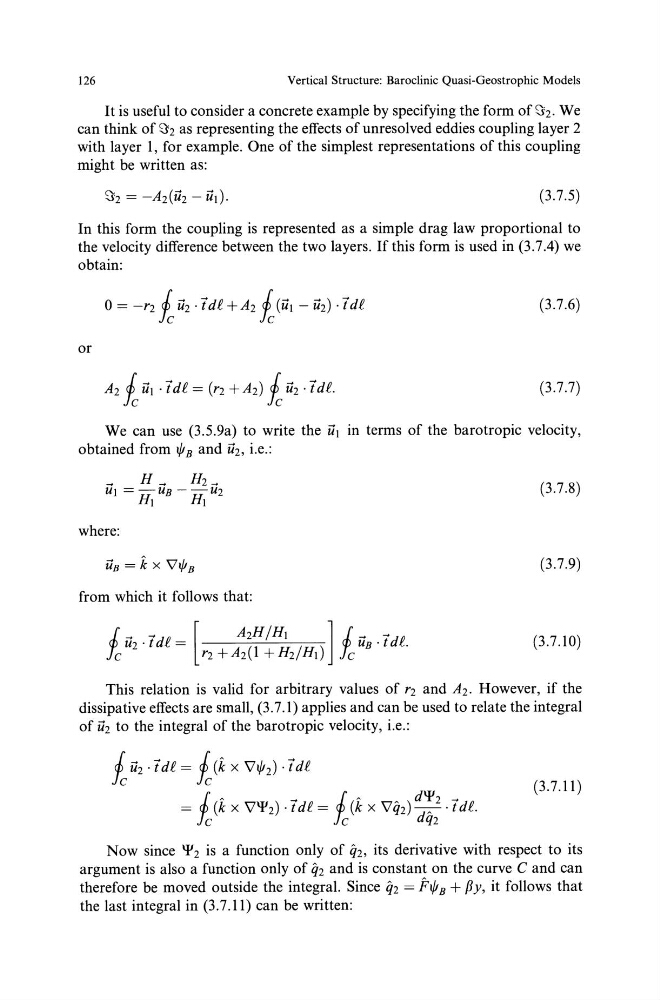
In this form the coupling is represented as a simple drag law proportional to
the velocity difference between the two layers. If this form is used in (3.7.4) we
obtain:
(3.7.6)
or
A2 i u, · 7 d£ = h + A2) i i12 · 7 d£.
(3.7.7)
We can use (3.5.9a) to write the u1 in terms of the barotropic velocity,
obtained from 1/ts and i12, i.e.:
(3.7.8)
where:
(3.7.9)
from which it follows that:
(3.7.10)
This relation is valid for arbitrary values of r2 and A2. However, if the
dissipative effects are small, (3. 7.1) applies and can be used to relate the integral
of u2 to the integral of the barotropic velocity, i.e.:
i i1z · 7 d£ = i (k x "' Vl/12) • 7 d£
i
A
-
i A d'¥2 -
= (kx\7'¥2)-td£= (kx\lqz)-dA ·td£.
c
c
qz
(3.7.11)
Now since '¥2 is a function only of q2, its derivative with respect to its
argument is also a function only of q2 and is constant on the curve C and can
therefore be moved outside the integral. Since q2 = Fl/ts + {Jy, it follows that
the last integral in (3.7.11) can be written:
Vertical Structure: Baroclinic Quasi-Geostrophic Models
It is useful to consider a concrete example by specifying the form of CS2. We
can think of CS2 as representing the effects of unresolved eddies coupling layer 2
with layer 1, for example. One of the simplest representations of this coupling
might be written as:
(3.7.5)
In this form the coupling is represented as a simple drag law proportional to
the velocity difference between the two layers. If this form is used in (3.7.4) we
obtain:
(3.7.6)
or
A2 i u, · 7 d£ = h + A2) i i12 · 7 d£.
(3.7.7)
We can use (3.5.9a) to write the u1 in terms of the barotropic velocity,
obtained from 1/ts and i12, i.e.:
(3.7.8)
where:
(3.7.9)
from which it follows that:
(3.7.10)
This relation is valid for arbitrary values of r2 and A2. However, if the
dissipative effects are small, (3. 7.1) applies and can be used to relate the integral
of u2 to the integral of the barotropic velocity, i.e.:
i i1z · 7 d£ = i (k x "' Vl/12) • 7 d£
i
A
-
i A d'¥2 -
= (kx\7'¥2)-td£= (kx\lqz)-dA ·td£.
c
c
qz
(3.7.11)
Now since '¥2 is a function only of q2, its derivative with respect to its
argument is also a function only of q2 and is constant on the curve C and can
therefore be moved outside the integral. Since q2 = Fl/ts + {Jy, it follows that
the last integral in (3.7.11) can be written: