

A Midocean Example
123
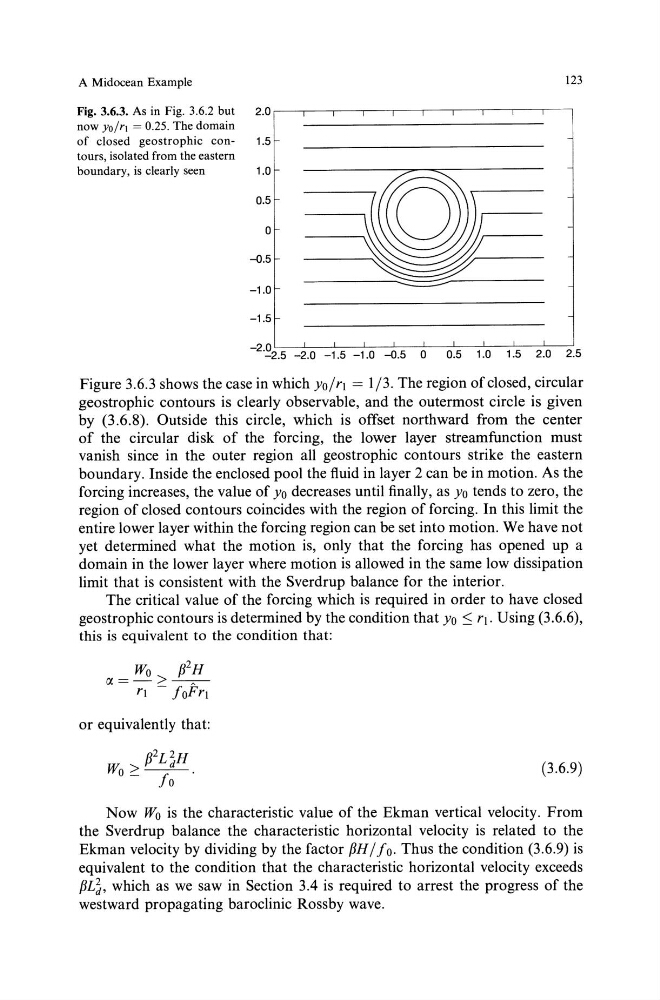
Fig. 3.6.3. As in Fig. 3.6.2 but
2.0.----------.----.--,--,------,------,---,--,--,-------,
now Yo/r1 = 0.25. The domain
of closed geostrophic con1.5
tours, isolated from the eastern
boundary, is clearly seen
1.0
0.5
0
-Q.5
-1.0
-1.5
- 2 .~2.5 -2.0 -1.5 -1.0 -Q.5 0 0.5 1.0 1.5 2.0 2.5
Figure 3.6.3 shows the case in which Yo/rt = 1/3. The region of closed, circular
geostrophic contours is clearly observable, and the outermost circle is given
by (3.6.8). Outside this circle, which is offset northward from the center
of the circular disk of the forcing, the lower layer streamfunction must
vanish since in the outer region all geostrophic contours strike the eastern
boundary. Inside the enclosed pool the fluid in layer 2 can be in motion. As the
forcing increases, the value of Yo decreases until finally, as Yo tends to zero, the
region of closed contours coincides with the region of forcing. In this limit the
entire lower layer within the forcing region can be set into motion. We have not
yet determined what the motion is, only that the forcing has opened up a
domain in the lower layer where motion is allowed in the same low dissipation
limit that is consistent with the Sverdrup balance for the interior.
The critical value of the forcing which is required in order to have closed
geostrophic contours is determined by the condition that Yo ::; r1. Using (3.6.6),
this is equivalent to the condition that:
Wo
[PH
IY.=->--Art - foFrt
or equivalently that:
(3.6.9)
Now W0 is the characteristic value of the Ekman vertical velocity. From
the Sverdrup balance the characteristic horizontal velocity is related to the
Ekman velocity by dividing by the factor f3H / fo. Thus the condition (3.6.9) is
equivalent to the condition that the characteristic horizontal velocity exceeds
f3L~, which as we saw in Section 3.4 is required to arrest the progress of the
westward propagating baroclinic Rossby wave.
123
Fig. 3.6.3. As in Fig. 3.6.2 but
2.0.----------.----.--,--,------,------,---,--,--,-------,
now Yo/r1 = 0.25. The domain
of closed geostrophic con1.5
tours, isolated from the eastern
boundary, is clearly seen
1.0
0.5
0
-Q.5
-1.0
-1.5
- 2 .~2.5 -2.0 -1.5 -1.0 -Q.5 0 0.5 1.0 1.5 2.0 2.5
Figure 3.6.3 shows the case in which Yo/rt = 1/3. The region of closed, circular
geostrophic contours is clearly observable, and the outermost circle is given
by (3.6.8). Outside this circle, which is offset northward from the center
of the circular disk of the forcing, the lower layer streamfunction must
vanish since in the outer region all geostrophic contours strike the eastern
boundary. Inside the enclosed pool the fluid in layer 2 can be in motion. As the
forcing increases, the value of Yo decreases until finally, as Yo tends to zero, the
region of closed contours coincides with the region of forcing. In this limit the
entire lower layer within the forcing region can be set into motion. We have not
yet determined what the motion is, only that the forcing has opened up a
domain in the lower layer where motion is allowed in the same low dissipation
limit that is consistent with the Sverdrup balance for the interior.
The critical value of the forcing which is required in order to have closed
geostrophic contours is determined by the condition that Yo ::; r1. Using (3.6.6),
this is equivalent to the condition that:
Wo
[PH
IY.=->--Art - foFrt
or equivalently that:
(3.6.9)
Now W0 is the characteristic value of the Ekman vertical velocity. From
the Sverdrup balance the characteristic horizontal velocity is related to the
Ekman velocity by dividing by the factor f3H / fo. Thus the condition (3.6.9) is
equivalent to the condition that the characteristic horizontal velocity exceeds
f3L~, which as we saw in Section 3.4 is required to arrest the progress of the
westward propagating baroclinic Rossby wave.