

120
Vertical Structure: Baroclinic Quasi-Geostrophic Models
The net Sverdrup transport across the basin at any latitude is proportional
to the integral of the Ekman pumping velocity along each latitude circle which
spans the basin. If that integral differs from zero, a western boundary current is
required to return the Sverdrup transport along the western boundary. We saw
in Chapter 2 that there are still unresolved dynamical issues associated with the
closure of the circulation in the low dissipation limit. In order to focus
attention on the physics by which lower layers of the thermocline can be set
into motion when the geostrophic contours close on themselves and avoid the
eastern boundary, Rhines and Young considered an Ekman pumping velocity
that is antisymmetric in longitude about a midpoint longitude, which we
choose to be x = 0, so that the integral of the Ekman pumping in x across the
basin is zero for all y, obviating the need for a western boundary current.
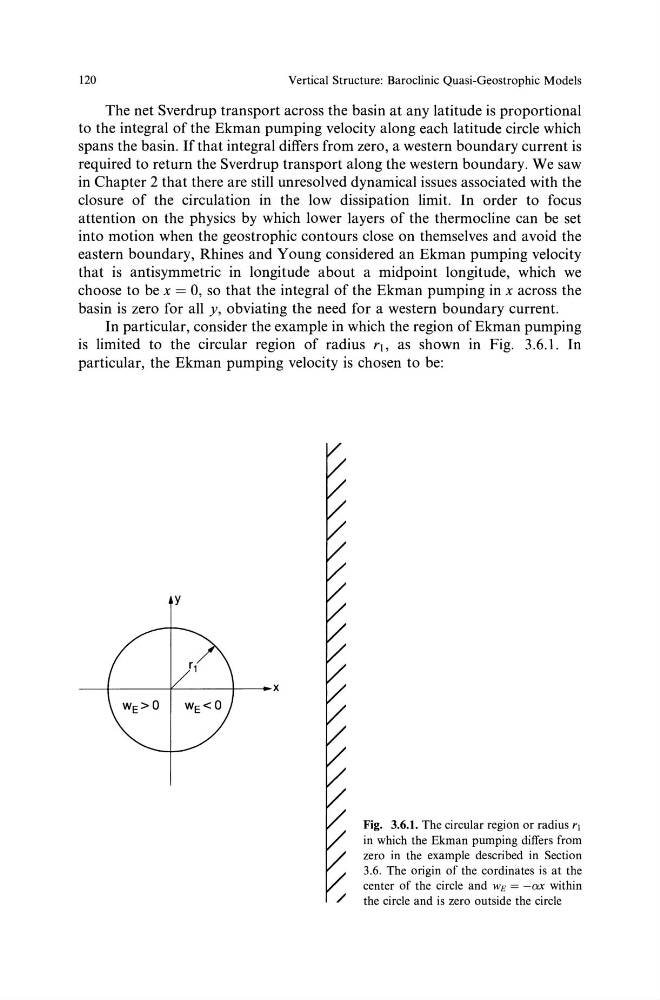
In particular, consider the example in which the region of Ekman pumping
is limited to the circular region of radius r,, as shown in Fig. 3.6.1. In
particular, the Ekman pumping velocity is chosen to be:
y
Fig. 3.6.1. The circular region or radius r,
in which the Ekman pumping differs from
zero in the example described in Section
3.6. The origin of the cordinates is at the
center of the circle and wE = -ax within
/
the circle and is zero outside the circle
Vertical Structure: Baroclinic Quasi-Geostrophic Models
The net Sverdrup transport across the basin at any latitude is proportional
to the integral of the Ekman pumping velocity along each latitude circle which
spans the basin. If that integral differs from zero, a western boundary current is
required to return the Sverdrup transport along the western boundary. We saw
in Chapter 2 that there are still unresolved dynamical issues associated with the
closure of the circulation in the low dissipation limit. In order to focus
attention on the physics by which lower layers of the thermocline can be set
into motion when the geostrophic contours close on themselves and avoid the
eastern boundary, Rhines and Young considered an Ekman pumping velocity
that is antisymmetric in longitude about a midpoint longitude, which we
choose to be x = 0, so that the integral of the Ekman pumping in x across the
basin is zero for all y, obviating the need for a western boundary current.
In particular, consider the example in which the region of Ekman pumping
is limited to the circular region of radius r,, as shown in Fig. 3.6.1. In
particular, the Ekman pumping velocity is chosen to be:
y
Fig. 3.6.1. The circular region or radius r,
in which the Ekman pumping differs from
zero in the example described in Section
3.6. The origin of the cordinates is at the
center of the circle and wE = -ax within
/
the circle and is zero outside the circle