

A Midocean Example
119
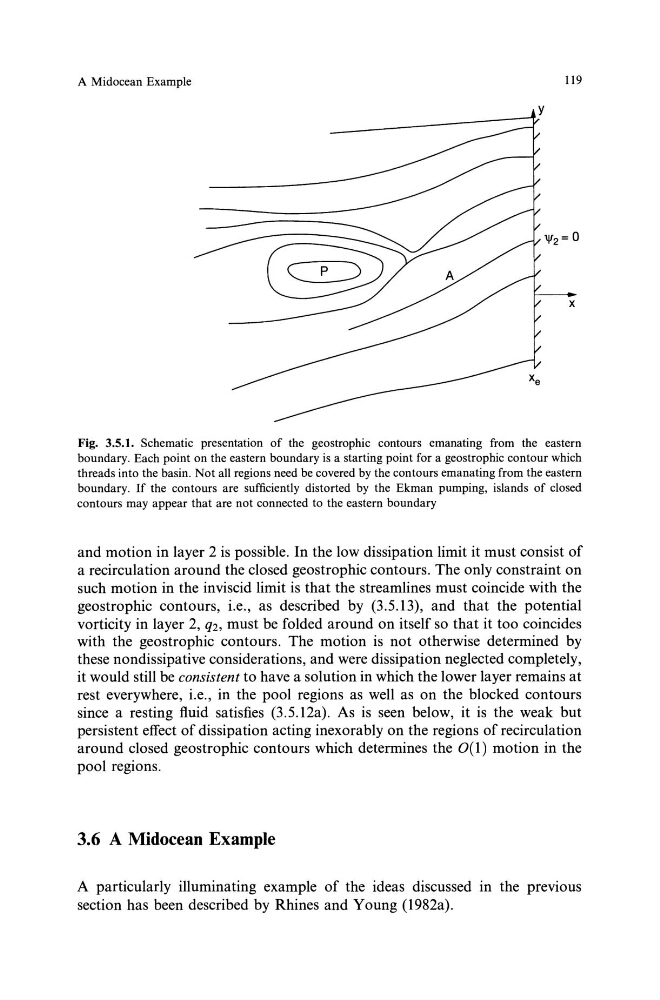
Fig. 3.5.1. Schematic presentation of the geostrophic contours emanating from the eastern
boundary. Each point on the eastern boundary is a starting point for a geostrophic contour which
threads into the basin. Not all regions need be covered by the contours emanating from the eastern
boundary. If the contours are sufficiently distorted by the Ekman pumping, islands of closed
contours may appear that are not connected to the eastern boundary
and motion in layer 2 is possible. In the low dissipation limit it must consist of
a recirculation around the closed geostrophic contours. The only constraint on
such motion in the inviscid limit is that the streamlines must coincide with the
geostrophic contours, i.e., as described by (3.5.13), and that the potential
vorticity in layer 2, q2, must be folded around on itself so that it too coincides
with the geostrophic contours. The motion is not otherwise determined by
these nondissipative considerations, and were dissipation neglected completely,
it would still be consistent to have a solution in which the lower layer remains at
rest everywhere, i.e., in the pool regions as well as on the blocked contours
since a resting fluid satisfies (3.5.12a). As is seen below, it is the weak but
persistent effect of dissipation acting inexorably on the regions of recirculation
around closed geostrophic contours which determines the 0( 1) motion in the
pool regions.
3.6 A Midocean Example
A particularly illuminating example of the ideas discussed in the previous
section has been described by Rhines and Young (1982a).
119
Fig. 3.5.1. Schematic presentation of the geostrophic contours emanating from the eastern
boundary. Each point on the eastern boundary is a starting point for a geostrophic contour which
threads into the basin. Not all regions need be covered by the contours emanating from the eastern
boundary. If the contours are sufficiently distorted by the Ekman pumping, islands of closed
contours may appear that are not connected to the eastern boundary
and motion in layer 2 is possible. In the low dissipation limit it must consist of
a recirculation around the closed geostrophic contours. The only constraint on
such motion in the inviscid limit is that the streamlines must coincide with the
geostrophic contours, i.e., as described by (3.5.13), and that the potential
vorticity in layer 2, q2, must be folded around on itself so that it too coincides
with the geostrophic contours. The motion is not otherwise determined by
these nondissipative considerations, and were dissipation neglected completely,
it would still be consistent to have a solution in which the lower layer remains at
rest everywhere, i.e., in the pool regions as well as on the blocked contours
since a resting fluid satisfies (3.5.12a). As is seen below, it is the weak but
persistent effect of dissipation acting inexorably on the regions of recirculation
around closed geostrophic contours which determines the 0( 1) motion in the
pool regions.
3.6 A Midocean Example
A particularly illuminating example of the ideas discussed in the previous
section has been described by Rhines and Young (1982a).