

The Quasi-Geostrophic Circulation Problem
117
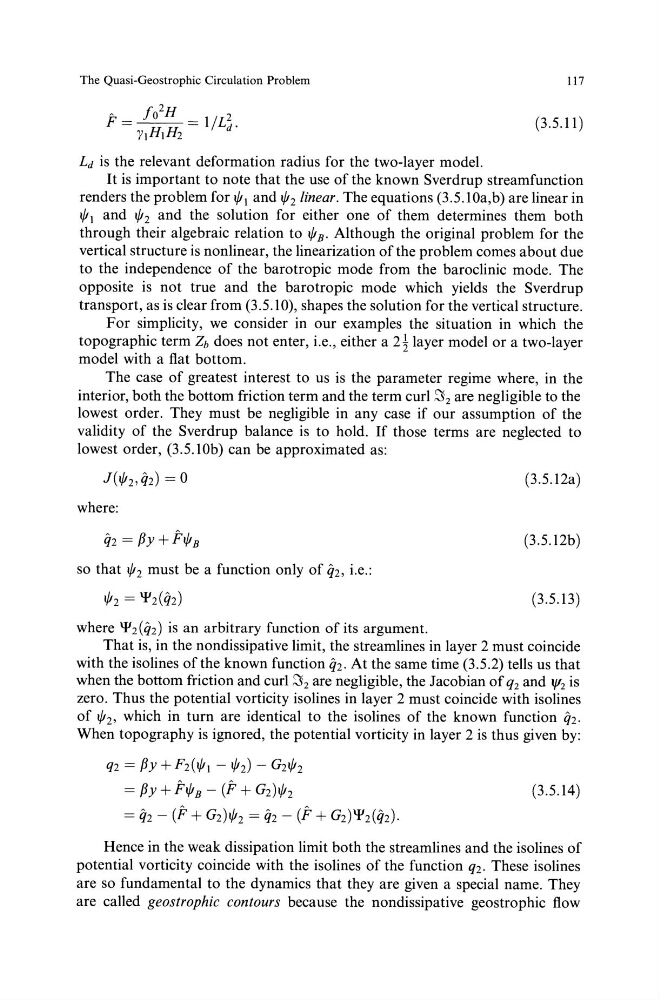
(3.5.11)
Ld is the relevant deformation radius for the two-layer model.
It is important to note that the use of the known Sverdrup streamfunction
renders the problem for t/1 1 and t/1 2 /inear. The equations (3.5.10a,b) are linear in
t/1 1 and t/1 2 and the solution for either one of them determines them both
through their algebraic relation to 1/Js. Although the original problem for the
vertical structure is nonlinear, the linearization of the problem comes about due
to the independence of the barotropic mode from the baroclinic mode. The
opposite is not true and the barotropic mode which yields the Sverdrup
transport, as is clear from (3.5.10), shapes the solution for the vertical structure.
For simplicity, we consider in our examples the situation in which the
topographic term Zb does not enter, i.e., either a 2! layer model or a two-layer
model with a flat bottom.
The case of greatest interest to us is the parameter regime where, in the
interior, both the bottom friction term and the term curl ;;J 2 are negligible to the
lowest order. They must be negligible in any case if our assumption of the
validity of the Sverdrup balance is to hold. If those terms are neglected to
lowest order, (3.5.10b) can be approximated as:
(3.5.12a)
where:
(3.5.12b)
so that t/1 2 must be a function only of lJ2, i.e.:
(3.5.13)
where 'l'2(q2) is an arbitrary function of its argument.
That is, in the nondissipative limit, the streamlines in layer 2 must coincide
with the isolines of the known function tl2· At the same time (3.5.2) tells us that
when the bottom friction and curl ;;J2 are negligible, the Jacobian of q 2 and l/f 2 is
zero. Thus the potential vorticity isolines in layer 2 must coincide with isolines
of t/1 2 , which in turn are identical to the isolines of the known function tl2·
When topography is ignored, the potential vorticity in layer 2 is thus given by:
q2 = f3y + F2(t/1, - t/12)- G2t/12
= f3y +iNs- (F + G2)t/12
= q2- (ft + G2)t/1 2 = q2- (F + G2)'1'2(q2).
(3.5.14)
Hence in the weak dissipation limit both the streamlines and the isolines of
potential vorticity coincide with the isolines of the function q2• These isolines
are so fundamental to the dynamics that they are given a special name. They
are called geostrophic contours because the nondissipative geostrophic flow
117
(3.5.11)
Ld is the relevant deformation radius for the two-layer model.
It is important to note that the use of the known Sverdrup streamfunction
renders the problem for t/1 1 and t/1 2 /inear. The equations (3.5.10a,b) are linear in
t/1 1 and t/1 2 and the solution for either one of them determines them both
through their algebraic relation to 1/Js. Although the original problem for the
vertical structure is nonlinear, the linearization of the problem comes about due
to the independence of the barotropic mode from the baroclinic mode. The
opposite is not true and the barotropic mode which yields the Sverdrup
transport, as is clear from (3.5.10), shapes the solution for the vertical structure.
For simplicity, we consider in our examples the situation in which the
topographic term Zb does not enter, i.e., either a 2! layer model or a two-layer
model with a flat bottom.
The case of greatest interest to us is the parameter regime where, in the
interior, both the bottom friction term and the term curl ;;J 2 are negligible to the
lowest order. They must be negligible in any case if our assumption of the
validity of the Sverdrup balance is to hold. If those terms are neglected to
lowest order, (3.5.10b) can be approximated as:
(3.5.12a)
where:
(3.5.12b)
so that t/1 2 must be a function only of lJ2, i.e.:
(3.5.13)
where 'l'2(q2) is an arbitrary function of its argument.
That is, in the nondissipative limit, the streamlines in layer 2 must coincide
with the isolines of the known function tl2· At the same time (3.5.2) tells us that
when the bottom friction and curl ;;J2 are negligible, the Jacobian of q 2 and l/f 2 is
zero. Thus the potential vorticity isolines in layer 2 must coincide with isolines
of t/1 2 , which in turn are identical to the isolines of the known function tl2·
When topography is ignored, the potential vorticity in layer 2 is thus given by:
q2 = f3y + F2(t/1, - t/12)- G2t/12
= f3y +iNs- (F + G2)t/12
= q2- (ft + G2)t/1 2 = q2- (F + G2)'1'2(q2).
(3.5.14)
Hence in the weak dissipation limit both the streamlines and the isolines of
potential vorticity coincide with the isolines of the function q2• These isolines
are so fundamental to the dynamics that they are given a special name. They
are called geostrophic contours because the nondissipative geostrophic flow