

The Quasi-Geostrophic Circulation Problem
115
which the layer variations are required to be small with respect to their average
values, remains valid as long as RoF « 1, which, as we saw in Section 3.2, is
met as long as L is of the order of 2000 km or less, which is still much greater
than Ld = 0(50 km).
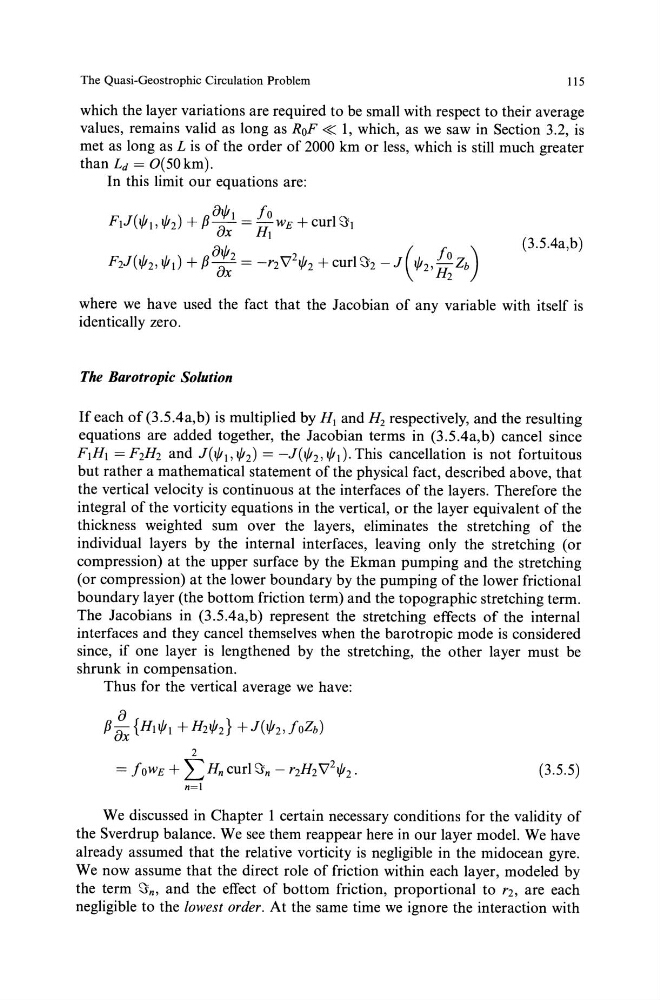
In this limit our equations are:
(3.5.4a,b)
where we have used the fact that the Jacobian of any variable with itself is
identically zero.
The Barotropic Solution
If each of (3.5.4a, b) is multiplied by H 1 and H 2 respectively, and the resulting
equations are added together, the Jacobian terms in (3.5.4a,b) cancel since
F1H1 =F2H2 and J(l/1 1 ,1/1 2 ) = -J(l/1 2 ,l/1 1 ).This cancellation is not fortuitous
but rather a mathematical statement of the physical fact, described above, that
the vertical velocity is continuous at the interfaces of the layers. Therefore the
integral of the vorticity equations in the vertical, or the layer equivalent of the
thickness weighted sum over the layers, eliminates the stretching of the
individual layers by the internal interfaces, leaving only the stretching (or
compression) at the upper surface by the Ekman pumping and the stretching
(or compression) at the lower boundary by the pumping of the lower frictional
boundary layer (the bottom friction term) and the topographic stretching term.
The Jacobians in (3.5.4a,b) represent the stretching effects of the internal
interfaces and they cancel themselves when the barotropic mode is considered
since, if one layer is lengthened by the stretching, the other layer must be
shrunk in compensation.
Thus for the vertical average we have:
a
f3 ax {Ht!/Jt +H2!/J2} +J(!/J2JoZb)
2
=/oWE+ l:Hn curl 'Sn- r2H2 \1 2 1/12 .
(3.5.5)
n=i
We discussed in Chapter 1 certain necessary conditions for the validity of
the Sverdrup balance. We see them reappear here in our layer model. We have
already assumed that the relative vorticity is negligible in the midocean gyre.
We now assume that the direct role of friction within each layer, modeled by
the term 'Sn, and the effect of bottom friction, proportional to r2, are each
negligible to the lowest order. At the same time we ignore the interaction with
115
which the layer variations are required to be small with respect to their average
values, remains valid as long as RoF « 1, which, as we saw in Section 3.2, is
met as long as L is of the order of 2000 km or less, which is still much greater
than Ld = 0(50 km).
In this limit our equations are:
(3.5.4a,b)
where we have used the fact that the Jacobian of any variable with itself is
identically zero.
The Barotropic Solution
If each of (3.5.4a, b) is multiplied by H 1 and H 2 respectively, and the resulting
equations are added together, the Jacobian terms in (3.5.4a,b) cancel since
F1H1 =F2H2 and J(l/1 1 ,1/1 2 ) = -J(l/1 2 ,l/1 1 ).This cancellation is not fortuitous
but rather a mathematical statement of the physical fact, described above, that
the vertical velocity is continuous at the interfaces of the layers. Therefore the
integral of the vorticity equations in the vertical, or the layer equivalent of the
thickness weighted sum over the layers, eliminates the stretching of the
individual layers by the internal interfaces, leaving only the stretching (or
compression) at the upper surface by the Ekman pumping and the stretching
(or compression) at the lower boundary by the pumping of the lower frictional
boundary layer (the bottom friction term) and the topographic stretching term.
The Jacobians in (3.5.4a,b) represent the stretching effects of the internal
interfaces and they cancel themselves when the barotropic mode is considered
since, if one layer is lengthened by the stretching, the other layer must be
shrunk in compensation.
Thus for the vertical average we have:
a
f3 ax {Ht!/Jt +H2!/J2} +J(!/J2JoZb)
2
=/oWE+ l:Hn curl 'Sn- r2H2 \1 2 1/12 .
(3.5.5)
n=i
We discussed in Chapter 1 certain necessary conditions for the validity of
the Sverdrup balance. We see them reappear here in our layer model. We have
already assumed that the relative vorticity is negligible in the midocean gyre.
We now assume that the direct role of friction within each layer, modeled by
the term 'Sn, and the effect of bottom friction, proportional to r2, are each
negligible to the lowest order. At the same time we ignore the interaction with