

104
Vertical Structure: Baroclinic Quasi-Geostrophic Models
friction, i.e., when the fluid motion in a layer is inviscid and adiabatic, the
potential vorticity of that layer is conserved, i.e., its total time derivative
vanishes.
There are two layers that require special attention. The first is layer 1, the
uppermost layer under the Ekman layer. Its upper surface, assuming the
Ekman layer is very thin, is actually the interface in pressure contact with the
overlying atmosphere. The density jump at the interface with the atmosphere is
so large, i.e., 0( 1), that the strong stratification at that surface renders the
motion of the upper surface negligible compared to that of its lower interface
by a factor 11pj p 0 , where 11p is the density jump from the first to the second
layer. Compared to z2 the upper interface is kinematically rigid although it
adjusts slightly to match the atmospheric pressure at the upper surface. At the
same time the mass flux across the upper interface with the Ekman layer is the
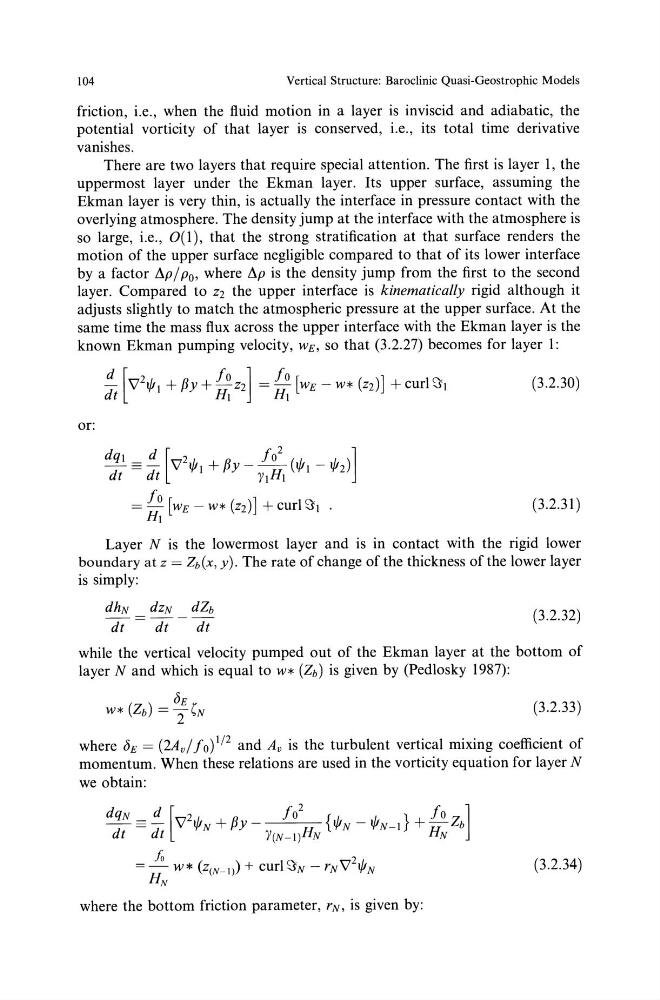
known Ekman pumping velocity, wE, so that (3.2.27) becomes for layer 1:
d [ 2
fo ]
/o [
( ]
- '\7 l/1 1 + {3y + -z2 = - WE- W* z2) +CUrl~~
dt
Ht
Ht
(3.2.30)
or:
(3.2.31)
Layer N is the lowermost layer and is in contact with the rigid lower
boundary at z = Zb (x, y). The rate of change of the thickness of the lower layer
is simply:
dzN dZb
- - -
dt
dt
(3.2.32)
while the vertical velocity pumped out of the Ekman layer at the bottom of
layer Nand which is equal to W* (Zb) is given by (Pedlosky 1987):
JE
W* (Zb) = l(N
(3.2.33)
where JE = (2Av/ f 0 ) 1 / 2 and Av is the turbulent vertical mixing coefficient of
momentum. When these relations are used in the vorticity equation for layer N
we obtain:
dqN
d [ 2
/o
2
{
}
/o ]
Tt = dt v l/JN + f3y- Y(N~lJHN l/JN -l/JN~t + HN zb
= __!i_ w * (z(N-1)) + curl ~N - rN 'V 2 l/l N
HN
(3.2.34)
where the bottom friction parameter, rN, is given by:
Vertical Structure: Baroclinic Quasi-Geostrophic Models
friction, i.e., when the fluid motion in a layer is inviscid and adiabatic, the
potential vorticity of that layer is conserved, i.e., its total time derivative
vanishes.
There are two layers that require special attention. The first is layer 1, the
uppermost layer under the Ekman layer. Its upper surface, assuming the
Ekman layer is very thin, is actually the interface in pressure contact with the
overlying atmosphere. The density jump at the interface with the atmosphere is
so large, i.e., 0( 1), that the strong stratification at that surface renders the
motion of the upper surface negligible compared to that of its lower interface
by a factor 11pj p 0 , where 11p is the density jump from the first to the second
layer. Compared to z2 the upper interface is kinematically rigid although it
adjusts slightly to match the atmospheric pressure at the upper surface. At the
same time the mass flux across the upper interface with the Ekman layer is the
known Ekman pumping velocity, wE, so that (3.2.27) becomes for layer 1:
d [ 2
fo ]
/o [
( ]
- '\7 l/1 1 + {3y + -z2 = - WE- W* z2) +CUrl~~
dt
Ht
Ht
(3.2.30)
or:
(3.2.31)
Layer N is the lowermost layer and is in contact with the rigid lower
boundary at z = Zb (x, y). The rate of change of the thickness of the lower layer
is simply:
dzN dZb
- - -
dt
dt
(3.2.32)
while the vertical velocity pumped out of the Ekman layer at the bottom of
layer Nand which is equal to W* (Zb) is given by (Pedlosky 1987):
JE
W* (Zb) = l(N
(3.2.33)
where JE = (2Av/ f 0 ) 1 / 2 and Av is the turbulent vertical mixing coefficient of
momentum. When these relations are used in the vorticity equation for layer N
we obtain:
dqN
d [ 2
/o
2
{
}
/o ]
Tt = dt v l/JN + f3y- Y(N~lJHN l/JN -l/JN~t + HN zb
= __!i_ w * (z(N-1)) + curl ~N - rN 'V 2 l/l N
HN
(3.2.34)
where the bottom friction parameter, rN, is given by: