

102
Vertical Structure: Baroclinic Quasi-Geostrophic Models
If the motion is adiabatic, the fluid must conserve its density and remain in
its original layer. In this case the cross-interface velocity is zero, and (3.2.18)
reduces to the adiabatic boundary condition at the interface wn(zn) = dzn/dt .
Note that although the cross-isopycnal velocity is zero, the vertical velocity at
the interface is not, in general, zero. In general, for both adiabatic and
nonadiabatic motion, unless the interface is flat, or the horizontal velocity is
very weak and associated with weak slopes of the interfaces, the crossisopycnal velocity differs substantially from the vertical velocity.
It is conceptually helpful momentarily to consider the same process of
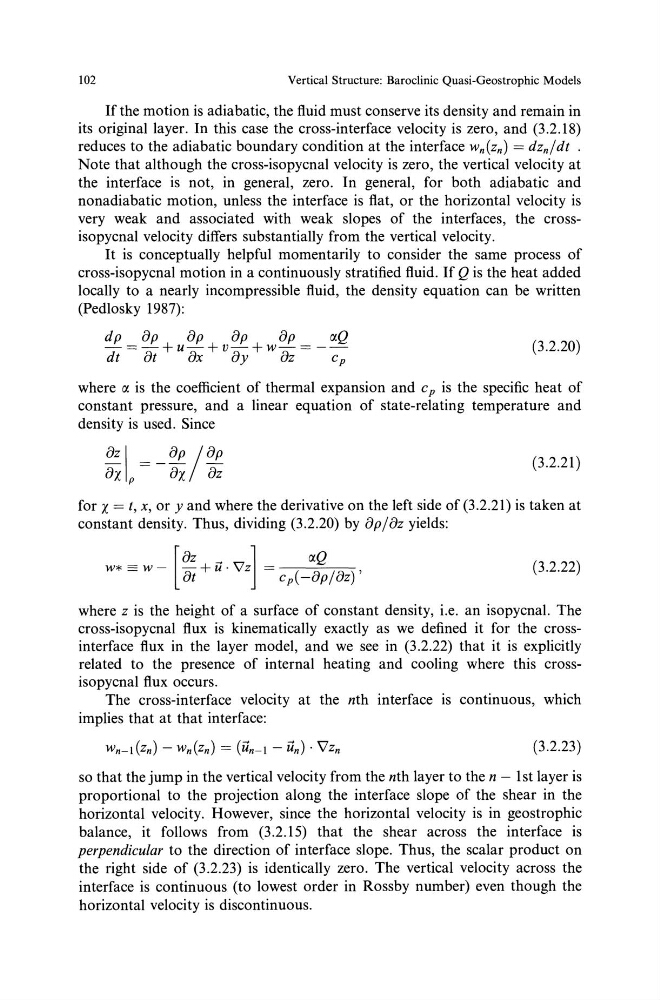
cross-isopycnal motion in a continuously stratified fluid. If Q is the heat added
locally to a nearly incompressible fluid, the density equation can be written
(Pedlosky 1987):
dp op
op
op
op
IXQ
-=-+u-+v-+w-= - -
dt
ot
ox
oy
oz
cp
(3.2.20)
where IX is the coefficient of thermal expansion and c P is the specific heat of
constant pressure, and a linear equation of state-relating temperature and
density is used. Since
oz \ __ op / op
ox p -
ox oz
(3.2.21)
for x = t, x, or y and where the derivative on the left side of (3.2.21) is taken at
constant density. Thus, dividing (3.2.20) by opjoz yields:
[
oz _
]
IXQ
W* = W- Ot + U. '\i'z = Cp( -opjoz)'
(3.2.22)
where z is the height of a surface of constant density, i.e. an isopycnal. The
cross-isopycnal flux is kinematically exactly as we defined it for the crossinterface flux in the layer model, and we see in (3.2.22) that it is explicitly
related to the presence of internal heating and cooling where this crossisopycnal flux occurs.
The cross-interface velocity at the nth interface is continuous, which
implies that at that interface:
(3.2.23)
so that the jump in the vertical velocity from the nth layer to then- 1st layer is
proportional to the projection along the interface slope of the shear in the
horizontal velocity. However, since the horizontal velocity is in geostrophic
balance, it follows from (3.2.15) that the shear across the interface is
perpendicular to the direction of interface slope. Thus, the scalar product on
the right side of (3.2.23) is identically zero. The vertical velocity across the
interface is continuous (to lowest order in Rossby number) even though the
horizontal velocity is discontinuous.
Vertical Structure: Baroclinic Quasi-Geostrophic Models
If the motion is adiabatic, the fluid must conserve its density and remain in
its original layer. In this case the cross-interface velocity is zero, and (3.2.18)
reduces to the adiabatic boundary condition at the interface wn(zn) = dzn/dt .
Note that although the cross-isopycnal velocity is zero, the vertical velocity at
the interface is not, in general, zero. In general, for both adiabatic and
nonadiabatic motion, unless the interface is flat, or the horizontal velocity is
very weak and associated with weak slopes of the interfaces, the crossisopycnal velocity differs substantially from the vertical velocity.
It is conceptually helpful momentarily to consider the same process of
cross-isopycnal motion in a continuously stratified fluid. If Q is the heat added
locally to a nearly incompressible fluid, the density equation can be written
(Pedlosky 1987):
dp op
op
op
op
IXQ
-=-+u-+v-+w-= - -
dt
ot
ox
oy
oz
cp
(3.2.20)
where IX is the coefficient of thermal expansion and c P is the specific heat of
constant pressure, and a linear equation of state-relating temperature and
density is used. Since
oz \ __ op / op
ox p -
ox oz
(3.2.21)
for x = t, x, or y and where the derivative on the left side of (3.2.21) is taken at
constant density. Thus, dividing (3.2.20) by opjoz yields:
[
oz _
]
IXQ
W* = W- Ot + U. '\i'z = Cp( -opjoz)'
(3.2.22)
where z is the height of a surface of constant density, i.e. an isopycnal. The
cross-isopycnal flux is kinematically exactly as we defined it for the crossinterface flux in the layer model, and we see in (3.2.22) that it is explicitly
related to the presence of internal heating and cooling where this crossisopycnal flux occurs.
The cross-interface velocity at the nth interface is continuous, which
implies that at that interface:
(3.2.23)
so that the jump in the vertical velocity from the nth layer to then- 1st layer is
proportional to the projection along the interface slope of the shear in the
horizontal velocity. However, since the horizontal velocity is in geostrophic
balance, it follows from (3.2.15) that the shear across the interface is
perpendicular to the direction of interface slope. Thus, the scalar product on
the right side of (3.2.23) is identically zero. The vertical velocity across the
interface is continuous (to lowest order in Rossby number) even though the
horizontal velocity is discontinuous.