

122
Walter Munk
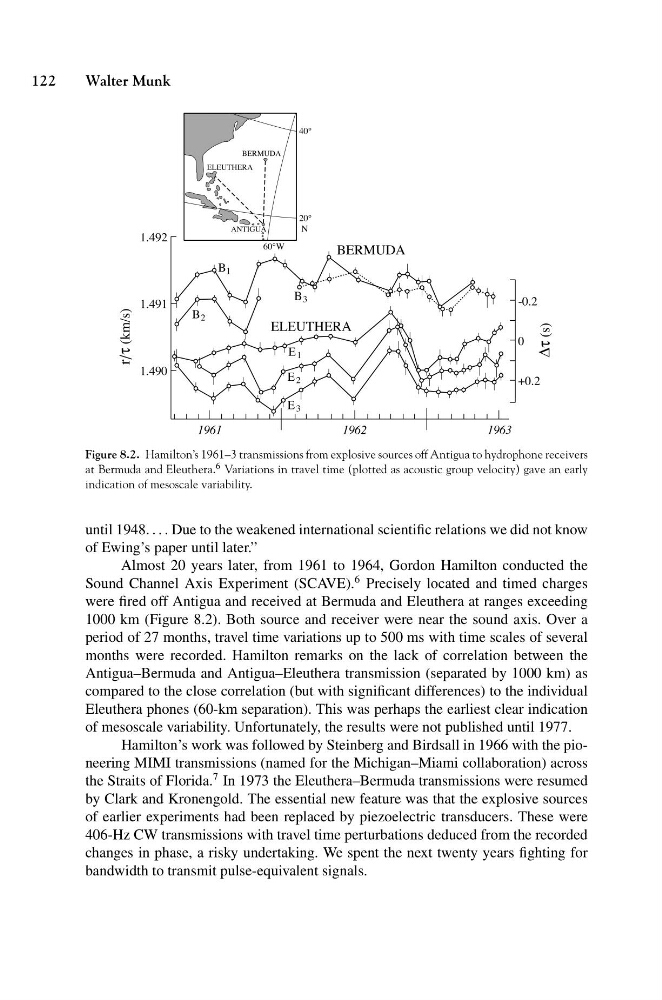
Figure 8.2. Hamilton’s 1961–3 transmissions from explosive sources off Antigua to hydrophone receivers
at Bermuda and Eleuthera. 6 Variations in travel time (plotted as acoustic group velocity) gave an early
indication of mesoscale variability.
until 1948. . . . Due to the weakened international scientific relations we did not know
of Ewing’s paper until later.”
Almost 20 years later, from 1961 to 1964, Gordon Hamilton conducted the
Sound Channel Axis Experiment (SCAVE).
6 Precisely located and timed charges
were fired off Antigua and received at Bermuda and Eleuthera at ranges exceeding
1000 km (Figure 8.2). Both source and receiver were near the sound axis. Over a
period of 27 months, travel time variations up to 500 ms with time scales of several
months were recorded. Hamilton remarks on the lack of correlation between the
Antigua–Bermuda and Antigua–Eleuthera transmission (separated by 1000 km) as
compared to the close correlation (but with significant differences) to the individual
Eleuthera phones (60-km separation). This was perhaps the earliest clear indication
of mesoscale variability. Unfortunately, the results were not published until 1977.
Hamilton’s work was followed by Steinberg and Birdsall in 1966 with the pioneering MIMI transmissions (named for the Michigan–Miami collaboration) across
the Straits of Florida.
7 In 1973 the Eleuthera–Bermuda transmissions were resumed
by Clark and Kronengold. The essential new feature was that the explosive sources
of earlier experiments had been replaced by piezoelectric transducers. These were
406-Hz CW transmissions with travel time perturbations deduced from the recorded
changes in phase, a risky undertaking. We spent the next twenty years fighting for
bandwidth to transmit pulse-equivalent signals.
Walter Munk
Figure 8.2. Hamilton’s 1961–3 transmissions from explosive sources off Antigua to hydrophone receivers
at Bermuda and Eleuthera. 6 Variations in travel time (plotted as acoustic group velocity) gave an early
indication of mesoscale variability.
until 1948. . . . Due to the weakened international scientific relations we did not know
of Ewing’s paper until later.”
Almost 20 years later, from 1961 to 1964, Gordon Hamilton conducted the
Sound Channel Axis Experiment (SCAVE).
6 Precisely located and timed charges
were fired off Antigua and received at Bermuda and Eleuthera at ranges exceeding
1000 km (Figure 8.2). Both source and receiver were near the sound axis. Over a
period of 27 months, travel time variations up to 500 ms with time scales of several
months were recorded. Hamilton remarks on the lack of correlation between the
Antigua–Bermuda and Antigua–Eleuthera transmission (separated by 1000 km) as
compared to the close correlation (but with significant differences) to the individual
Eleuthera phones (60-km separation). This was perhaps the earliest clear indication
of mesoscale variability. Unfortunately, the results were not published until 1977.
Hamilton’s work was followed by Steinberg and Birdsall in 1966 with the pioneering MIMI transmissions (named for the Michigan–Miami collaboration) across
the Straits of Florida.
7 In 1973 the Eleuthera–Bermuda transmissions were resumed
by Clark and Kronengold. The essential new feature was that the explosive sources
of earlier experiments had been replaced by piezoelectric transducers. These were
406-Hz CW transmissions with travel time perturbations deduced from the recorded
changes in phase, a risky undertaking. We spent the next twenty years fighting for
bandwidth to transmit pulse-equivalent signals.