

Ocean Acoustic Tomography
121
Sound channel axis
axis
Source
+8
–10
–7
Receiver
0 km
0 s
166 s
167 s
1 km
3 km
Range
Travel Time
Depth
250 km
Transmitted pulse
Received signal
Sound Speed
trasmission 1
trasmission 2
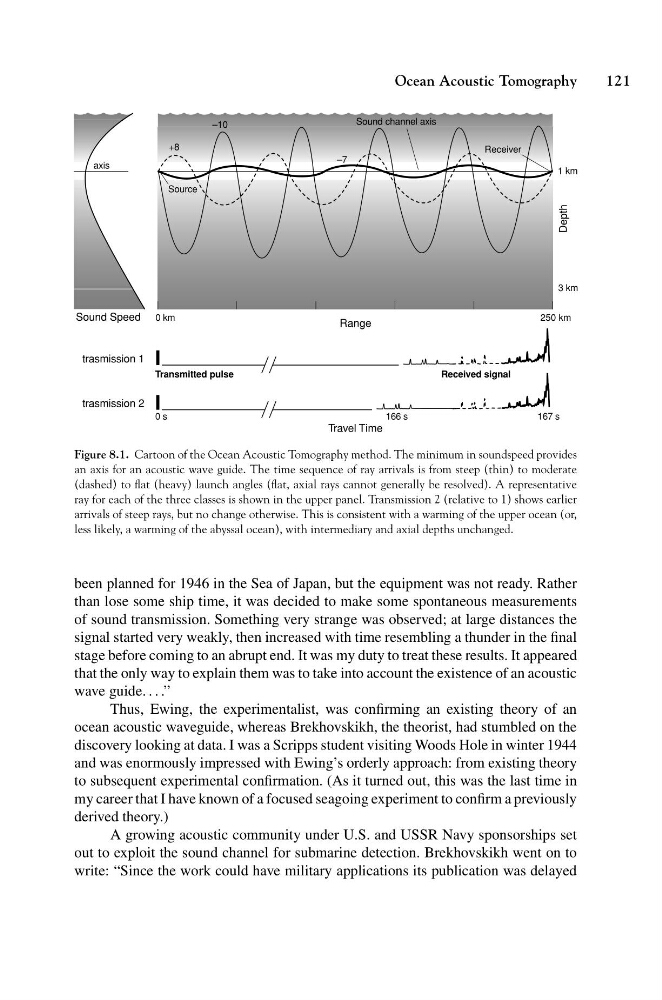
Figure 8.1. Cartoon of the Ocean Acoustic Tomography method. The minimum in soundspeed provides
an axis for an acoustic wave guide. The time sequence of ray arrivals is from steep (thin) to moderate
(dashed) to flat (heavy) launch angles (flat, axial rays cannot generally be resolved). A representative
ray for each of the three classes is shown in the upper panel. Transmission 2 (relative to 1) shows earlier
arrivals of steep rays, but no change otherwise. This is consistent with a warming of the upper ocean (or,
less likely, a warming of the abyssal ocean), with intermediary and axial depths unchanged.
been planned for 1946 in the Sea of Japan, but the equipment was not ready. Rather
than lose some ship time, it was decided to make some spontaneous measurements
of sound transmission. Something very strange was observed; at large distances the
signal started very weakly, then increased with time resembling a thunder in the final
stage before coming to an abrupt end. It was my duty to treat these results. It appeared
that the only way to explain them was to take into account the existence of an acoustic
wave guide. . . .”
Thus, Ewing, the experimentalist, was confirming an existing theory of an
ocean acoustic waveguide, whereas Brekhovskikh, the theorist, had stumbled on the
discovery looking at data. I was a Scripps student visiting Woods Hole in winter 1944
and was enormously impressed with Ewing’s orderly approach: from existing theory
to subsequent experimental confirmation. (As it turned out, this was the last time in
my career that I have known of a focused seagoing experiment to confirm a previously
derived theory.)
A growing acoustic community under U.S. and USSR Navy sponsorships set
out to exploit the sound channel for submarine detection. Brekhovskikh went on to
write: “Since the work could have military applications its publication was delayed
121
Sound channel axis
axis
Source
+8
–10
–7
Receiver
0 km
0 s
166 s
167 s
1 km
3 km
Range
Travel Time
Depth
250 km
Transmitted pulse
Received signal
Sound Speed
trasmission 1
trasmission 2
Figure 8.1. Cartoon of the Ocean Acoustic Tomography method. The minimum in soundspeed provides
an axis for an acoustic wave guide. The time sequence of ray arrivals is from steep (thin) to moderate
(dashed) to flat (heavy) launch angles (flat, axial rays cannot generally be resolved). A representative
ray for each of the three classes is shown in the upper panel. Transmission 2 (relative to 1) shows earlier
arrivals of steep rays, but no change otherwise. This is consistent with a warming of the upper ocean (or,
less likely, a warming of the abyssal ocean), with intermediary and axial depths unchanged.
been planned for 1946 in the Sea of Japan, but the equipment was not ready. Rather
than lose some ship time, it was decided to make some spontaneous measurements
of sound transmission. Something very strange was observed; at large distances the
signal started very weakly, then increased with time resembling a thunder in the final
stage before coming to an abrupt end. It was my duty to treat these results. It appeared
that the only way to explain them was to take into account the existence of an acoustic
wave guide. . . .”
Thus, Ewing, the experimentalist, was confirming an existing theory of an
ocean acoustic waveguide, whereas Brekhovskikh, the theorist, had stumbled on the
discovery looking at data. I was a Scripps student visiting Woods Hole in winter 1944
and was enormously impressed with Ewing’s orderly approach: from existing theory
to subsequent experimental confirmation. (As it turned out, this was the last time in
my career that I have known of a focused seagoing experiment to confirm a previously
derived theory.)
A growing acoustic community under U.S. and USSR Navy sponsorships set
out to exploit the sound channel for submarine detection. Brekhovskikh went on to
write: “Since the work could have military applications its publication was delayed