

El Ni ˜
no and Ocean Observations
95
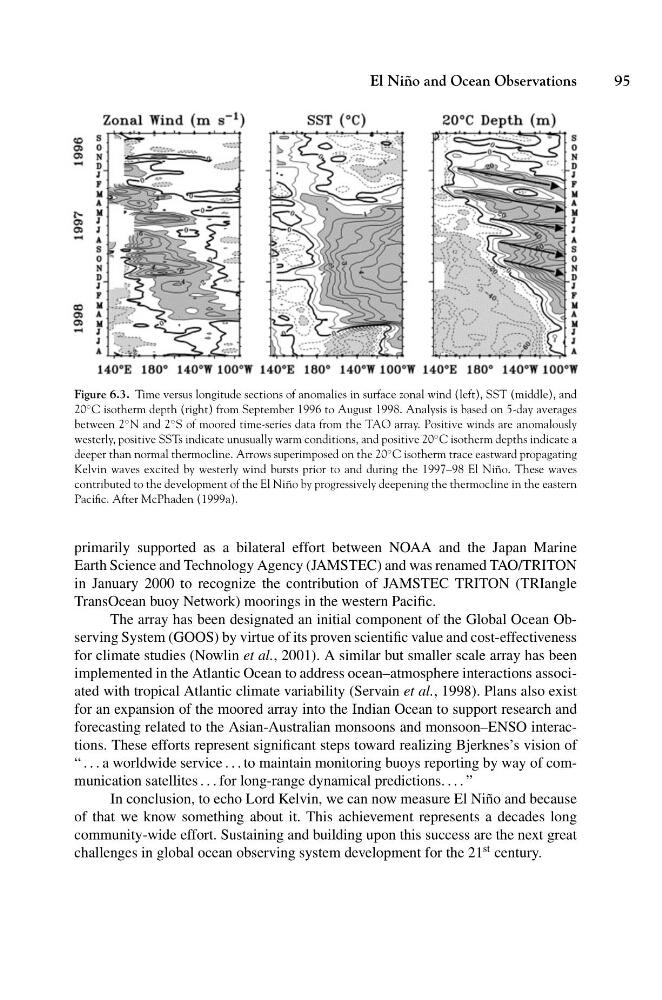
Figure 6.3. Time versus longitude sections of anomalies in surface zonal wind (left), SST (middle), and
20 ◦ C isotherm depth (right) from September 1996 to August 1998. Analysis is based on 5-day averages
between 2 ◦ N and 2 ◦ S of moored time-series data from the TAO array. Positive winds are anomalously
westerly, positive SSTs indicate unusually warm conditions, and positive 20 ◦ C isotherm depths indicate a
deeper than normal thermocline. Arrows superimposed on the 20 ◦ C isotherm trace eastward propagating
Kelvin waves excited by westerly wind bursts prior to and during the 1997–98 El Ni ˜
no. These waves
contributed to the development of the El Ni ˜
no by progressively deepening the thermocline in the eastern
Pacific. After McPhaden (1999a).
primarily supported as a bilateral effort between NOAA and the Japan Marine
Earth Science and Technology Agency (JAMSTEC) and was renamed TAO/TRITON
in January 2000 to recognize the contribution of JAMSTEC TRITON (TRIangle
TransOcean buoy Network) moorings in the western Pacific.
The array has been designated an initial component of the Global Ocean Observing System (GOOS) by virtue of its proven scientific value and cost-effectiveness
for climate studies (Nowlin et al., 2001). A similar but smaller scale array has been
implemented in the Atlantic Ocean to address ocean–atmosphere interactions associated with tropical Atlantic climate variability (Servain et al., 1998). Plans also exist
for an expansion of the moored array into the Indian Ocean to support research and
forecasting related to the Asian-Australian monsoons and monsoon–ENSO interactions. These efforts represent significant steps toward realizing Bjerknes’s vision of
“ . . . a worldwide service . . . to maintain monitoring buoys reporting by way of communication satellites . . . for long-range dynamical predictions. . . . ”
In conclusion, to echo Lord Kelvin, we can now measure El Ni˜ no and because
of that we know something about it. This achievement represents a decades long
community-wide effort. Sustaining and building upon this success are the next great
challenges in global ocean observing system development for the 21
st century.
no and Ocean Observations
95
Figure 6.3. Time versus longitude sections of anomalies in surface zonal wind (left), SST (middle), and
20 ◦ C isotherm depth (right) from September 1996 to August 1998. Analysis is based on 5-day averages
between 2 ◦ N and 2 ◦ S of moored time-series data from the TAO array. Positive winds are anomalously
westerly, positive SSTs indicate unusually warm conditions, and positive 20 ◦ C isotherm depths indicate a
deeper than normal thermocline. Arrows superimposed on the 20 ◦ C isotherm trace eastward propagating
Kelvin waves excited by westerly wind bursts prior to and during the 1997–98 El Ni ˜
no. These waves
contributed to the development of the El Ni ˜
no by progressively deepening the thermocline in the eastern
Pacific. After McPhaden (1999a).
primarily supported as a bilateral effort between NOAA and the Japan Marine
Earth Science and Technology Agency (JAMSTEC) and was renamed TAO/TRITON
in January 2000 to recognize the contribution of JAMSTEC TRITON (TRIangle
TransOcean buoy Network) moorings in the western Pacific.
The array has been designated an initial component of the Global Ocean Observing System (GOOS) by virtue of its proven scientific value and cost-effectiveness
for climate studies (Nowlin et al., 2001). A similar but smaller scale array has been
implemented in the Atlantic Ocean to address ocean–atmosphere interactions associated with tropical Atlantic climate variability (Servain et al., 1998). Plans also exist
for an expansion of the moored array into the Indian Ocean to support research and
forecasting related to the Asian-Australian monsoons and monsoon–ENSO interactions. These efforts represent significant steps toward realizing Bjerknes’s vision of
“ . . . a worldwide service . . . to maintain monitoring buoys reporting by way of communication satellites . . . for long-range dynamical predictions. . . . ”
In conclusion, to echo Lord Kelvin, we can now measure El Ni˜ no and because
of that we know something about it. This achievement represents a decades long
community-wide effort. Sustaining and building upon this success are the next great
challenges in global ocean observing system development for the 21
st century.