

Sea-Surface Temperature Estimations Using a Modem Analog Technique
87
Stage 5 Stage 6
Stage 7 stage 8
-2.5 0
-1.5 co
~90
-0.5 .l!l
Qj
0.5
"C
o 60 120 180 240 300 360 420 480 540 600 660
Depth in core (cm)
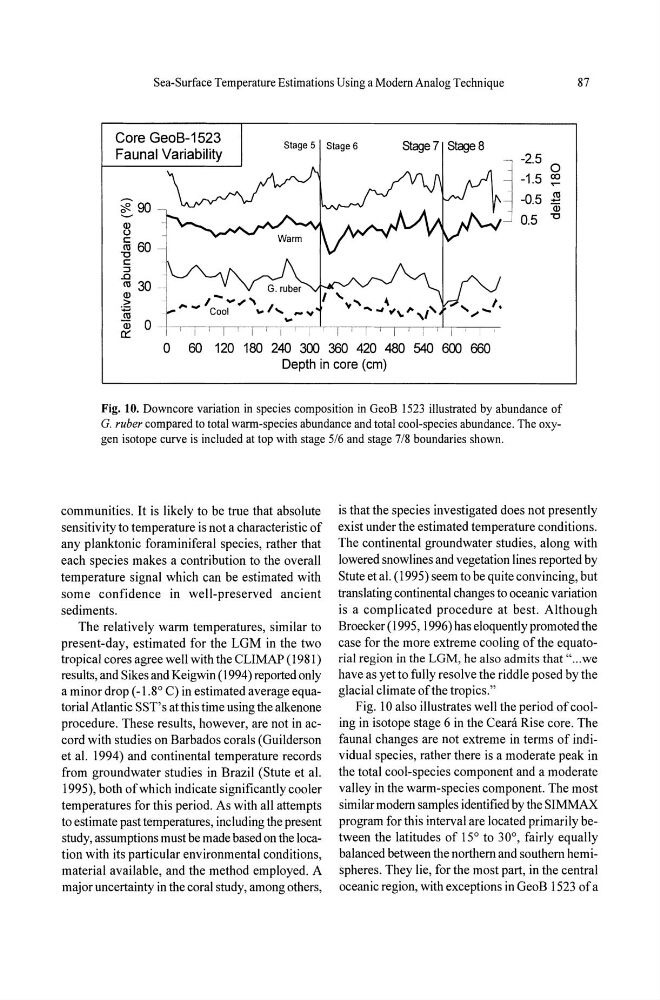
Fig. 10. Downcore variation in species composition in GeoB 1523 illustrated by abundance of
G. ruber compared to total warm-species abundance and total cool-species abundance. The oxygen isotope curve is included at top with stage 5/6 and stage 7/8 boundaries shown.
communities. It is likely to be true that absolute
sensitivity to temperature is not a characteristic of
any planktonic foraminiferal species, rather that
each species makes a contribution to the overall
temperature signal which can be estimated with
some confidence in well-preserved ancient
sediments.
The relatively warm temperatures, similar to
present-day, estimated for the LGM in the two
tropical cores agree well with the CLIMAP (1981)
results, and Sikes and Keigwin (1994) reported only
a minor drop (_1.8 0 C) in estimated average equatorial Atlantic SST's at this time using the alkenone
procedure. These results, however, are not in accord with studies on Barbados corals (Guilderson
et a!. 1994) and continental temperature records
from groundwater studies in Brazil (Stute et a!.
1995), both of which indicate significantly cooler
temperatures for this period. As with all attempts
to estimate past temperatures, including the present
study, assumptions must be made based on the location with its particular environmental conditions,
material available, and the method employed. A
major uncertainty in the coral study, among others,
is that the species investigated does not presently
exist under the estimated temperature conditions.
The continental groundwater studies, along with
lowered snowlines and vegetation lines reported by
Stute eta!. (1995) seem to be quite convincing, but
translating continental changes to oceanic variation
is a complicated procedure at best. Although
Broecker (1995, 1996) has eloquently promoted the
case for the more extreme cooling of the equatorial region in the LGM, he also admits that " ... we
have as yet to fully resolve the riddle posed by the
glacial climate of the tropics."
Fig. 10 also illustrates well the period of cooling in isotope stage 6 in the Ceara Rise core. The
faunal changes are not extreme in terms of individual species, rather there is a moderate peak in
the total cool-species component and a moderate
valley in the warm-species component. The most
similar modem samples identified by the SIMMAX
program for this interval are located primarily between the latitudes of 150 to 30 0 , fairly equally
balanced between the northern and southern hemispheres. They lie, for the most part, in the central
oceanic region, with exceptions in GeoB 1523 of a
87
Stage 5 Stage 6
Stage 7 stage 8
-2.5 0
-1.5 co
~90
-0.5 .l!l
Qj
0.5
"C
o 60 120 180 240 300 360 420 480 540 600 660
Depth in core (cm)
Fig. 10. Downcore variation in species composition in GeoB 1523 illustrated by abundance of
G. ruber compared to total warm-species abundance and total cool-species abundance. The oxygen isotope curve is included at top with stage 5/6 and stage 7/8 boundaries shown.
communities. It is likely to be true that absolute
sensitivity to temperature is not a characteristic of
any planktonic foraminiferal species, rather that
each species makes a contribution to the overall
temperature signal which can be estimated with
some confidence in well-preserved ancient
sediments.
The relatively warm temperatures, similar to
present-day, estimated for the LGM in the two
tropical cores agree well with the CLIMAP (1981)
results, and Sikes and Keigwin (1994) reported only
a minor drop (_1.8 0 C) in estimated average equatorial Atlantic SST's at this time using the alkenone
procedure. These results, however, are not in accord with studies on Barbados corals (Guilderson
et a!. 1994) and continental temperature records
from groundwater studies in Brazil (Stute et a!.
1995), both of which indicate significantly cooler
temperatures for this period. As with all attempts
to estimate past temperatures, including the present
study, assumptions must be made based on the location with its particular environmental conditions,
material available, and the method employed. A
major uncertainty in the coral study, among others,
is that the species investigated does not presently
exist under the estimated temperature conditions.
The continental groundwater studies, along with
lowered snowlines and vegetation lines reported by
Stute eta!. (1995) seem to be quite convincing, but
translating continental changes to oceanic variation
is a complicated procedure at best. Although
Broecker (1995, 1996) has eloquently promoted the
case for the more extreme cooling of the equatorial region in the LGM, he also admits that " ... we
have as yet to fully resolve the riddle posed by the
glacial climate of the tropics."
Fig. 10 also illustrates well the period of cooling in isotope stage 6 in the Ceara Rise core. The
faunal changes are not extreme in terms of individual species, rather there is a moderate peak in
the total cool-species component and a moderate
valley in the warm-species component. The most
similar modem samples identified by the SIMMAX
program for this interval are located primarily between the latitudes of 150 to 30 0 , fairly equally
balanced between the northern and southern hemispheres. They lie, for the most part, in the central
oceanic region, with exceptions in GeoB 1523 of a