

Sea-Surface Temperature Estimations Using a Modern Analog Technique
71
nas, and no modern analog fit can be made (Hutson
1977; Pflaumann et a\. 1996). The modern analog
technique, by contrast, uses a similarity index to
make one-to-one comparisons between the fossil
sample and the coretop data set, then computes an
average of the associated modern SST's for a predetermined number of the most similar modern
samples. A more recent development, the alkenone
technique (U;7 index, Brassel et a\. 1986), is independent of species relative abundance data because it is based on unsaturation ratios recorded in
long-chain ketones of prymnesiophyte origin (Prahl
et a\. 1995). These ratios have been empirically
shown to be linearly related to water temperature
(Sikes and Keigwin 1994), and therefore show great
promise as a paleotemperature proxy. However,
there are still problems with this method. For example, different strains of prymnesiophytes can
have different U~7- temperature relationships. In
addition, anomalous temperature relationships have
been observed in some geographical regions (see
Prahl et a\. 1995 for a summary). Another obstacle in some cores is the absence of sufficient organic material to apply this technique.
Our study employs the SIMMAX modern
analog technique (MAT), using planktonic
foraminiferal assemblages to estimate paleotemperatures in four gravity cores from two
contrasting oceanic regions in the western
Atlantic.
a
Soulh EqualCWl:tl Coun!at Current
ANTARCTIC CIRCUMPOLAR
CURRENT
fJJO S +-O::::Z:;--r---.---r-----r--.,..----r---r----,---.---+ fJJoS
fJJW
20°
a
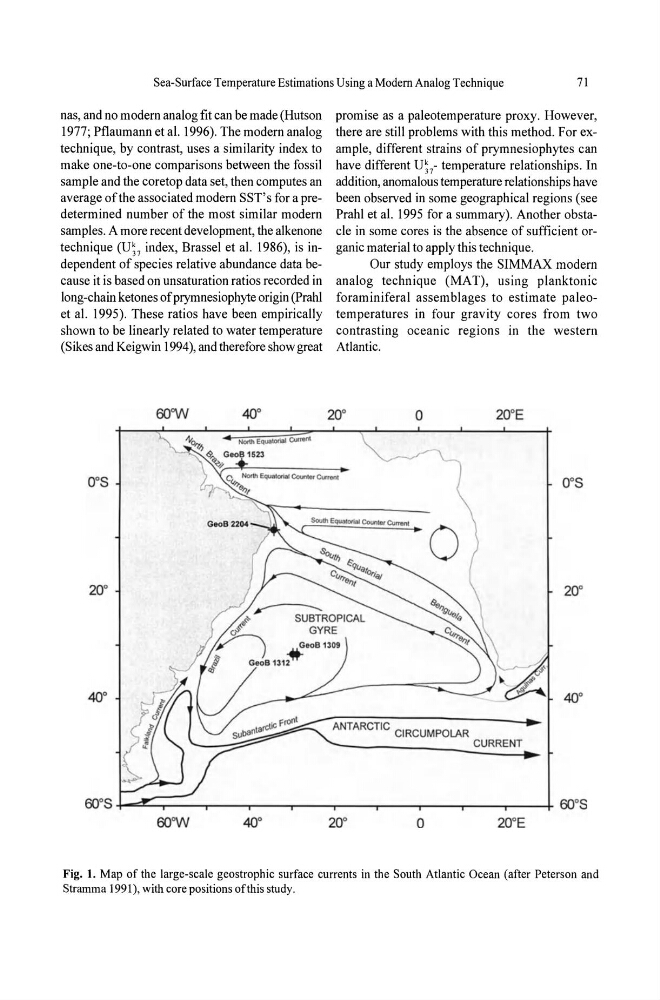
Fig. 1. Map of the large-scale geostrophic surface currents in the South Atlantic Ocean (after Peterson and
Stramma 1991), with core positions of this study.
71
nas, and no modern analog fit can be made (Hutson
1977; Pflaumann et a\. 1996). The modern analog
technique, by contrast, uses a similarity index to
make one-to-one comparisons between the fossil
sample and the coretop data set, then computes an
average of the associated modern SST's for a predetermined number of the most similar modern
samples. A more recent development, the alkenone
technique (U;7 index, Brassel et a\. 1986), is independent of species relative abundance data because it is based on unsaturation ratios recorded in
long-chain ketones of prymnesiophyte origin (Prahl
et a\. 1995). These ratios have been empirically
shown to be linearly related to water temperature
(Sikes and Keigwin 1994), and therefore show great
promise as a paleotemperature proxy. However,
there are still problems with this method. For example, different strains of prymnesiophytes can
have different U~7- temperature relationships. In
addition, anomalous temperature relationships have
been observed in some geographical regions (see
Prahl et a\. 1995 for a summary). Another obstacle in some cores is the absence of sufficient organic material to apply this technique.
Our study employs the SIMMAX modern
analog technique (MAT), using planktonic
foraminiferal assemblages to estimate paleotemperatures in four gravity cores from two
contrasting oceanic regions in the western
Atlantic.
a
Soulh EqualCWl:tl Coun!at Current
ANTARCTIC CIRCUMPOLAR
CURRENT
fJJO S +-O::::Z:;--r---.---r-----r--.,..----r---r----,---.---+ fJJoS
fJJW
20°
a
Fig. 1. Map of the large-scale geostrophic surface currents in the South Atlantic Ocean (after Peterson and
Stramma 1991), with core positions of this study.