

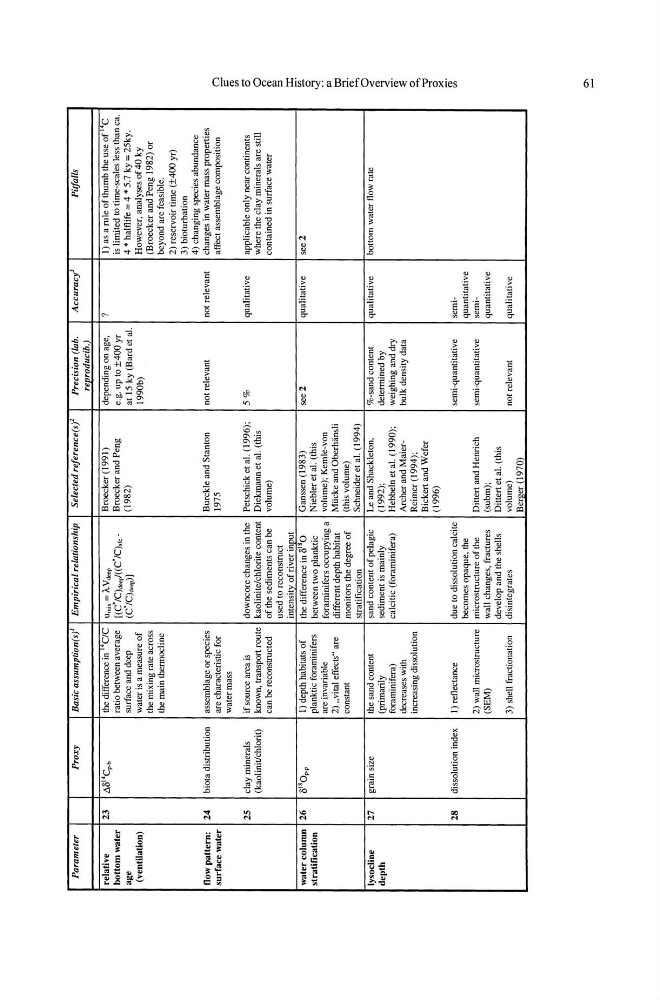
Parameter
Proxy
Basic assumption(s)' Empirical relationship
relative
23
lI.0 14
Cp-b
the difference in
ClC
Umix -
A. V deep
bottom water
ratio between average
[(C·,C).."t«C"C)." -
age
surface and deep
(C"C)"",,))
(ventilation)
water is a measure of
the mixing rate across
the main thermocline
flow
pattern:
24
biota distribution assemblage
or species
surface water
are characteristic for
water mass
2S
clay minerals
if source area is
downcore changes in the
(kaolinitlchlorit)
known, transport route kaolinite/chlorite content
can be
reconstructed
of the sediments can be
used to reconstruct
intensity of river input
water column
26
0"0""
1) depth habitats of
the difference in
0"0
stratification
planktic foraminifers
between two planktic
are invariable
foraminifers occupying a
2) "vital effects" are
different depth habitat
constant
monitors the degree of
stratification
lysocline
27
grain size
the sand content
sand content of pelagic
depth
(primarily
sediment is mainly
foraminifera)
calcitic (foraminifera)
decreases
with
increasing dissolution
28
dissolution index
I) reflectance
due to dissolution calcite
becomes opaque, the
2) wall microstructure microstructure of the
(SEM)
wall changes, fractures
develop
and the shells
3) shell fractionation
disintegrates
Selected reference(s}'
Precision (lab.
relJroducib.l
Broecker (1991)
depending on age,
Broecker and Peng
e.g. up to ±400 yr
(1982)
at IS
ky (Bard et aI.
I 990b)
Burckle and Stanton
not relevant
1975
Petschicket aI. (1996);
5%
Diekmann et aI. (this
volume)
Ganssen (1983)
see 2
Niebler et aI. (this
volume); Kernle-von
Mucke and Oberhiinsli
(this
volume)
Schneideret aI.
(1994)
Le and Shackleton,
%-sand content
(1992);
determined by
HebbelnetaI. (1990);
weighing and dry
Arcber and Maierbulk density data
Reimer (1994);
Bickert and Wefer
(1996)
semi-quantitative
Ditter! and Henrich
semi-quantitative
(subm);
Ditter! et aI. (this
volume)
not relevant
Berger (1970)
AccuracyJ
?
not relevant
qualitative
qualitative
qualitative
semiquantitative
semiquantitative
qualitative
Pitfalls
1) as a rule of thumb the use of C
is limited to time-scales less than ca.
4 • halflife
= 4' 5.7 ky
= 25ky.
However, analyses of 40 ky
(Broecker and Peng 1982) or
beyond are feasible.
2) reservoir time (±400 yr)
3) bioturbation
4) changing species abundance
changes in
water mass properties
affect assemblage composition
applicable only near continents
where the clay minerals are still
contained in surface water
see
2
bottom water flow rate
\.l
E"
1]
S
~
f
'"
g:
~
~
i'
o
....,
~
if
0\
-
Proxy
Basic assumption(s)' Empirical relationship
relative
23
lI.0 14
Cp-b
the difference in
ClC
Umix -
A. V deep
bottom water
ratio between average
[(C·,C).."t«C"C)." -
age
surface and deep
(C"C)"",,))
(ventilation)
water is a measure of
the mixing rate across
the main thermocline
flow
pattern:
24
biota distribution assemblage
or species
surface water
are characteristic for
water mass
2S
clay minerals
if source area is
downcore changes in the
(kaolinitlchlorit)
known, transport route kaolinite/chlorite content
can be
reconstructed
of the sediments can be
used to reconstruct
intensity of river input
water column
26
0"0""
1) depth habitats of
the difference in
0"0
stratification
planktic foraminifers
between two planktic
are invariable
foraminifers occupying a
2) "vital effects" are
different depth habitat
constant
monitors the degree of
stratification
lysocline
27
grain size
the sand content
sand content of pelagic
depth
(primarily
sediment is mainly
foraminifera)
calcitic (foraminifera)
decreases
with
increasing dissolution
28
dissolution index
I) reflectance
due to dissolution calcite
becomes opaque, the
2) wall microstructure microstructure of the
(SEM)
wall changes, fractures
develop
and the shells
3) shell fractionation
disintegrates
Selected reference(s}'
Precision (lab.
relJroducib.l
Broecker (1991)
depending on age,
Broecker and Peng
e.g. up to ±400 yr
(1982)
at IS
ky (Bard et aI.
I 990b)
Burckle and Stanton
not relevant
1975
Petschicket aI. (1996);
5%
Diekmann et aI. (this
volume)
Ganssen (1983)
see 2
Niebler et aI. (this
volume); Kernle-von
Mucke and Oberhiinsli
(this
volume)
Schneideret aI.
(1994)
Le and Shackleton,
%-sand content
(1992);
determined by
HebbelnetaI. (1990);
weighing and dry
Arcber and Maierbulk density data
Reimer (1994);
Bickert and Wefer
(1996)
semi-quantitative
Ditter! and Henrich
semi-quantitative
(subm);
Ditter! et aI. (this
volume)
not relevant
Berger (1970)
AccuracyJ
?
not relevant
qualitative
qualitative
qualitative
semiquantitative
semiquantitative
qualitative
Pitfalls
1) as a rule of thumb the use of C
is limited to time-scales less than ca.
4 • halflife
= 4' 5.7 ky
= 25ky.
However, analyses of 40 ky
(Broecker and Peng 1982) or
beyond are feasible.
2) reservoir time (±400 yr)
3) bioturbation
4) changing species abundance
changes in
water mass properties
affect assemblage composition
applicable only near continents
where the clay minerals are still
contained in surface water
see
2
bottom water flow rate
\.l
E"
1]
S
~
f
'"
g:
~
~
i'
o
....,
~
if
0\
-