

Reconstructing and Modelling the Last Glacial Maximum
697
they are strongly dependent on our knowledge of
the paleoclimatic boundary conditions at the interface, such as the CLIMAP reconstruction (cf.
section Atmospheric modelling and Ocean modelling). Another approach is to integrate a coupled
model until a new equilibrium circulation of atmosphere and ocean is achieved. This has the potential to make boundary conditions at the interface
superfluous. Driven by paleoclimatic boundary
conditions far away from the ocean surface (i .e.
solar radiation and land surface characteristics)
coupled models should be able to derive independent sea surface data (SST, SSS).
Unfortunately, current general circulation models have two major shortcomings: (I) An atmospheric model with a time step in the range of minutes is too computation-expensive to extend the
length of a model run to the range of the response
time of the deep ocean, which is at least 1000 years.
(2) The accuracy of both atmospheric and, oceanic
synchronously
coupled
phase
ocean
only
phase
submodels is not yet sufficient to directly couple the
fluxes at the interface on such a long time scale.
Small errors in the surface fluxes of both models
lead to an artificial drift towards an unrealistic state
of the global ocean circulation. Presently, so-called
flux adjustments are used to avoid such a drift
(Sausen et al. 1988; Sausen and Lunkeit 1990), but
they restrict the application of the coupled model
to simulations of a general circulation similar to the
modern one.
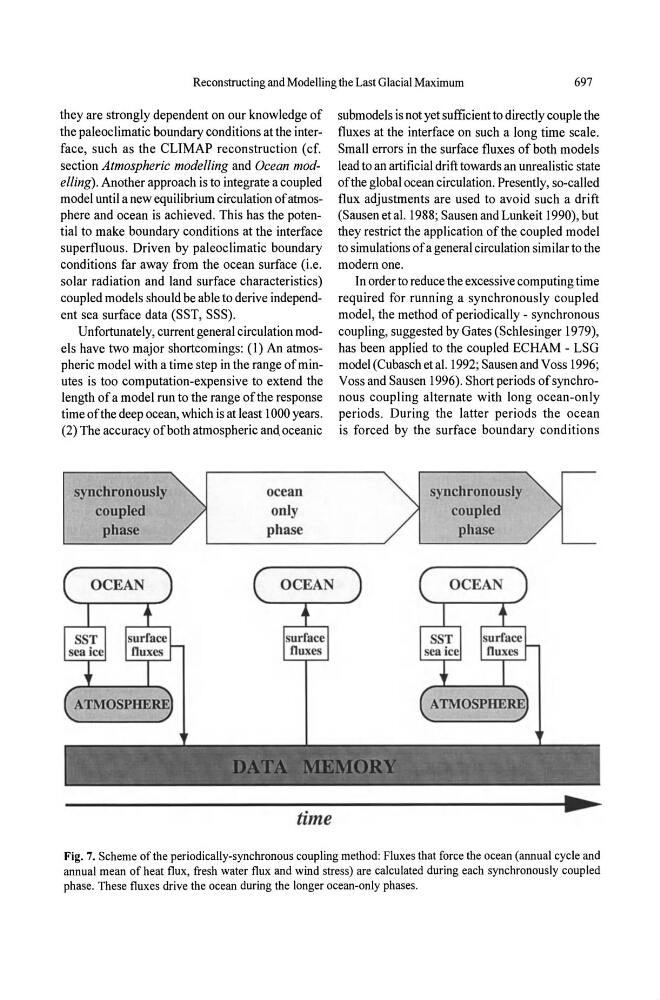
In order to reduce the excessive computing time
required for running a synchronously coupled
model, the method of periodically - synchronous
coupling, suggested by Gates (Schlesinger 1979),
has been applied to the coupled ECHAM - LSG
model (Cubaschetal. 1992; Sausenand Voss 1996;
Voss and Sausen 1996). Short periods of synchronous coupling alternate with long ocean-only
periods. During the latter periods the ocean
is forced by the surface boundary conditions
synchronously
coupled
phase
I
-
~
-
- . - -
I
I "
: ' \
\ 'l I! I \ 'I II ~) ~~; , I
time
Fig. 7. Scheme of the periodically-synchronous coupling method: Fluxes that force the ocean (annual cycle and
annual mean of heat flux, fresh water flux and wind stress) are calculated during each synchronously coupled
phase. These fluxes drive the ocean during the longer ocean-only phases.