

Geomagnetic Events and Relative Paleointensity Records
651
Lithology
Total
Model Lock·in Depth
c(z)
[cm)
Incremental
Lock·in
Function
o 0.5
Magnetic
Field Model
Lock-in Function
at Reversals and
Partial PDRM
Total
PDRM
Relative
PaleoIntensity
o
1
o 50
0
0.5
1 -1 0 1
0
20
20
40
40
K
60
60
.s::.
80
a
80
Q)
0
100
E
100
g
0
120
.0
120
.6
=>
(/)
140
140
160
160
180
180
200
Two Component Lithology
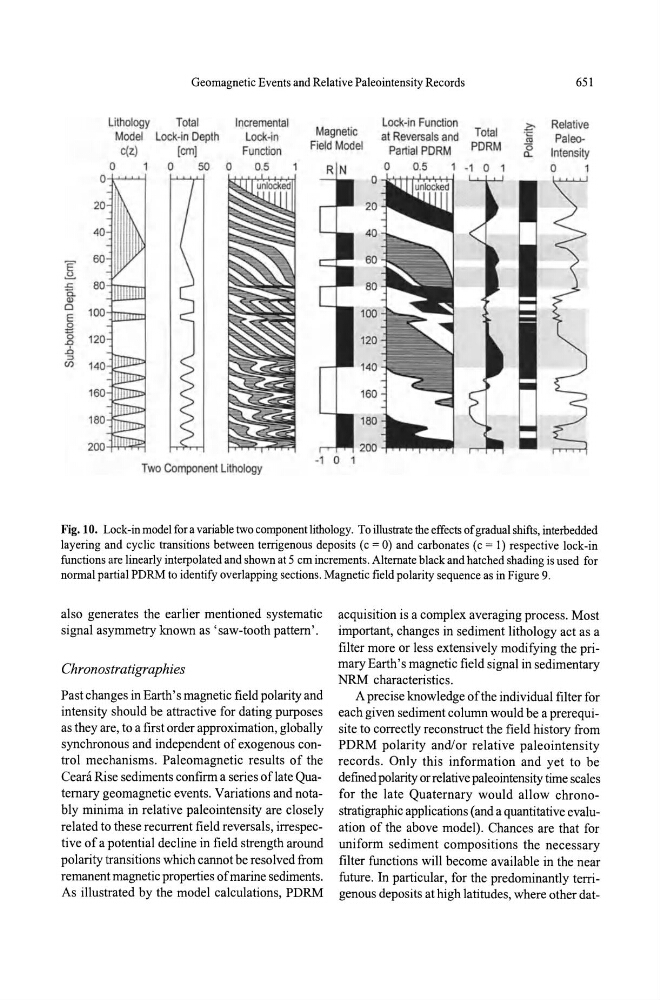
Fig. 10. Lock·in model for a variable two component lithology. To illustrate the effects of gradual shifts, interbedded
layering and cyclic transitions between terrigenous deposits (c = 0) and carbonates (c = I) respective lock·in
functions are linearly interpolated and shown at 5 em increments. Alternate black and hatched shading is used for
normal partial PDRM to identify overlapping sections. Magnetic field polarity sequence as in Figure 9.
also generates the earlier mentioned systematic
signal asymmetry known as 'saw-tooth pattern'.
Chronostratigraphies
Past changes in Earth's magnetic field polarity and
intensity should be attractive for dating purposes
as they are, to a first order approximation, globally
synchronous and independent of exogenous control mechanisms. Paleomagnetic results of the
Ceara Rise sediments confirm a series of late Quaternary geomagnetic events. Variations and nota·
bly minima in relative paleointensity are closely
related to these recurrent field reversals, irrespective of a potential decline in field strength around
polarity transitions which cannot be resolved from
remanent magnetic properties of marine sediments.
As illustrated by the model calculations, PDRM
acquisition is a complex averaging process. Most
important, changes in sediment lithology act as a
filter more or less extensively modifying the primary Earth's magnetic field signal in sedimentary
NRM characteristics.
A precise knowledge ofthe individual filter for
each given sediment column would be a prerequisite to correctly reconstruct the field history from
PDRM polarity and/or relative paleointensity
records. Only this information and yet to be
defined polarity or relative paleointensity time scales
for the late Quaternary would allow chronostratigraphic applications (and a quantitative evaluation of the above model). Chances are that for
uniform sediment compositions the necessary
filter functions will become available in the near
future. In particular, for the predominantly terrigenous deposits at high latitudes, where other dat-