

Geomagnetic Events and Relative Paleointensity Records
649
Magnetic
Field
«i
cO> '"
E .c:
0> ::J
_III
u
Propagation of Lock-in,
Locked Polarity and
Incremental PDRM
Total PDRM
Relative
PaleoIntensity
o
1
,5
cO>
C)
E
~
1:J ::J
en
-1 0 1
E
o
0.5
-1
0
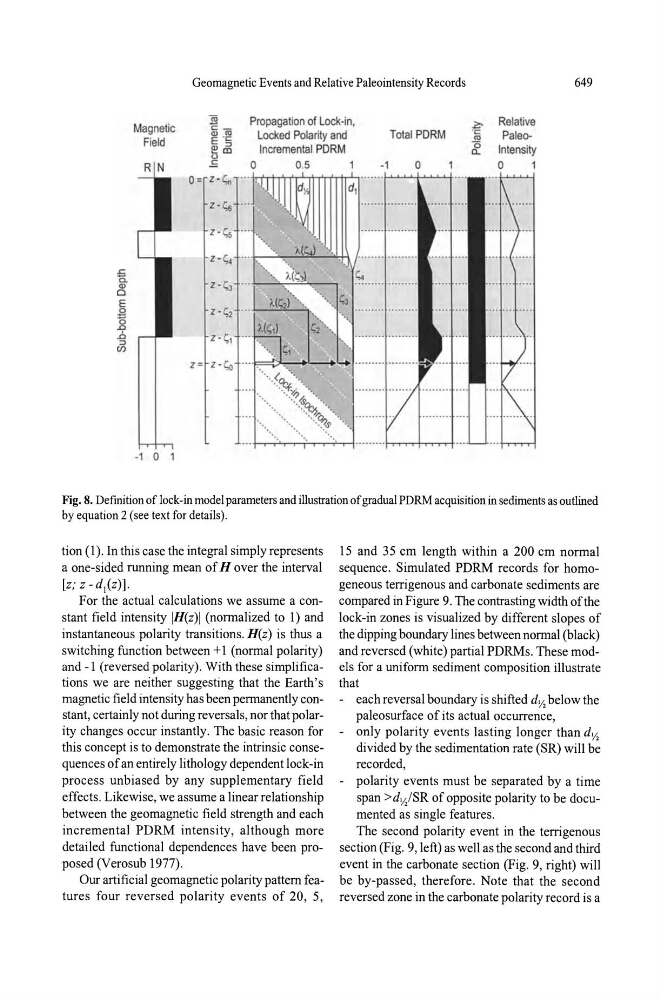
Fig. 8. Defmition of lock-in model parameters and illustration of gradual PDRM acquisition in sediments as outlined
by equation 2 (see text for details).
tion (I). In this case the integral simply represents
a one-sided running mean of H over the interval
[z; z - dt(z)].
For the actual calculations we assume a constant field intensity IH(z) I (normalized to I) and
instantaneous polarity transitions. H(z) is thus a
switching function between + I (normal polarity)
and -1 (reversed polarity). With these simplifications we are neither suggesting that the Earth's
magnetic field intensity has been permanently constant, certainly not during reversals, nor that polarity changes occur instantly. The basic reason for
this concept is to demonstrate the intrinsic consequences of an entirely lithology dependent lock-in
process unbiased by any supplementary field
effects. Likewise, we assume a linear relationship
between the geomagnetic field strength and each
incremental PDRM intensity, although more
detailed functional dependences have been proposed (Verosub 1977).
Our artificial geomagnetic polarity pattern features four reversed polarity events of 20, 5,
IS and 35 cm length within a 200 cm normal
sequence. Simulated PDRM records for homogeneous terrigenous and carbonate sediments are
compared in Figure 9. The contrasting width of the
lock-in zones is visualized by different slopes of
the dipping boundary lines between normal (black)
and reversed (white) partial PDRMs. These models for a uniform sediment composition illustrate
that
- each reversal boundary is shifted d,/, below the
paleosurface of its actual occurrence,
- only polarity events lasting longer than dy,
divided by the sedimentation rate (SR) will be
recorded,
- polarity events must be separated by a time
span >dy,/SR of opposite polarity to be documented as single features.
The second polarity event in the terrigenous
section (Fig. 9, left) as well as the second and third
event in the carbonate section (Fig. 9, right) will
be by-passed, therefore . Note that the second
reversed zone in the carbonate polarity record is a