

644
Bleil and von Dobeneck
'" '"
,en
'"
c::u
>.: . ~ C
'"
'"
"'~
-
0
"'c::
c::
~'"
Ii:
'"
'"
c::
.~
. ~
0
o~
'"
:::;
ZeJ
I I i 1 111, 1 i
In
.:<:0-0
85 ~ 1001-->->
.... Q)
roer
(5 ~ 50 -0.2...
o
>:l
-0 . '"
Q)
~ . £ ~
~O(/)
1 ~
oQ)
zm
0.
0
II)
' :1
::I
.~g
'-0. 50
Q; E
1-0
~U 25 1 2
0
3
4
5
6
.......... t:
8
10 11 0
i i i
i
i
i
, i
I ' j , i i
j
i I , , • I '
' I j i •
0
50
100
150
200
Age [ka)
250
300
350
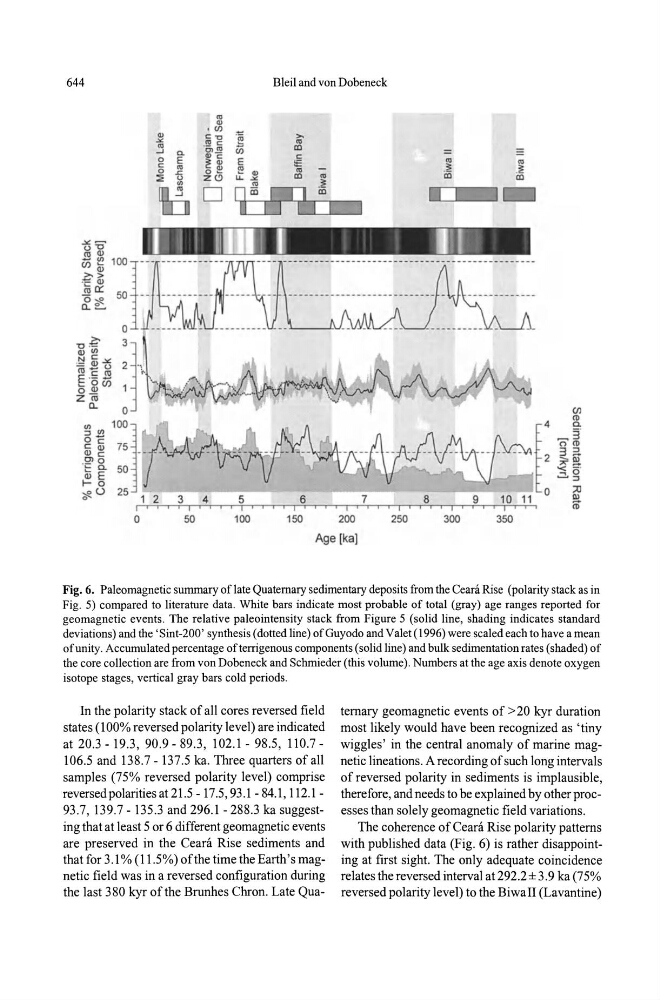
Fig. 6. Paleomagnetic summary of late Quaternary sedimentary deposits from the Ceara Rise (polarity stack as in
Fig. 5) compared to literature data. White bars indicate most probable of total (gray) age ranges reported for
geomagnetic events. The relative paleointensity stack from Figure 5 (solid line, shading indicates standard
deviations) and the 'Sint-200' synthesis (dotted line) of Guyodo and Valet (1996) were scaled each to have a mean
of unity. Accumulated percentage of terrigenous components (solid line) and bulk sedimentation rates (shaded) of
the core collection are from von Dobeneck and Schmieder (this volume). Numbers at the age axis denote oxygen
isotope stages, vertical gray bars cold periods.
In the polarity stack of all cores reversed field
states (100% reversed polarity level) are indicated
at 20.3 - 19.3, 90.9 - 89.3, 102.1 - 98 .5, 110.7106.5 and 138.7 - 137.5 ka. Three quarters of all
samples (75% reversed polarity level) comprise
reversed polarities at 21.5 - 17.5,93.1 - 84.1,112.1 -
93 .7, 139.7 - 135.3 and 296.1 -288.3 ka suggesting that at least 5 or 6 different geomagnetic events
are preserved in the Ceara Rise sediments and
that for 3.1 % (11.5%) ofthe time the Earth's magnetic field was in a reversed configuration during
the last 380 kyr of the Brunhes Chron. Late Quaternary geomagnetic events of >20 kyr duration
most likely would have been recognized as 'tiny
wiggles' in the central anomaly of marine magnetic lineations. A recording of such long intervals
of reversed polarity in sediments is implausible,
therefore, and needs to be explained by other processes than solely geomagnetic field variations.
The coherence of Ceara Rise polarity patterns
with published data (Fig. 6) is rather disappointing at first sight. The only adequate coincidence
relates the reversed interval at 292.2 ± 3.9 ka (75%
reversed polarity level) to the Biwa II (Lavantine)