

Geomagnetic Events and Relative Paleointensity Records
643
stantiated by a considerably higher relative number
of anomalous ChRM declinations towards the
south. In places, some directional scatter in the
data may also result from undetected minor internal deformations, but none of the sedimentary
sequences was obviously affected by any major
gradual or abrupt rotations during the coring process (Figs. 3 to 5).
Geomagnetic Events
With the high-resolution age control available for
the Ceara Rise sediments (von Dobeneck and
Schmieder this volume), paleomagnetic data sets
of cores GeoB 1515-1,1516-2,1517-1,1519-1,
1520-2, 1522-2 and 1523-1 were converted into
time series spanning the last approximately 380 kyr.
To around 200 ka a detailed time resolution of about
2 kyr or better is attained. Due to the constant sample spacing and decreasing apparent sedimentation rates (Fig. 6), which are entirely attributed to
a coring compression of the lowermost about 1 to
1.5 m of sediments, the time resolution successively
drops to about 5 kyr and less in the older parts.
For core GeoB 1518-2, recovered from greatest
water depth of all sites at the margin to the Para
Abyssal Plain (Fig. 1), no acceptable age model
could be established as a number of turbiditic layers disrupt the hemipelagic deposits. The average
sedimentation rate in core GeoB 1521-2 amounts
to only about half of that found at the other sites
(von Dobeneck and Schmieder this volume).
Because ofthis limited stratigraphic resolution, but
possibly also due to distinctly different remanence
acquisition and preservation processes related to
a local regime of reduced sedimentation, fewer and
less clearly developed polarity events could be
resolved. No data are given for the top segment of
core GeoB 1520-2 as its paleomagnetic record was
largely disturbed by the coring process.
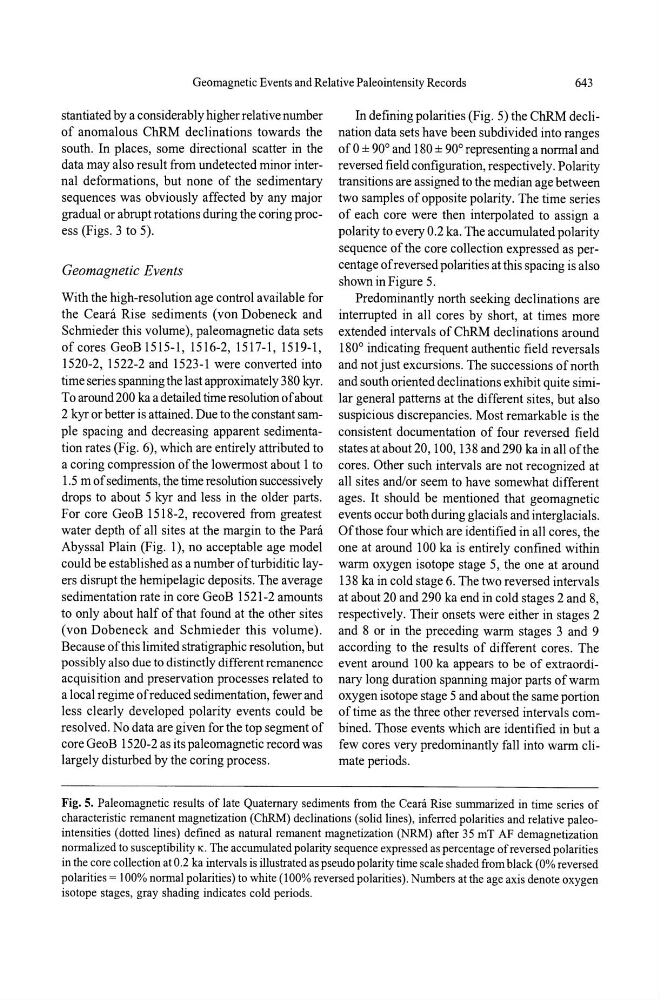
In defining polarities (Fig. 5) the ChRM declination data sets have been subdivided into ranges
of 0 ± 90° and 180 ± 90° representing a normal and
reversed field configuration, respectively. Polarity
transitions are assigned to the median age between
two samples of opposite polarity. The time series
of each core were then interpolated to assign a
polarity to every 0.2 ka. The accumulated polarity
sequence of the core collection expressed as percentage of reversed polarities at this spacing is also
shown in Figure 5.
Predominantly north seeking declinations are
interrupted in all cores by short, at times more
extended intervals of ChRM declinations around
180° indicating frequent authentic field reversals
and not just excursions. The successions of north
and south oriented declinations exhibit quite similar general patterns at the different sites, but also
suspicious discrepancies. Most remarkable is the
consistent documentation of four reversed field
states at about 20,100,138 and 290 ka in all of the
cores. Other such intervals are not recognized at
all sites and/or seem to have somewhat different
ages. It should be mentioned that geomagnetic
events occur both during glacials and interglacials.
Of those four which are identified in all cores, the
one at around 100 ka is entirely confined within
warm oxygen isotope stage 5, the one at around
138 ka in cold stage 6. The two reversed intervals
at about 20 and 290 ka end in cold stages 2 and 8,
respectively. Their onsets were either in stages 2
and 8 or in the preceding warm stages 3 and 9
according to the results of different cores. The
event around 100 ka appears to be of extraordinary long duration spanning major parts of warm
oxygen isotope stage 5 and about the same portion
of time as the three other reversed intervals combined. Those events which are identified in but a
few cores very predominantly fall into warm climate periods.
Fig. 5. Paleomagnetic results of late Quaternary sediments from the Ceara Rise summarized in time series of
characteristic remanent magnetization (ChRM) declinations (solid lines), inferred polarities and relative paleointensities (dotted lines) defined as natural remanent magnetization (NRM) after 35 mT AF demagnetization
normalized to susceptibility K. The accumulated polarity sequence expressed as percentage of reversed polarities
in the core collection at 0.2 ka intervals is illustrated as pseudo polarity time scale shaded from black (0% reversed
polarities = 100% normal polarities) to white (100% reversed polarities). Numbers at the age axis denote oxygen
isotope stages, gray shading indicates cold periods.