

Using Rock Magnetic Proxy Records for Orbital Tuning and Extended Time Series Analyses
613
error source is age-depth-nonlinearity (Schiffelbein
and Dorman 1986). The applied (linear) age interpolation does not consider fluctuations of the sedimentation rate between tie points. The relative age
discrepancies between CEARIS cores due to this
effect should on average be less than 1 kyr, as the
matched signal features are densely spaced and
their high resemblance implies regionally uniform
sedimentation conditions. A quasi-continuous pattern correlation (Martinson et al. 1982) may further reduce this margin. The synchronism with the
external forcing signal is potentially more affected
by interpolation errors. Its precision can be roughly
estimated from cross spectral analyses and is in the
order of 2 kyr. The absolute error margins of orbital tuning are even larger, but difficult to quantify. They result from uncertain and unstable phase
relations (Martinson et al. 1987), vertical mixing by
o I . :.,' . '1 ' , ... ' .. ~.' , 'i'··:.' ' "':',: , ' . /\1 t:.~j" , .:.:(' (.:·i ' ' :: . . ~ , ' .: .. :. [' , ' :: .. : \' '~ I :' " , , '.~.: ' ' . . . . . . : '1 .
. ' .1' . ,
70 .. ~ ..................... ...j..... . .. "" i···· J \..... ........ . .. j I........ ; .
.... ; ....... "1"" .. j..... ....:' ,.... · .... ·-1 Jl
~
1
I
I
I
1
I
I I
o
20 40 60 80 100 120 140 160 180 200 220 240 260 280 300 320 340 360 360
Age [ka)
"[
1~
[
.40~ , -350 ·300 · 250 -200 ·150 ·100 -50
0
50
100 150 200 250 300 350 400
;. !;:.
;.
\
Signal Lag [kyr)
Lag
;:J~
~
~y~
~ ~
i
e!
0.
&180
10
.. .f\
~_"'{"
I
5.67kyr 4---J..oJ.....J.......Lo...Lo.J..oJ.....J.......Lo+J..o..,JL.....L....L..u.....,r'-'-l.L..L...J..+
o
\·.fI1I~
..................
.........
0.03 0.035
·10 ·6 ·6 -4 -2
0
2
4
6
6 10
Signal Lag [kyr)
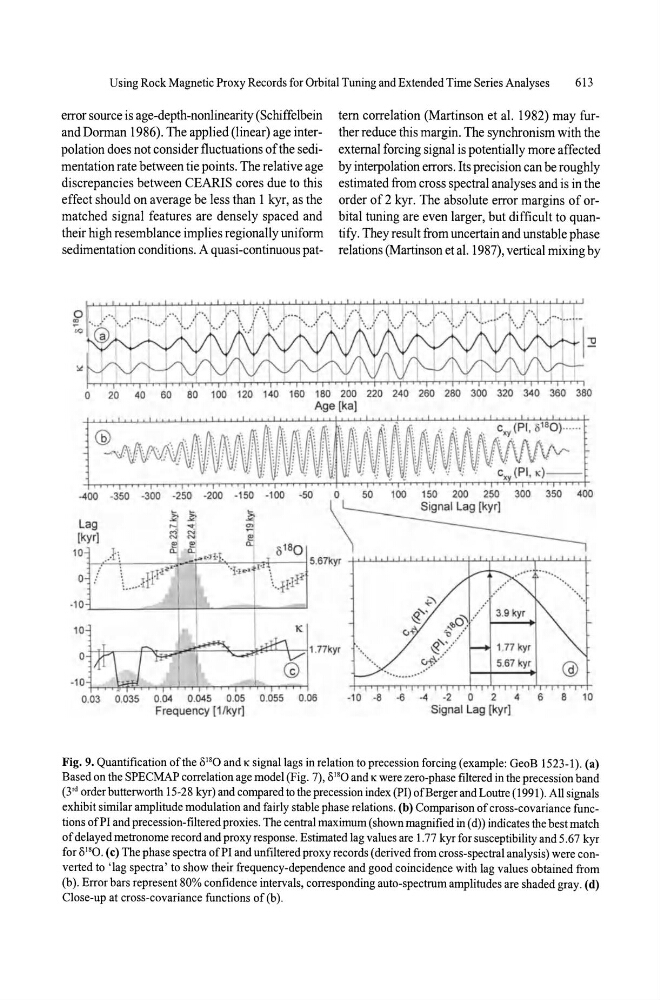
Fig. 9. Quantification of the 8" 0 and K signal lags in relation to precession forcing (example: GeoB 1523-1). (a)
Based on the SPECMAP correlation age model (Fig. 7), 8"0 and K were zero-phase filtered in the precession band
(3 ,d order butterworth 15-28 kyr) and compared to the precession index (PI) of Berger and Loutre (1991). All signals
exhibit similar amplitude modulation and fairly stable phase relations. (b) Comparison of cross-covariance functions ofP! and precession-filtered proxies. The central maximum (shown magnified in (d» indicates the best match
of delayed metronome record and proxy response. Estimated lag values are 1.77 kyr for susceptibility and 5.67 kyr
for 8"0. ( c) The phase spectra of PI and unfiltered proxy records (derived from cross-spectral analysis) were converted to ' lag spectra' to show their frequency-dependence and good coincidence with lag values obtained from
(b). Error bars represent 80% confidence intervals, corresponding auto-spectrum amplitudes are shaded gray. (d)
Close-up at cross-covariance functions of (b).