

592
Frederichs et al.
~ j
]
0.6
j
~ 0.4
)t.~ 0.2
~
o
co
o
2
o
-2
3 4
5
@
©
6
7
8
9 10
11
i
c:
i .Q Cl
c: Ql
'- a:
.!2 c: Ql
. ~ .~ ~
_o:J
'" ~ 0
...J ill(/)
~
~Ql
~ E
0:J
t o
~>
QlQl
10
0~
~
()
ill
0(/)
-"'r'l C\I -N M"" II') (\I,...,...
In CD _ N ("') ~ II') NM -.:r U') <.0.- C\I M t\!
'jij..!:!
<'1",E
...: NM
co? -.;f uju; triU"i ui u:) tOO
to to ,..: ,..: ,..: ,..:.....: cOo:) o:i cDcOo;cioi~
:: :: (/)
I i .
,
i
"
i
i i
• I ' • I I I •• i l l ' i
I
I i , i • I
o
50
100
150
200
250
300
350
400
Age [kaj and S 1a O Stages
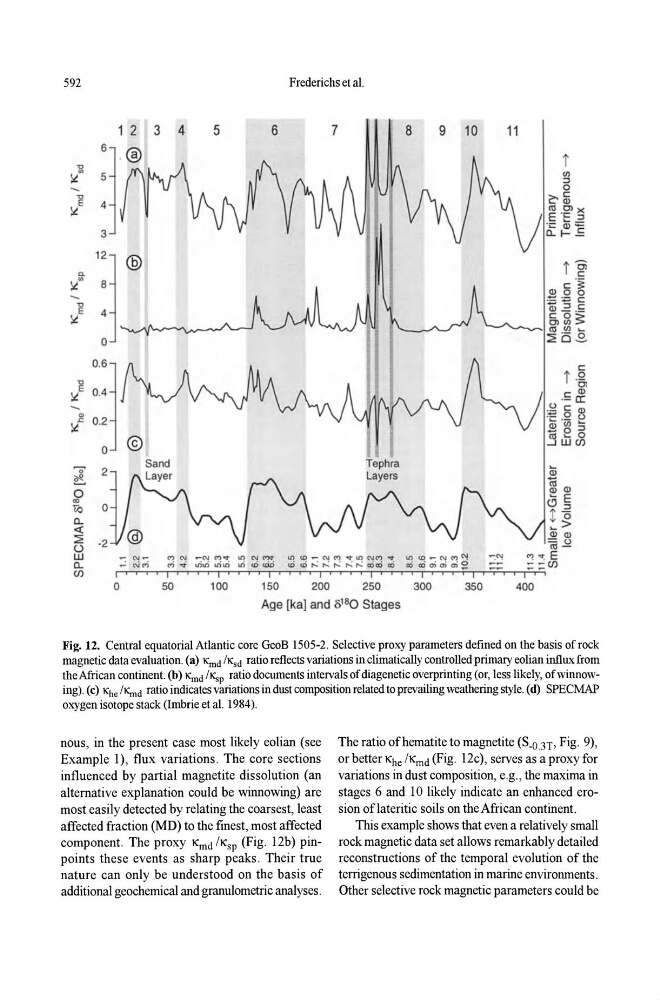
Fig. 12. Central equatorial Atlantic core GeoB 1505-2. Selective proxy parameters defined on the basis of rock
magnetic data evaluation. (a) Kmd he,d ratio reflects variations in climatically controlled primary eolian influx from
the African continent. (b) Kmd IKs p ratio documents intervals of diagenetic overprinting (or, less likely, of winnowing). (c) Khe IKmd ratio indicates variations in dust compositionrelated to prevailing weathering style. (d) SPECMAP
oxygen isotope stack (Imbrie et al. 1984).
nous, in the present case most likely eolian (see
Example I), flux variations. The core sections
influenced by partial magnetite dissolution (an
alternative explanation could be winnowing) are
most easily detected by relating the coarsest, least
affected fraction (MD) to the finest, most affected
component. The proxy Kmd 1Ksp (Fig. 12b) pinpoints these events as sharp peaks. Their true
nature can only be understood on the basis of
additional geochemical and granulometric analyses.
The ratio of hematite to magnetite (S-03T' Fig. 9),
or better Khe 1Kmd (Fig. 12c), serves as a proxy for
variations in dust composition, e.g. , the maxima in
stages 6 and 10 likely indicate an enhanced erosion oflateritic soils on the African continent.
This example shows that even a relatively small
rock magnetic data set allows remarkably detailed
reconstructions of the temporal evolution of the
terrigenous sedimentation in marine environments.
Other selective rock magnetic parameters could be