

The Magnetic View on the Marine Paleoenvironment
1 2 3
4 5
6
7
8
9 10
0.02l
~- 0.04
;:. 0.06
0.08
J
2
0
IX)
0
'i¢
a...
~
::',!
-2
0
w
a...
(/)
I
0
~
(\I~
...:. NM
i i i
~!i :ri~ ~~ :A ~ ~ ~:;: ~ ~ ~ ~ ~~ ~ ~ ~ ; ~ ~ g
I I I I i I I I I I I ' i i i Iii i i i I i ' I I I I I I I
50
100
150
200
250
300
350
Age [kaJ and OlBO Stages
11
i i
Qj
iii
587
Q)Q)
~ E
(!)::I
t o
~>
Q)Q)
= 0
M -.;f" co.. E
:: :: (/)
I I I
400
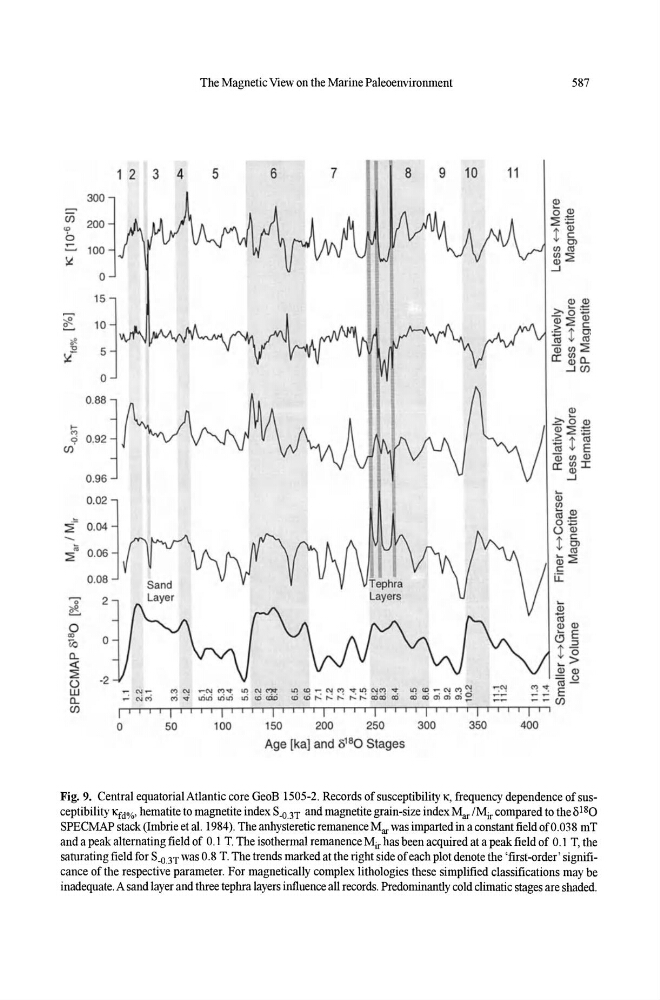
Fig. 9. Central equatorial Atlantic core GeoB 1505-2. Records of susceptibility K, frequency dependence of susceptibility Kfd%' hematite to magnetite index S-O.3T and magnetite grain-size index M.r /~r compared to the 8 18 0
SPECMAP stack (Imbrie et aI. 1984). The anhysteretic remanence Mar was imparted in a constant field of 0.038 mT
and a peak alternating field of 0.1 T. The isothermal remanence M ir has been acquired at a peak field of 0.1 T, the
saturating field for S-03T was 0.8 T. The trends marked at the right side of each plot denote the 'first-order' significance of the respective parameter. For magnetically complex lithologies these simplified classifications may be
inadequate. A sand layer and three tephra layers influence all records. Predominantly cold climatic stages are shaded.