

The Magnetic View on the Marine Paleoenvironment
583
10· N
O·
South America
Do ,
10· S
50· W
40·
30·
20·
10·
O·
10· E
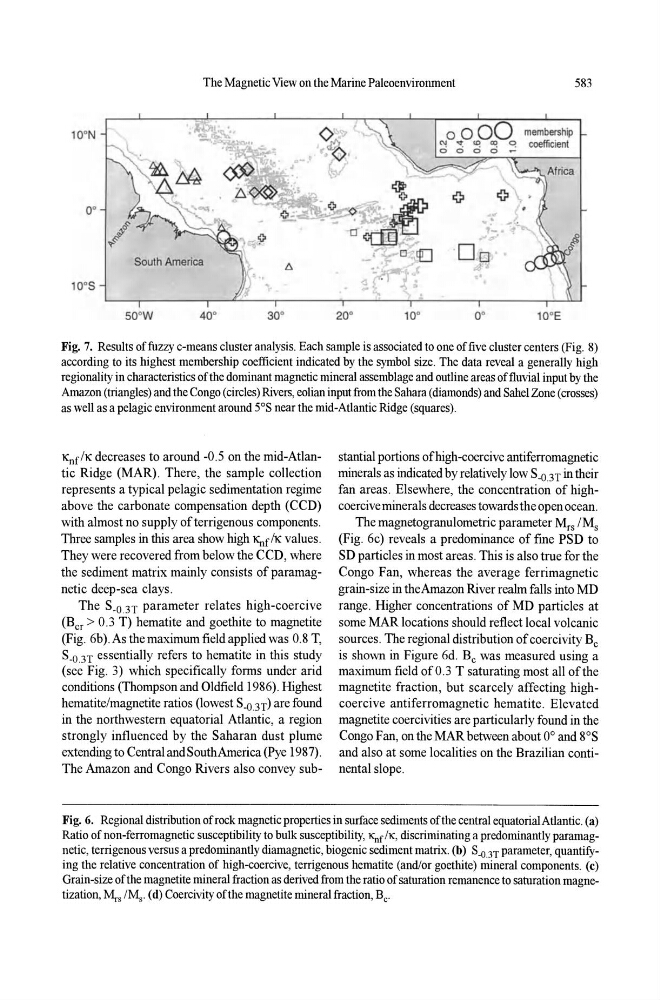
Fig. 7. Results offuzzy c-means cluster analysis. Each sample is associated to one of five cluster centers (Fig. 8)
according to its highest membership coefficient indicated by the symbol size. The data reveal a generally high
regionality in characteristics of the dominant magnetic mineral assemblage and outline areas of fluvial input by the
Amazon (triangles) and the Congo ( circles) Rivers, eolian input from the Sahara ( diamonds) and Sahel Zone (crosses)
as well as a pelagic environment around 5 0 S near the mid-Atlantic Ridge (squares).
Knf/K decreases to around -0.5 on the mid-Atlantic Ridge (MAR). There, the sample collection
represents a typical pelagic sedimentation regime
above the carbonate compensation depth (CCD)
with almost no supply ofterrigenous components.
Three samples in this area show high Knf /K values.
They were recovered from below the CCD, where
the sediment matrix mainly consists of paramagnetic deep-sea clays.
The S-03T parameter relates high-coercive
(B er > OJ T) hematite and goethite to magnetite
(Fig. 6b). As the maximum field applied was 0.8 T,
S-0.3T essentially refers to hematite in this study
(see Fig. 3) which specifically forms under arid
conditions (Thompson and Oldfield 1986) Highest
hematite/magnetite ratios (lowest S-03T) are found
in the northwestern equatorial Atlantic, a region
strongly influenced by the Saharan dust plume
extending to Central and SouthAmerica (Pye 1987).
The Amazon and Congo Rivers also convey substantial portions of high-coercive antiferromagnetic
minerals as indicated by relatively low S-03T in their
fan areas. Elsewhere, the concentration of highcoercive minerals decreases towards the open ocean.
The magnetogranulometric parameter Mrs /Ms
(Fig. 6c) reveals a predominance of fine PSD to
SD particles in most areas. This is also true for the
Congo Fan, whereas the average ferrimagnetic
grain-size in the Amazon River realm falls into MD
range . Higher concentrations of MD particles at
some MAR locations should reflect local volcanic
sources. The regional distribution of coercivity Be
is shown in Figure 6d. Be was measured using a
maximum field of 0.3 T saturating most all of the
magnetite fraction, but scarcely affecting highcoercive anti ferromagnetic hematite. Elevated
magnetite coercivities are particularly found in the
Congo Fan, on the MAR between about 0° and 8 0 S
and also at some localities on the Brazilian continental slope.
Fig. 6. Regional distribution ofrock magnetic properties in surface sediments of the central equatorial Atlantic. (a)
Ratio of non-ferromagnetic susceptibility to bulk susceptibility, xnr /K, discriminating a predominantly paramagnetic, terrigenous versus a predominantly diamagnetic, biogenic sediment matrix. (b) S-O.3T parameter, quantifying the relative concentration of high-coercive, terrigenous hematite (andlor goethite) mineral components. (c)
Grain-size of the magnetite mineral fraction as derived from the ratio of saturation remanence to saturation magnetization, ~s I M s ' (d) Coercivity ofthe magnetite mineral fraction, Be.