

The Magnetic View on the Marine Paleoenvironment
579
1.0
0.5
0.8
il __ 0.6
.; __ 0.0 +--'---'---'--L-....L..---'-lf-L----L-.J/-_t_
:::! -
::20.4
M-o.3T
-0.5
0.2
o. 0 ~_r_T"_r_r.,....,...rrrr_rr-1C"f""'"T"T-rr-r-r.,....,...t_
-1.0 ~--:":'-r:- -..:.;--::r-.:..:- -:.:;.--:..:-.:..:- -;..:;.-.:..:- -~--;';;;-"=1- -=-.--.---+--+
o
500
1000 1500 2000 2500
-1000
-500
Ber 0
(a)
Field [mT]
(b)
Back Field [mT]
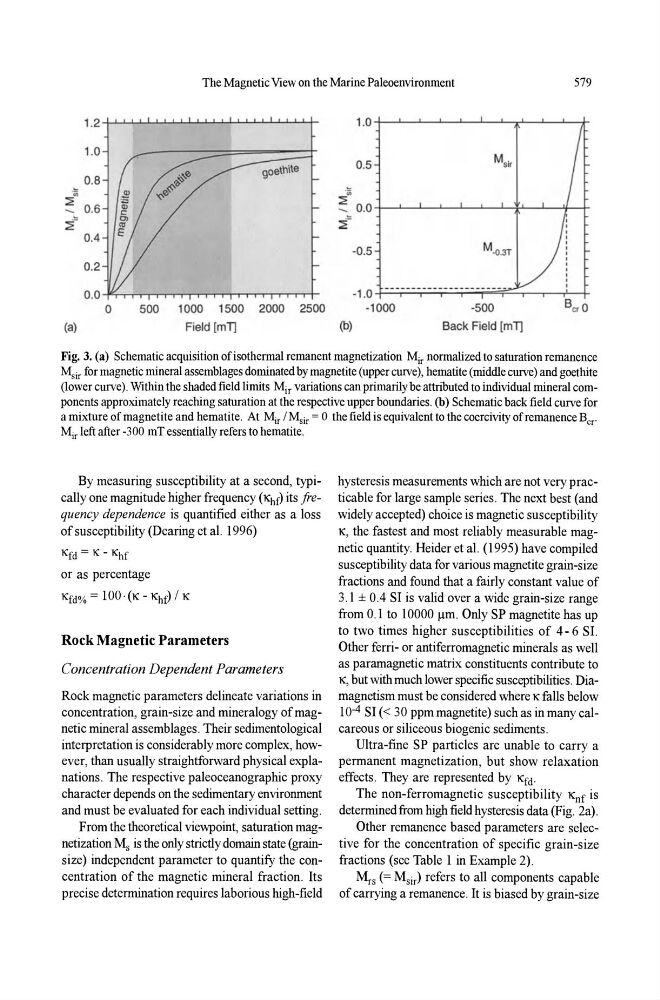
Fig. 3. (a) Schematic acquisition of isothermal remanent magnetization Mir normalized to saturation remanence
Msir for magnetic mineral assemblages dominated by magnetite (upper curve), hematite (middle curve) and goethite
(lower curve). Within the shaded field limits Mir variations can primarily be attributed to individual mineral components approximately reaching saturation at the respective upper boundaries. (b) Schematic back field curve for
a mixture of magnetite and hematite. At ~r / M sir = 0 the field is equivalent to the coercivity of remanence B er .
M ir left after -300 mT essentially refers to hematite.
By measuring susceptibility at a second, typically one magnitude higher frequency (Khf) its frequency dependence is quantified either as a loss
of susceptibility (Dearing et a1. 1996)
Kfd = K - Khf
or as percentage
Kfd% = IOO ' (K - Khf) / K
Rock Magnetic Parameters
Concentration Dependent Parameters
Rock magnetic parameters delineate variations in
concentration, grain-size and mineralogy of magnetic mineral assemblages. Their sedimentological
interpretation is considerably more complex, however, than usually straightforward physical explanations. The respective paleoceanographic proxy
character depends on the sedimentary environment
and must be evaluated for each individual setting.
From the theoretical viewpoint, saturation magnetization Ms is the only strictly domain state (grainsize) independent parameter to quantify the concentration of the magnetic mineral fraction. Its
precise determination requires laborious high-field
hysteresis measurements which are not very practicable for large sample series. The next best (and
widely accepted) choice is magnetic susceptibility
K, the fastest and most reliably measurable magnetic quantity. Heider et a1. (1995) have compiled
susceptibility data for various magnetite grain-size
fractions and found that a fairly constant value of
3.1 ± 0.4 SI is valid over a wide grain-size range
from 0.1 to 10000 J.lm. Only SP magnetite has up
to two times higher susceptibilities of 4- 6 SI.
Other ferri- or antiferromagnetic minerals as well
as paramagnetic matrix constituents contribute to
K, but with much lower specific susceptibilities. Diamagnetism must be considered where K falls below
10- 4 SI « 30 ppm magnetite) such as in many calcareous or siliceous biogenic sediments.
Ultra-fine SP particles are unable to carry a
permanent magnetization, but show relaxation
effects. They are represented by Kfd'
The non-ferromagnetic susceptibility Knf is
determined from high field hysteresis data (Fig. 2a).
Other remanence based parameters are selective for the concentration of specific grain-size
fractions (see Table 1 in Example 2).
Mrs (= Msir) refers to all components capable
of carrying a remanence. It is biased by grain-size