

578
F rederichs et al.
0
" i
c:
.2
~
Qi
E
c:
e!
0>
., .,
E .e"E
..
~
'0
Field
Field
(a)
(b)
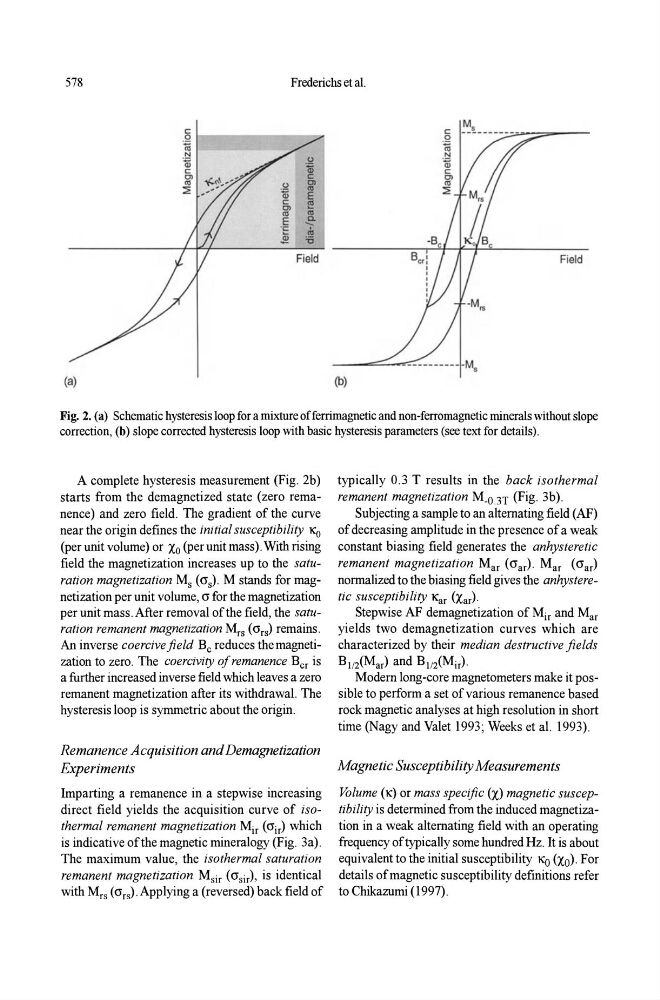
Fig. 2. (a) Schematic hysteresis loop for a mixture offerrimagnetic and non-ferromagnetic minerals without slope
correction, (b) slope corrected hysteresis loop with basic hysteresis parameters (see text for details).
A complete hysteresis measurement (Fig. 2b)
starts from the demagnetized state (zero remanence) and zero field . The gradient of the curve
near the origin defines the initial susceptibility KD
(per unit volume) or Xo (per unit mass). With rising
field the magnetization increases up to the saturation magnetization Ms (cr s ). M stands for magnetization per unit volume, cr for the magnetization
per unit mass. After removal of the field, the saturation remanent magnetization Mrs (cr rs ) remains .
An inverse coercive field Be reduces themagnetization to zero. The coercivity of remanence Ber is
a further increased inverse field which leaves a zero
remanent magnetization after its withdrawal. The
hysteresis loop is symmetric about the origin.
Remanence Acquisition and Demagnetization
Experiments
Imparting a remanence in a stepwise increasing
direct field yields the acquisition curve of isothermal remanent magnetization Mir (crir) which
is indicative of the magnetic mineralogy (Fig. 3a).
The maximum value, the isothermal saturation
remanent magnetization Msir (crsir)' is identical
with Mrs (cr rs ). Applying a (reversed) back field of
typically 0.3 T results in the back isothermal
remanent magnetization M.03T (Fig. 3b).
Subjecting a sample to an alternating field (AF)
of decreasing amplitude in the presence of a weak
constant biasing field generates the anhysteretic
remanent magnetization Mar (cr ar )· Mar (cr ar )
normalized to the biasing field gives the anhysteretic susceptibility Kar (Xar) .
Stepwise AF demagnetization of Mir and Mar
yields two demagnetization curves which are
characterized by their median destructive fields
BI/2(Mar) and B1/2(Mir).
Modem long-core magnetometers make it possible to perform a set of various remanence based
rock magnetic analyses at high resolution in short
time (Nagy and Valet 1993; Weeks et al. 1993).
Magnetic Susceptibility Measurements
Volume (K) or mass specific (X) magnetic susceptibility is determined from the induced magnetization in a weak alternating field with an operating
frequency of typically some hundred Hz. It is about
equivalent to the initial susceptibility Ko (Xo). For
details ofmagnetic susceptibility definitions refer
to Chikazumi (1997).