

568
Wagner and Dupont
20% of the total OM. This record to some extent
parallels the phytolith record, thus being supported
by an independant parameter. We want to point out
that this interpretation should be regarded as a
working hypothesis since C4-grass material has not
been unambiguously proven yet. Nevertheless,
optical and isotopic studies performed on grain size
fractions of glacial and interglacial deposits from
ODP Site 959 indicate that in the grain size fraction 20-63 /lm plant debris is isotopically heavy and
thermally mature. Both aspects are characteristic
for oxidized material from C4-plants. (Wagner
1999).
Central Equatorial Atlantic
Core 776
380
390
400
410
420
'i' 430
e
450
460
470
480
490
AR Pollen, Spores
-2 -I
(#*cm *yr )
0
2
3
10
12
Total Pollen
Grass Pollen
('Yo)
('Yo)
0 20 40 60 80 0
5
10
15
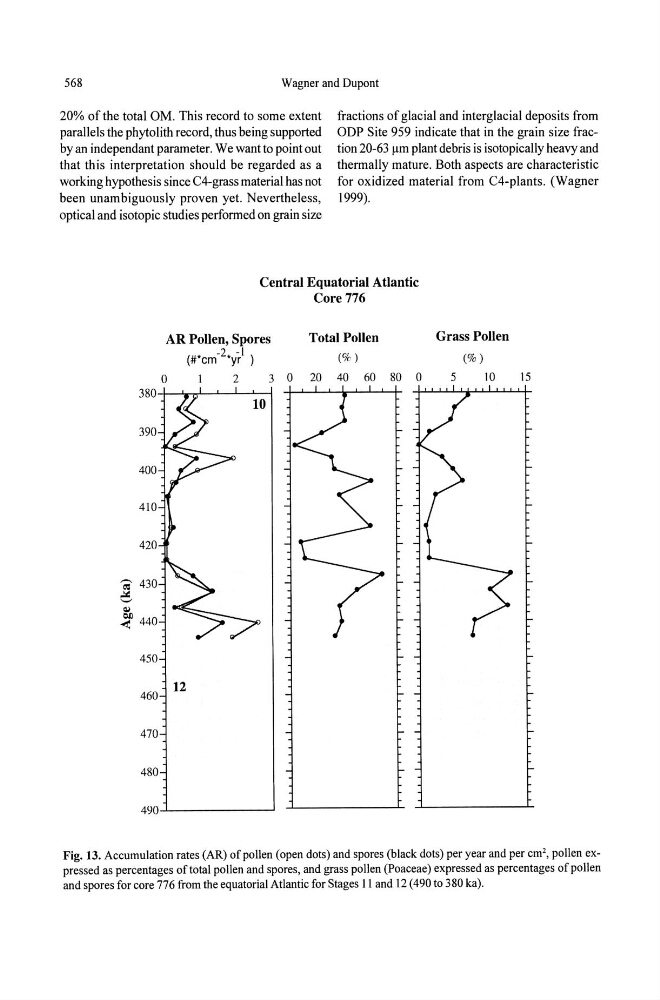
Fig. 13. Accumulation rates (AR) of pollen (open dots) and spores (black dots) per year and per em', pollen expressed as percentages of total pollen and spores, and grass pollen (Poaceae) expressed as percentages of pollen
and spores for core 776 from the equatorial Atlantic for Stages 11 and 12 (490 to 380 ka).