

562
Wagner and Dupont
I)}·~ O _ ---=2:.:..1-,....,.,,;.2;:.,0 ,......----!t--_....! I:. -!. O _---'=----_~
10
Terrigenous org!ln ic
mnttu (%)tSti m:l ltd
from mDcernllln!llysb
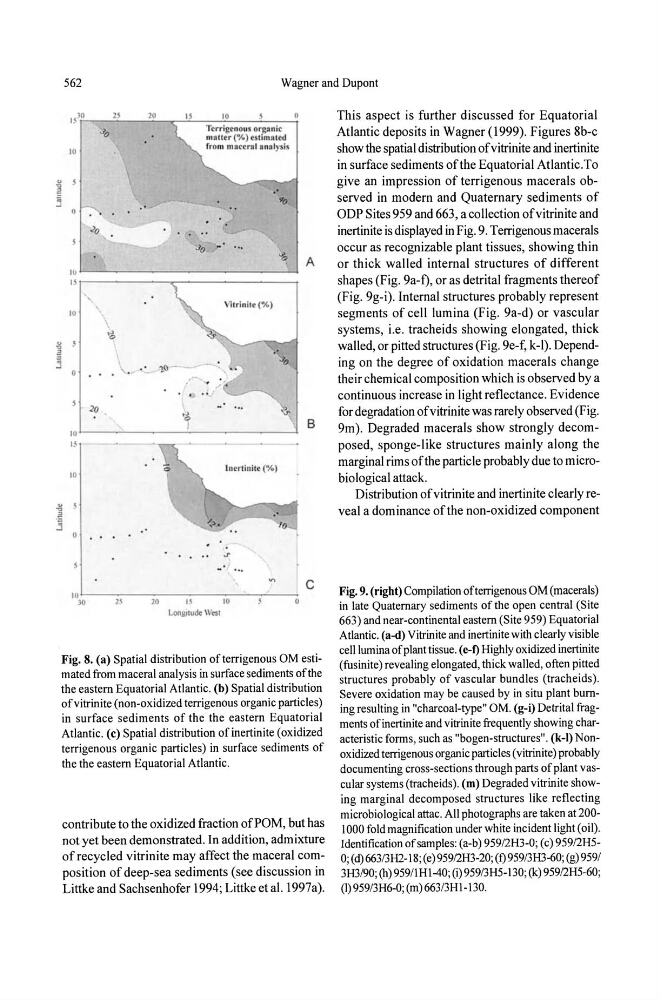
Fig. 8. (a) Spatial distribution of terrigenous OM estimated from maceral analysis in surface sediments oftbe
the eastern Equatorial Atlantic. (b) Spatial distribution
of vitrinite (non-oxidized terrigenous organic particles)
in surface sediments of the the eastern Equatorial
Atlantic. (c) Spatial distribution of inertinite (oxidized
terrigenous organic particles) in surface sediments of
the the eastern Equatorial Atlantic.
contribute to the oxidized fraction ofPOM, but has
not yet been demonstrated. Tn addition, admixture
of recycled vitrinite may affect the maceral composition of deep-sea sediments (see discussion in
Littke and Sachsenhofer 1994; Littke et al. 1997a).
This aspect is further discussed for Equatorial
Atlantic deposits in Wagner (1999). Figures 8b-c
show the spatial distribution of vitrinite and inertinite
in surface sediments ofthe Equatorial Atiantic.To
give an impression of terrigenous macerals observed in modern and Quaternary sediments of
ODP Sites 959 and 663, a collection of vitrinite and
inertinite is displayed in Fig. 9. Terrigenous macerals
occur as recognizable plant tissues, showing thin
or thick walled internal structures of different
shapes (Fig. 9a-f), or as detrital fragments thereof
(Fig. 9g-i). Internal structures probably represent
segments of cell lumina (Fig. 9a-d) or vascular
systems, i.e. tracheids showing elongated, thick
walled, or pitted structures (Fig. ge-f, k-l). Depending on the degree of oxidation macerals change
their chemical composition which is observed by a
continuous increase in light reflectance. Evidence
for degradation of vitrinite was rarely observed (Fig.
9m). Degraded macerals show strongly decomposed, sponge-like structures mainly along the
marginal rims of the particle probably due to microbiological attack.
Distribution of vitrinite and inertinite clearly reveal a dominance ofthe non-oxidized component
Fig. 9. (right) Compilation of terrigenous OM (macerals)
in late Quaternary sediments of the open central (Site
663) and near-continental eastern (Site 959) Equatorial
Atlantic. (a-d) Vitrinite and inertinite witb clearly visible
celliuminaofplanttissue. (e-I) Highly oxidized inertinite
(fusinite) revealing elongated, thick walled, often pitted
structures probably of vascular bundles (tracheids).
Severe oxidation may be caused by in situ plant burning resulting in "charcoal-type" OM. (g-i) Detrital fragments of inertinite and vitrinite frequently showing characteristic forms, such as "bogen-structures". (k-I) Nonoxidized terrigenous organic particles (vitrinite) probably
documenting cross-sections through parts of plant vascular systems (tracheids). (m) Degraded vitrinite showing marginal decomposed structures like reflecting
microbiological attac. All photographs are taken at 2001000 fold magnification under white incident light (oil).
Identification of samples: (a-b) 959I2H3-0; (c) 959/2H50; (d) 663/3H2-18; (e) 959I2H3-20; (f) 959/3H3-60; (g) 9591
3H3/90; (h) 959/1HI-40; (i) 959/3H5-130; (k) 959I2H5-60;
(I) 959/3H6-0; (m) 663/3Hl-130.