

Pollen and Spores in Marine Sediments from the East Atlantic
541
40
35
30
25
20
15
10
o
-~25 -20
-15 -1 0
-10
modern
-15
-20
Mediterranean forest
Saharan-Med.
trans. steppes
Saharan desert
Sahelian savanna
o
5
10
20
40
35
30
25
20
15
10
5
0
-~25
-20
-15
-10
-10
LGM
-1 5
-20
-25 '--~- -~--.....
-5
0
5
10
15
20
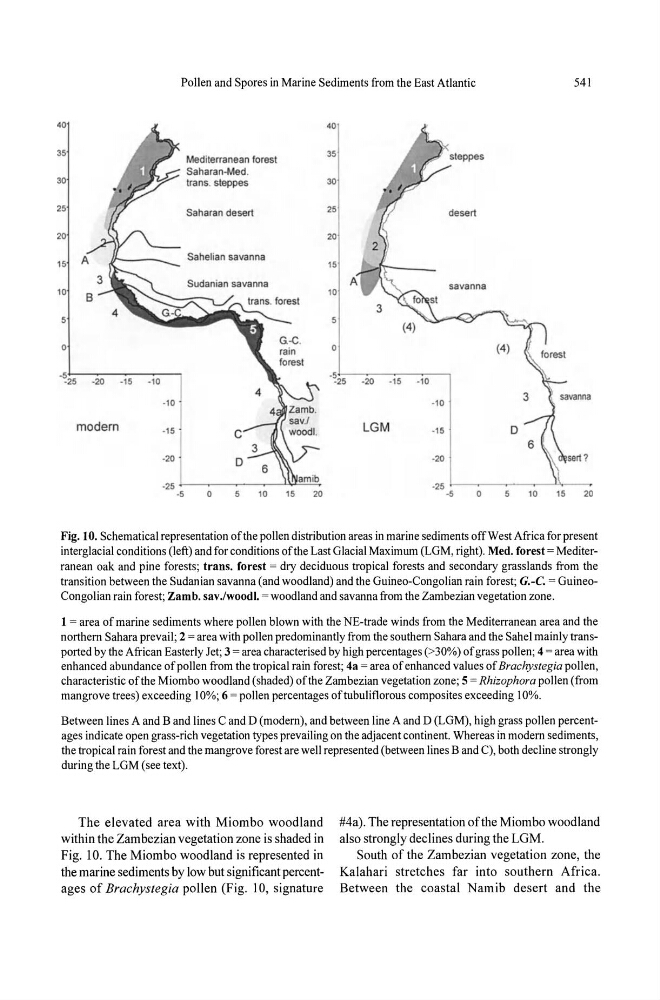
Fig. 10. Schematical representation of the pollen distribution areas in marine sediments off West Africa for present
interglacial conditions (left) and for conditions of the Last Glacial Maximum (LGM, right). Med. forest = Mediterranean oak and pine forests; trans. forest = dry deciduous tropical forests and secondary grasslands from the
transition between the Sudan ian savanna (and woodland) and the Guineo-Congolian rain forest; G.-c. = GuineoCongolian rain forest; Zambo sav.lwoodI. = woodland and savanna from the Zambezian vegetation zone.
I = area of marine sediments where pollen blown with the NE-trade winds from the Mediterranean area and the
northern Sahara prevail; 2 = area with pollen predominantly from the southern Sahara and the Sahel mainly transported by the African Easterly Jet; 3 = area characterised by high percentages (>30%) of grass pollen; 4 = area with
enhanced abundance of pollen from the tropical rain forest; 4a = area of enhanced values of Brachystegia pollen,
characteristic of the Miombo woodland (shaded) of the Zambezian vegetation zone; 5 = Rhizophora pollen (from
mangrove trees) exceeding 10%; 6 = pollen percentages oftubuliflorous composites exceeding 10%.
Between lines A and B and lines C and D (modem), and between line A and D (LGM), high grass pollen percentages indicate open grass-rich vegetation types prevailing on the adjacent continent. Whereas in modem sediments,
the tropical rain forest and the mangrove forest are well represented (between lines B and C), both decline strongly
during the LGM (see text).
The elevated area with Miombo woodland
within the Zambezian vegetation zone is shaded in
Fig. 10. The Miombo woodland is represented in
the marine sediments by low but significant percentages of Brachyslegia pollen (Fig. 10, signature
#4a). The representation of the Miombo woodland
also strongly declines during the LGM.
South of the Zambezian vegetation zone, the
Kalahari stretches far into southern Africa.
Between the coastal Namib desert and the
541
40
35
30
25
20
15
10
o
-~25 -20
-15 -1 0
-10
modern
-15
-20
Mediterranean forest
Saharan-Med.
trans. steppes
Saharan desert
Sahelian savanna
o
5
10
20
40
35
30
25
20
15
10
5
0
-~25
-20
-15
-10
-10
LGM
-1 5
-20
-25 '--~- -~--.....
-5
0
5
10
15
20
Fig. 10. Schematical representation of the pollen distribution areas in marine sediments off West Africa for present
interglacial conditions (left) and for conditions of the Last Glacial Maximum (LGM, right). Med. forest = Mediterranean oak and pine forests; trans. forest = dry deciduous tropical forests and secondary grasslands from the
transition between the Sudan ian savanna (and woodland) and the Guineo-Congolian rain forest; G.-c. = GuineoCongolian rain forest; Zambo sav.lwoodI. = woodland and savanna from the Zambezian vegetation zone.
I = area of marine sediments where pollen blown with the NE-trade winds from the Mediterranean area and the
northern Sahara prevail; 2 = area with pollen predominantly from the southern Sahara and the Sahel mainly transported by the African Easterly Jet; 3 = area characterised by high percentages (>30%) of grass pollen; 4 = area with
enhanced abundance of pollen from the tropical rain forest; 4a = area of enhanced values of Brachystegia pollen,
characteristic of the Miombo woodland (shaded) of the Zambezian vegetation zone; 5 = Rhizophora pollen (from
mangrove trees) exceeding 10%; 6 = pollen percentages oftubuliflorous composites exceeding 10%.
Between lines A and B and lines C and D (modem), and between line A and D (LGM), high grass pollen percentages indicate open grass-rich vegetation types prevailing on the adjacent continent. Whereas in modem sediments,
the tropical rain forest and the mangrove forest are well represented (between lines B and C), both decline strongly
during the LGM (see text).
The elevated area with Miombo woodland
within the Zambezian vegetation zone is shaded in
Fig. 10. The Miombo woodland is represented in
the marine sediments by low but significant percentages of Brachyslegia pollen (Fig. 10, signature
#4a). The representation of the Miombo woodland
also strongly declines during the LGM.
South of the Zambezian vegetation zone, the
Kalahari stretches far into southern Africa.
Between the coastal Namib desert and the