

Pollen and Spores in Marine Sediments from the East Atlantic
537
a
10
I ?
p~nu s
A
1 I
A: European.
20
Mediterranean
30
Ephedra
40
("""hem sector).
Asleraceae
50
I'Z: B I
60
B: (S8mi)desert
70
I C I
00
c: P"""",.e
9J
Cyperaoeae
100
Miombo
110
I '_'~
120
D: tropical for.sl
130
140
E: Afromontane
150
forest
ka
a 20400000 %
o 20 40 00 80 % 0 20 40 60 80 %
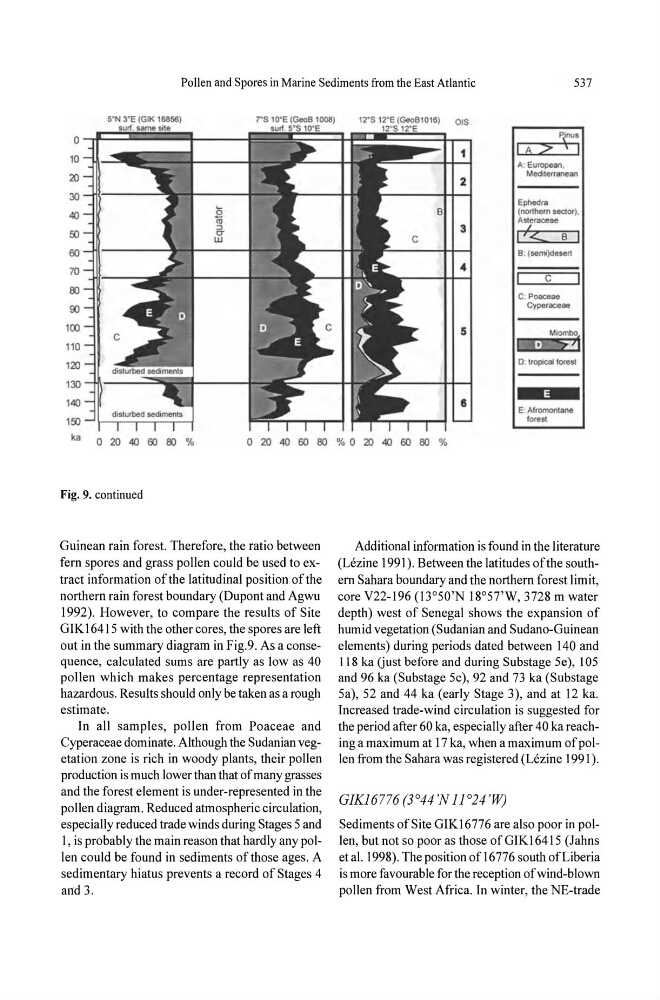
Fig. 9. continued
Guinean rain forest. Therefore, the ratio between
fern spores and grass pollen could be used to extract information of the latitudinal position ofthe
northern rain forest boundary (Dupont and Agwu
1992). However, to compare the results of Site
GIK 16415 with the other cores, the spores are left
out in the summary diagram in Fig.9. As a consequence, calculated sums are partly as low as 40
pollen which makes percentage representation
hazardous. Results should only be taken as a rough
estimate.
In all samples, pollen from Poaceae and
Cyperaceae dominate. Although the Sudanian vegetation zone is rich in woody plants, their pollen
production is much lower than that of many grasses
and the forest element is under-represented in the
pollen diagram . Reduced atmospheric circulation,
especially reduced trade winds during Stages 5 and
I , is probably the main reason that hardly any pollen could be found in sediments of those ages. A
sedimentary hiatus prevents a record of Stages 4
and 3.
Additional information is found in the literature
(Lezine 1991). Between the latitudes ofthe southern Sahara boundary and the northern forest limit,
core V22-196 (l3°50'N 18°57'W, 3728 m water
depth) west of Senegal shows the expansion of
humid vegetation (Sudanian and Sudano-Guinean
elements) during periods dated between 140 and
118 ka (just before and during Substage 5e), 105
and 96 ka (Substage 5c), 92 and 73 ka (Substage
Sa), 52 and 44 ka (early Stage 3), and at 12 ka.
Increased trade-wind circulation is suggested for
the period after 60 ka, especially after 40 ka reaching a maximum at 17 ka, when a maximum of pollen from the Sahara was registered (Lezine 1991).
GIKI6776 (3 °44 'N 11 °24 'w)
Sediments of Site GlK16776 are also poor in pollen, but not so poor as those of GlK 16415 (Jahns
et a!. 1998). The position of 16776 south of Liberia
is more favourable for the reception ofwind-blown
pollen from West Africa. In winter, the NE-trade
537
a
10
I ?
p~nu s
A
1 I
A: European.
20
Mediterranean
30
Ephedra
40
("""hem sector).
Asleraceae
50
I'Z: B I
60
B: (S8mi)desert
70
I C I
00
c: P"""",.e
9J
Cyperaoeae
100
Miombo
110
I '_'~
120
D: tropical for.sl
130
140
E: Afromontane
150
forest
ka
a 20400000 %
o 20 40 00 80 % 0 20 40 60 80 %
Fig. 9. continued
Guinean rain forest. Therefore, the ratio between
fern spores and grass pollen could be used to extract information of the latitudinal position ofthe
northern rain forest boundary (Dupont and Agwu
1992). However, to compare the results of Site
GIK 16415 with the other cores, the spores are left
out in the summary diagram in Fig.9. As a consequence, calculated sums are partly as low as 40
pollen which makes percentage representation
hazardous. Results should only be taken as a rough
estimate.
In all samples, pollen from Poaceae and
Cyperaceae dominate. Although the Sudanian vegetation zone is rich in woody plants, their pollen
production is much lower than that of many grasses
and the forest element is under-represented in the
pollen diagram . Reduced atmospheric circulation,
especially reduced trade winds during Stages 5 and
I , is probably the main reason that hardly any pollen could be found in sediments of those ages. A
sedimentary hiatus prevents a record of Stages 4
and 3.
Additional information is found in the literature
(Lezine 1991). Between the latitudes ofthe southern Sahara boundary and the northern forest limit,
core V22-196 (l3°50'N 18°57'W, 3728 m water
depth) west of Senegal shows the expansion of
humid vegetation (Sudanian and Sudano-Guinean
elements) during periods dated between 140 and
118 ka (just before and during Substage 5e), 105
and 96 ka (Substage 5c), 92 and 73 ka (Substage
Sa), 52 and 44 ka (early Stage 3), and at 12 ka.
Increased trade-wind circulation is suggested for
the period after 60 ka, especially after 40 ka reaching a maximum at 17 ka, when a maximum of pollen from the Sahara was registered (Lezine 1991).
GIKI6776 (3 °44 'N 11 °24 'w)
Sediments of Site GlK16776 are also poor in pollen, but not so poor as those of GlK 16415 (Jahns
et a!. 1998). The position of 16776 south of Liberia
is more favourable for the reception ofwind-blown
pollen from West Africa. In winter, the NE-trade