

Pollen and Spores in Marine Sediments from the East Atlantic
535
Pollen taxon
vegetation zones·
transport·
Mediterranean pine forest
Pinus
Quercus
Artemisia
Ephedra
Mediterranean oak forests
Mediterranean-Saharan transitional steppes
Mediterranean-Saharan transitional steppes,
northern Sahara
NE-trade winds
NE-trade winds
NE-trade winds
NE-trade winds
ChenopodiaceaeAmarantaceae
Poaceae
Saharan desert (halophytic vegetation)
AEJ, NE-trade winds
extreme values (>50%): Kalahari, Namib 2 ;
high values (>20%): Sahelian savanna,
Sudanian savanna and dry open forest
SE-trade winds 2 ,
rivers', AEJ
Alchornea
Rhizophora
Podocarpus
rain forest
> 10%: mangroves
Afromontane forest
Miombo woodland 2
Brachystegia
Asteroideae
(tubuliflorous
composites)
Namib 2 , Mediterranean, Sahara
(January trades), rivers'
rivers, ocean currents
mid-tropospheric winds,
SE-trade winds
SE-trade winds 2
SE-trade winds 2 ,
NE-trade winds, AEJ
1 After Hooghiemstraet al. (1986) and Dupont and Agwu (1991).
2 After results from cores GeoBI008, GeoBIOI6, and GeoB1023 (Jahns 1996, Shi and Dupont 1997; Shi et al. submitted)
3 After Dupont and Weinelt (1996)
, Alchornea trees often grow along water courses. As a result Alchomea pollen is well distributed on the continental shelf in
the vicinity of the Sanaga river (Bengo 1997). River-borne Alchornea pollen grains are probably abundant in all those
sediments sufficiently near the coast to recieve fluvial sediment loads.
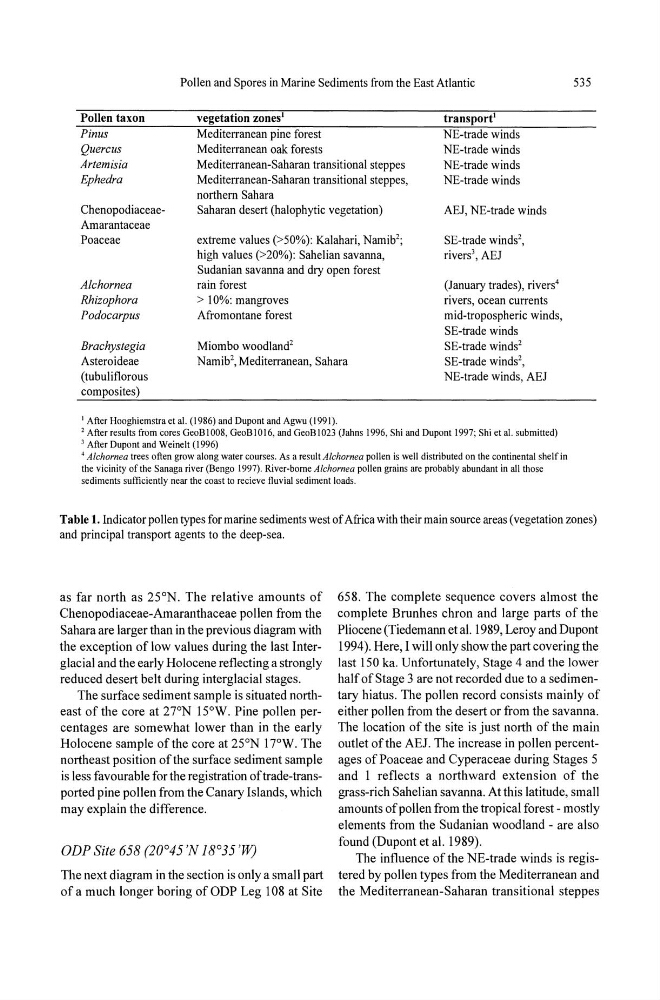
Table 1. Indicator pollen types for marine sediments west of Africa with their main source areas (vegetation zones)
and principal transport agents to the deep-sea.
as far north as 25°N_ The relative amounts of
Chenopodiaceae-Amaranthaceae pollen from the
Sahara are larger than in the previous diagram with
the exception of low values during the last Interglacial and the early Holocene reflecting a strongly
reduced desert belt during interglacial stages_
The surface sediment sample is situated northeast of the core at 27°N 15°W. Pine pollen percentages are somewhat lower than in the early
Holocene sample of the core at 25°N 17°W. The
northeast position ofthe surface sediment sample
is less favourable for the registration of trade-transported pine pollen from the Canary Islands, which
may explain the difference.
ODP Site 658 (20°45 'N 18°35'W)
The next diagram in the section is only a small part
of a much longer boring of ODP Leg 108 at Site
658. The complete sequence covers almost the
complete Brunhes chron and large parts of the
Pliocene (Tiedemann et aI. 1989, Leroy and Dupont
1994). Here, I will only show the part covering the
last 150 ka. Unfortunately, Stage 4 and the lower
half of Stage 3 are not recorded due to a sedimentary hiatus. The pollen record consists mainly of
either pollen from the desert or from the savanna.
The location of the site is just north of the main
outlet of the AEJ. The increase in pollen percentages of Poaceae and Cyperaceae during Stages 5
and I reflects a northward extension of the
grass-rich Sahelian savanna. At this latitude, small
amounts of pollen from the tropical forest - mostly
elements from the Sudanian woodland - are also
found (Dupont et al. 1989).
The influence of the NE-trade winds is registered by pollen types from the Mediterranean and
the Mediterranean-Saharan transitional steppes
535
Pollen taxon
vegetation zones·
transport·
Mediterranean pine forest
Pinus
Quercus
Artemisia
Ephedra
Mediterranean oak forests
Mediterranean-Saharan transitional steppes
Mediterranean-Saharan transitional steppes,
northern Sahara
NE-trade winds
NE-trade winds
NE-trade winds
NE-trade winds
ChenopodiaceaeAmarantaceae
Poaceae
Saharan desert (halophytic vegetation)
AEJ, NE-trade winds
extreme values (>50%): Kalahari, Namib 2 ;
high values (>20%): Sahelian savanna,
Sudanian savanna and dry open forest
SE-trade winds 2 ,
rivers', AEJ
Alchornea
Rhizophora
Podocarpus
rain forest
> 10%: mangroves
Afromontane forest
Miombo woodland 2
Brachystegia
Asteroideae
(tubuliflorous
composites)
Namib 2 , Mediterranean, Sahara
(January trades), rivers'
rivers, ocean currents
mid-tropospheric winds,
SE-trade winds
SE-trade winds 2
SE-trade winds 2 ,
NE-trade winds, AEJ
1 After Hooghiemstraet al. (1986) and Dupont and Agwu (1991).
2 After results from cores GeoBI008, GeoBIOI6, and GeoB1023 (Jahns 1996, Shi and Dupont 1997; Shi et al. submitted)
3 After Dupont and Weinelt (1996)
, Alchornea trees often grow along water courses. As a result Alchomea pollen is well distributed on the continental shelf in
the vicinity of the Sanaga river (Bengo 1997). River-borne Alchornea pollen grains are probably abundant in all those
sediments sufficiently near the coast to recieve fluvial sediment loads.
Table 1. Indicator pollen types for marine sediments west of Africa with their main source areas (vegetation zones)
and principal transport agents to the deep-sea.
as far north as 25°N_ The relative amounts of
Chenopodiaceae-Amaranthaceae pollen from the
Sahara are larger than in the previous diagram with
the exception of low values during the last Interglacial and the early Holocene reflecting a strongly
reduced desert belt during interglacial stages_
The surface sediment sample is situated northeast of the core at 27°N 15°W. Pine pollen percentages are somewhat lower than in the early
Holocene sample of the core at 25°N 17°W. The
northeast position ofthe surface sediment sample
is less favourable for the registration of trade-transported pine pollen from the Canary Islands, which
may explain the difference.
ODP Site 658 (20°45 'N 18°35'W)
The next diagram in the section is only a small part
of a much longer boring of ODP Leg 108 at Site
658. The complete sequence covers almost the
complete Brunhes chron and large parts of the
Pliocene (Tiedemann et aI. 1989, Leroy and Dupont
1994). Here, I will only show the part covering the
last 150 ka. Unfortunately, Stage 4 and the lower
half of Stage 3 are not recorded due to a sedimentary hiatus. The pollen record consists mainly of
either pollen from the desert or from the savanna.
The location of the site is just north of the main
outlet of the AEJ. The increase in pollen percentages of Poaceae and Cyperaceae during Stages 5
and I reflects a northward extension of the
grass-rich Sahelian savanna. At this latitude, small
amounts of pollen from the tropical forest - mostly
elements from the Sudanian woodland - are also
found (Dupont et al. 1989).
The influence of the NE-trade winds is registered by pollen types from the Mediterranean and
the Mediterranean-Saharan transitional steppes