

Pollen and Spores in Marine Sediments from the East Atlantic
533
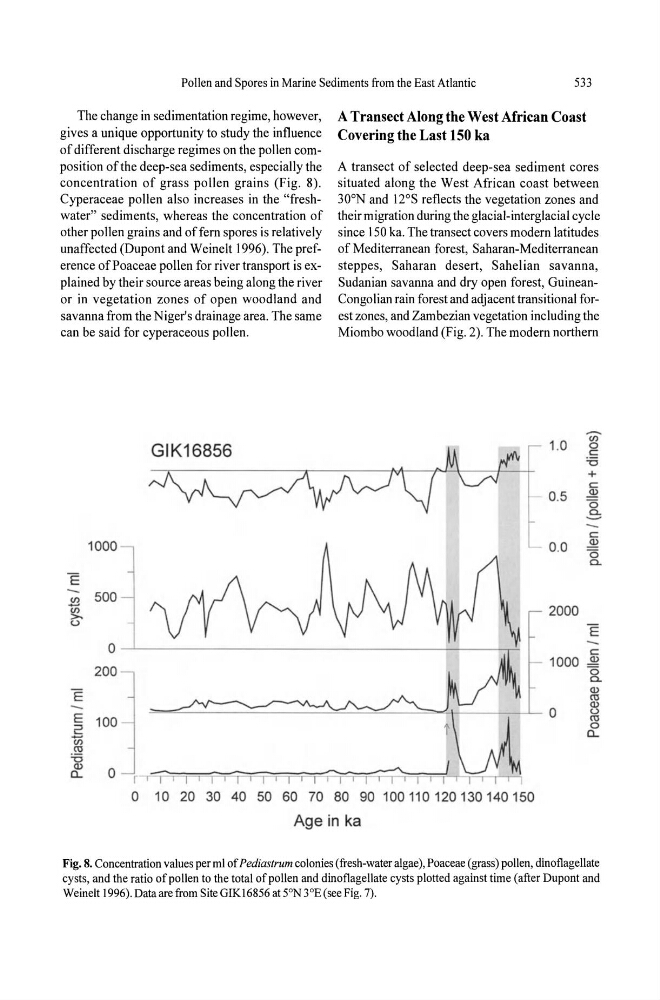
The change in sedimentation regime, however,
gives a unique opportunity to study the influence
of different discharge regimes on the pollen composition of the deep-sea sediments, especially the
concentration of grass pollen grains (Fig. 8).
Cyperaceae pollen also increases in the "freshwater" sediments, whereas the concentration of
other pollen grains and offern spores is relatively
unaffected (Dupont and Weinelt 1996). The preference ofPoaceae pollen for river transport is explained by their source areas being along the river
or in vegetation zones of open woodland and
savanna from the Niger's drainage area. The same
can be said for cyperaceous pollen .
1000
E
'"
500
~ u
0
200
E
E 100
2
en C\J
A Transect Along the West Mrican Coast
Covering the Last 150 ka
A transect of selected deep-sea sediment cores
situated along the West African coast between
30 0 N and 12°S reflects the vegetation zones and
their migration during the glacial-interglacial cycle
since 150 ka. The transect covers modern latitudes
of Mediterranean forest, Saharan-Mediterranean
steppes, Saharan desert, Sahelian savanna,
Sudanian savanna and dry open forest, GuineanCongolian rain forest and adjacent transitional forest zones, and Zambezian vegetation including the
Miombo woodland (Fig. 2). The modern northern
1.0
Vi
0
c
'6
+
c
0.5 ~
(5
.s
c
0.0 ~
(5
0..
2000
E
c
1000 ~
(5
0QJ
C\J
QJ
0
U
C\J
0
a..
~ o I 1 I
rt I I I I I I I I I I I I I I I
o 10 20 30 40 50 60 70 80 90 100110120130140150
Age in ka
Fig. 8. Concentration values per ml of Pediastrum colonies (fresh-water algae), Poaceae (grass) pollen, dinoflagellate
cysts, and the ratio of pollen to the total of pollen and dinoflagellate cysts plotted against time (after Dupont and
Weinelt 1996). Data are from Site GIK16856 at 5°N 3°E (see Fig. 7).
533
The change in sedimentation regime, however,
gives a unique opportunity to study the influence
of different discharge regimes on the pollen composition of the deep-sea sediments, especially the
concentration of grass pollen grains (Fig. 8).
Cyperaceae pollen also increases in the "freshwater" sediments, whereas the concentration of
other pollen grains and offern spores is relatively
unaffected (Dupont and Weinelt 1996). The preference ofPoaceae pollen for river transport is explained by their source areas being along the river
or in vegetation zones of open woodland and
savanna from the Niger's drainage area. The same
can be said for cyperaceous pollen .
1000
E
'"
500
~ u
0
200
E
E 100
2
en C\J
A Transect Along the West Mrican Coast
Covering the Last 150 ka
A transect of selected deep-sea sediment cores
situated along the West African coast between
30 0 N and 12°S reflects the vegetation zones and
their migration during the glacial-interglacial cycle
since 150 ka. The transect covers modern latitudes
of Mediterranean forest, Saharan-Mediterranean
steppes, Saharan desert, Sahelian savanna,
Sudanian savanna and dry open forest, GuineanCongolian rain forest and adjacent transitional forest zones, and Zambezian vegetation including the
Miombo woodland (Fig. 2). The modern northern
1.0
Vi
0
c
'6
+
c
0.5 ~
(5
.s
c
0.0 ~
(5
0..
2000
E
c
1000 ~
(5
0QJ
C\J
QJ
0
U
C\J
0
a..
~ o I 1 I
rt I I I I I I I I I I I I I I I
o 10 20 30 40 50 60 70 80 90 100110120130140150
Age in ka
Fig. 8. Concentration values per ml of Pediastrum colonies (fresh-water algae), Poaceae (grass) pollen, dinoflagellate
cysts, and the ratio of pollen to the total of pollen and dinoflagellate cysts plotted against time (after Dupont and
Weinelt 1996). Data are from Site GIK16856 at 5°N 3°E (see Fig. 7).