

532
Dupont
-20
-15
-10
-5
0
5
35
Poaceae (grasses)
40 50 60 %
30
Q
a
IIIIIlIlIIIIIl main source area
25
20
15
10
5
.' +
o
o
,
-15
I
-10
-5
longitude
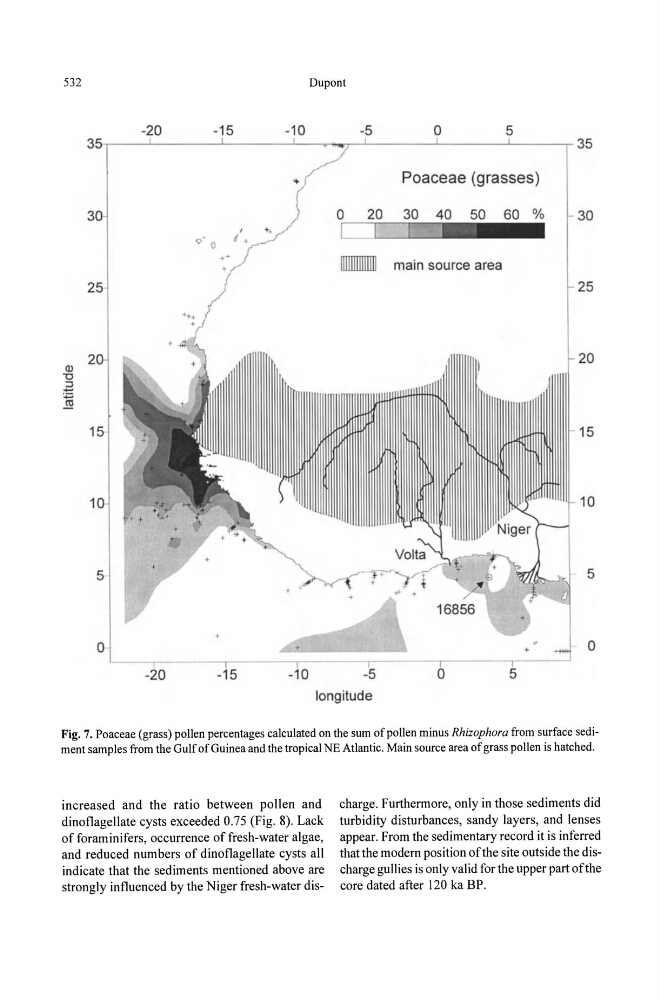
Fig. 7. Poaceae (grass) pollen percentages calculated on the sum of pollen minus Rhizophora from surface sediment samples from the Gulf of Guinea and the tropical NE Atlantic. Main source area of grass pollen is hatched.
increased and the ratio between pollen and
dinoflagellate cysts exceeded 0.75 (Fig. 8). Lack
of foraminifers, occurrence of fresh-water algae,
and reduced numbers of dinoflagellate cysts all
indicate that the sediments mentioned above are
strongly influenced by the Niger fresh-water discharge. Furthermore, only in those sediments did
turbidity disturbances, sandy layers, and lenses
appear. From the sedimentary record it is inferred
that the modern position ofthe site outside the discharge gullies is only valid for the upper part ofthe
core dated after 120 ka BP.
Dupont
-20
-15
-10
-5
0
5
35
Poaceae (grasses)
40 50 60 %
30
Q
a
IIIIIlIlIIIIIl main source area
25
20
15
10
5
.' +
o
o
,
-15
I
-10
-5
longitude
Fig. 7. Poaceae (grass) pollen percentages calculated on the sum of pollen minus Rhizophora from surface sediment samples from the Gulf of Guinea and the tropical NE Atlantic. Main source area of grass pollen is hatched.
increased and the ratio between pollen and
dinoflagellate cysts exceeded 0.75 (Fig. 8). Lack
of foraminifers, occurrence of fresh-water algae,
and reduced numbers of dinoflagellate cysts all
indicate that the sediments mentioned above are
strongly influenced by the Niger fresh-water discharge. Furthermore, only in those sediments did
turbidity disturbances, sandy layers, and lenses
appear. From the sedimentary record it is inferred
that the modern position ofthe site outside the discharge gullies is only valid for the upper part ofthe
core dated after 120 ka BP.