

Implications of a Carbonate Ion Effect on Shell Carbon and Oxygen Isotopes
517
a
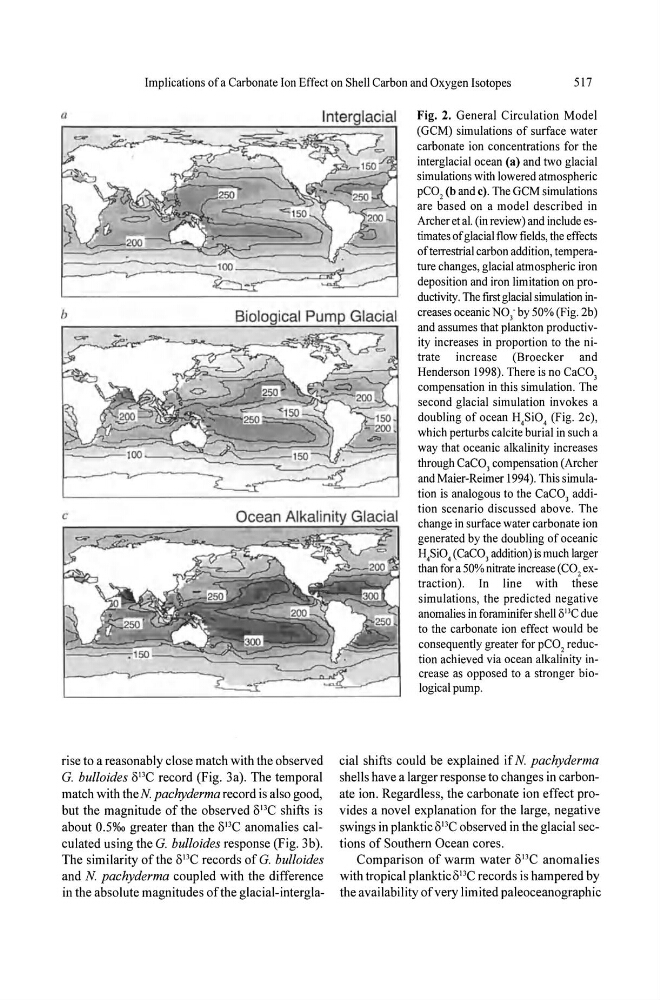
Interglacial Fig. 2. General Circulation Model
(GCM) simulations of surface water
carbonate ion concentrations for the
interglacial ocean (a) and two glacial
simulations with lowered atmospheric
pCO, (b and c). The GCM simulations
are based on a model described in
Archer et al. (in review) and include estimates of glacial flow fields, the effects
of terrestrial carbon addition, temperature changes, glacial atmospheric iron
deposition and iron limitation on pro·
ductivity. The first glacial simulation in·
creases oceanic N0 3 ' by 50% (Fig. 2b)
and assumes that plankton productivity increases in proportion to the nitrate increase (Broecker and
Henderson 1998). There is no CaC0 3
compensation in this simulation. The
second glacial simulation invokes a
doubling of ocean H.SiO, (Fig. 2c),
which perturbs calcite burial in such a
way that oceanic alkalinity increases
through CaC0 3 compensation (Archer
and Maier-Reimer 1994). This simulation is analogous to the CaC0 3 addition scenario discussed above. The
change in surface water carbonate ion
generated by the doubling of oceanic
H,SiO, (CaC0 3 addition) is much larger
than for a 50% nitrate increase (C0 2 extraction). In line with these
simulations, the predicted negative
anomalies in foraminifer shellli 13 C due
to the carbonate ion effect would be
consequently greater for pC0 2 reduction achieved via ocean alkalinity increase as opposed to a stronger biological pump.
b
Biological Pump Glacial
rise to a reasonably close match with the observed
G. bullaides S13C record (Fig. 3a). The temporal
match with the N. pachyderma record is also good,
but the magnitude of the observed S13C shifts is
about 0.5%0 greater than the S13C anomalies calculated using the G. bulla ides response (Fig. 3 b).
The similarity of the s 13 e records of G. bullaides
and N. pachyderma coupled with the difference
in the absolute magnitudes of the glacial-interglacial shifts could be explained if N. pachyderma
shells have a larger response to changes in carbonate ion. Regardless, the carbonate ion effect provides a novel explanation for the large, negative
swings in planktic S13C observed in the glacial sections of Southern Ocean cores.
Comparison of warm water S13C anomalies
with tropical plankticS 13 C records is hampered by
the availability ofvery limited paleoceanographic
517
a
Interglacial Fig. 2. General Circulation Model
(GCM) simulations of surface water
carbonate ion concentrations for the
interglacial ocean (a) and two glacial
simulations with lowered atmospheric
pCO, (b and c). The GCM simulations
are based on a model described in
Archer et al. (in review) and include estimates of glacial flow fields, the effects
of terrestrial carbon addition, temperature changes, glacial atmospheric iron
deposition and iron limitation on pro·
ductivity. The first glacial simulation in·
creases oceanic N0 3 ' by 50% (Fig. 2b)
and assumes that plankton productivity increases in proportion to the nitrate increase (Broecker and
Henderson 1998). There is no CaC0 3
compensation in this simulation. The
second glacial simulation invokes a
doubling of ocean H.SiO, (Fig. 2c),
which perturbs calcite burial in such a
way that oceanic alkalinity increases
through CaC0 3 compensation (Archer
and Maier-Reimer 1994). This simulation is analogous to the CaC0 3 addition scenario discussed above. The
change in surface water carbonate ion
generated by the doubling of oceanic
H,SiO, (CaC0 3 addition) is much larger
than for a 50% nitrate increase (C0 2 extraction). In line with these
simulations, the predicted negative
anomalies in foraminifer shellli 13 C due
to the carbonate ion effect would be
consequently greater for pC0 2 reduction achieved via ocean alkalinity increase as opposed to a stronger biological pump.
b
Biological Pump Glacial
rise to a reasonably close match with the observed
G. bullaides S13C record (Fig. 3a). The temporal
match with the N. pachyderma record is also good,
but the magnitude of the observed S13C shifts is
about 0.5%0 greater than the S13C anomalies calculated using the G. bulla ides response (Fig. 3 b).
The similarity of the s 13 e records of G. bullaides
and N. pachyderma coupled with the difference
in the absolute magnitudes of the glacial-interglacial shifts could be explained if N. pachyderma
shells have a larger response to changes in carbonate ion. Regardless, the carbonate ion effect provides a novel explanation for the large, negative
swings in planktic S13C observed in the glacial sections of Southern Ocean cores.
Comparison of warm water S13C anomalies
with tropical plankticS 13 C records is hampered by
the availability ofvery limited paleoceanographic