

516
SST = 10°C: G. bulloides response
, 120
T=10'C. S.:lS%o
Cl
a
-'"
'" 90
0
E
~
~
' "
E
0
c
' "
o~
£
260
pC0 2 (ppmV)
0
i
-0.2
extract CO 2
{ -0.4
addCaCO ,
E
0
c
' "
?
00
C
220
240
260
260
pC0 2 (ppmV)
0
;f
-:: -0.1
~
E
0
c
' "
~O -0.2
00
e
-0.3
200
220
240
260
280
pC0 2 (ppmV)
Leaet a!.
SST = 25°C: O. universa response
Cl
S o
E
~
>.
~ o
c
' "
{ -0.4
E
0
c
IV
..P
~oo
-0.6
- 1
200
0
~-0.1
~
E
0
c
IV
jJ -0.2
00
-0.3
200
T =2S'C. 6=35%0
b
add CaCO,
d
220
240
260
260
pC0 2 (ppmV)
220
240
260
260
pC0 2 (ppmV)
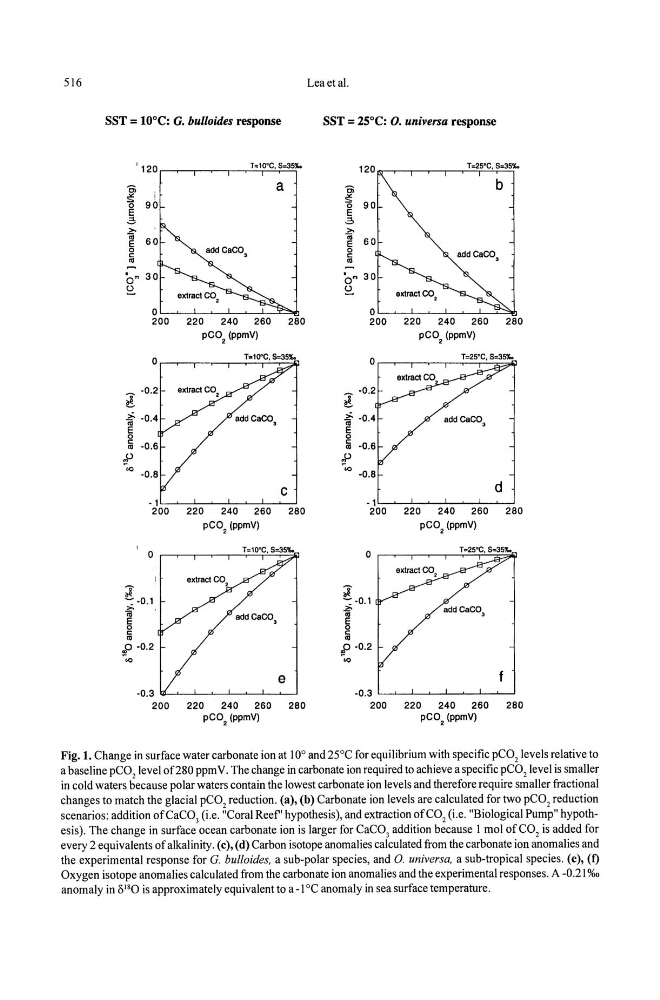
Fig_ 1. Change in surface water carbonate ion at 10° and 25°C for equilibrium with specific pCO, levels relative to
a baseline pCO, level of280 ppm V. The change in carbonate ion required to achieve a specific pCO, level is smaller
in cold waters because polar waters contain the lowest carbonate ion levels and therefore require smaller fractional
changes to match the glacial pCO, reduction. (a), (b) Carbonate ion levels are calculated for two pCO, reduction
scenarios: addition ofCaCO J (Le. "Coral Reef' hypothesis), and extraction of CO, (i.e. "Biological Pump" hypothesis). The change in surface ocean carbonate ion is larger for CaCO J addition because 1 mol of CO, is added for
every 2 equivalents of alkalinity. (c), (d) Carbon isotope anomalies calculated from the carbonate ion anomalies and
the experimental response for G. bulloides. a sub-polar species, and 0. universa, a sub-tropical species. (e), (I)
Oxygen isotope anomalies calculated from the carbonate ion anomalies and the experimental responses. A -0.21 %0
anomaly in 8180 is approximately equivalent to a-1°C anomaly in sea surface temperature.
SST = 10°C: G. bulloides response
, 120
T=10'C. S.:lS%o
Cl
a
-'"
'" 90
0
E
~
~
' "
E
0
c
' "
o~
£
260
pC0 2 (ppmV)
0
i
-0.2
extract CO 2
{ -0.4
addCaCO ,
E
0
c
' "
?
00
C
220
240
260
260
pC0 2 (ppmV)
0
;f
-:: -0.1
~
E
0
c
' "
~O -0.2
00
e
-0.3
200
220
240
260
280
pC0 2 (ppmV)
Leaet a!.
SST = 25°C: O. universa response
Cl
S o
E
~
>.
~ o
c
' "
{ -0.4
E
0
c
IV
..P
~oo
-0.6
- 1
200
0
~-0.1
~
E
0
c
IV
jJ -0.2
00
-0.3
200
T =2S'C. 6=35%0
b
add CaCO,
d
220
240
260
260
pC0 2 (ppmV)
220
240
260
260
pC0 2 (ppmV)
Fig_ 1. Change in surface water carbonate ion at 10° and 25°C for equilibrium with specific pCO, levels relative to
a baseline pCO, level of280 ppm V. The change in carbonate ion required to achieve a specific pCO, level is smaller
in cold waters because polar waters contain the lowest carbonate ion levels and therefore require smaller fractional
changes to match the glacial pCO, reduction. (a), (b) Carbonate ion levels are calculated for two pCO, reduction
scenarios: addition ofCaCO J (Le. "Coral Reef' hypothesis), and extraction of CO, (i.e. "Biological Pump" hypothesis). The change in surface ocean carbonate ion is larger for CaCO J addition because 1 mol of CO, is added for
every 2 equivalents of alkalinity. (c), (d) Carbon isotope anomalies calculated from the carbonate ion anomalies and
the experimental response for G. bulloides. a sub-polar species, and 0. universa, a sub-tropical species. (e), (I)
Oxygen isotope anomalies calculated from the carbonate ion anomalies and the experimental responses. A -0.21 %0
anomaly in 8180 is approximately equivalent to a-1°C anomaly in sea surface temperature.