

Alkenone 8 l3 C as a Proxy for Past PCO z in Surface Waters
481
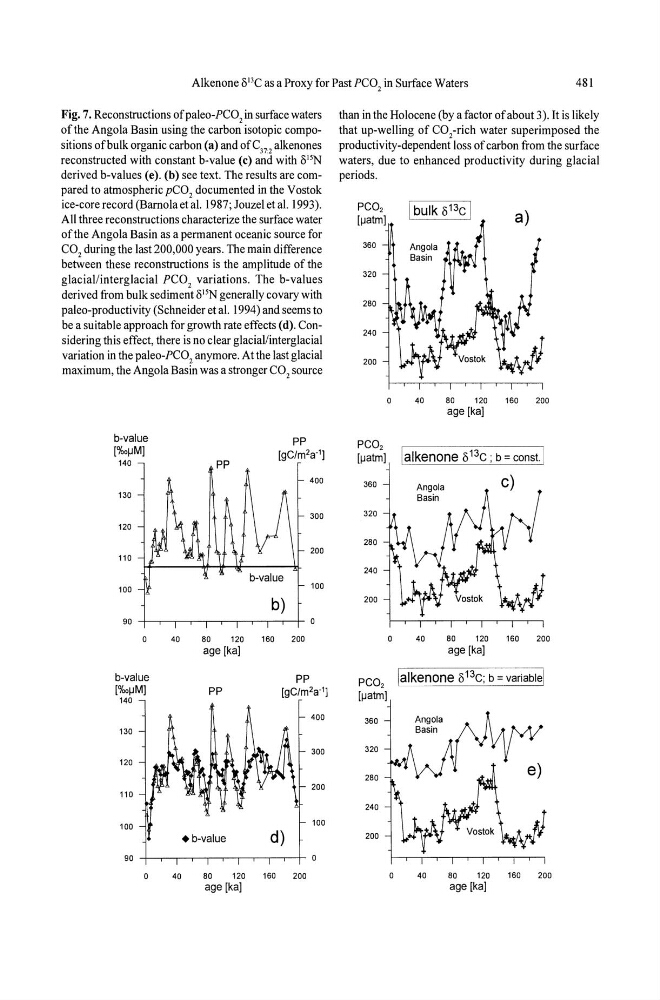
Fig. 7. Reconstructions of paleo-PCO z in surface waters
of the Angola Basin using the carbon isotopic compositions of bulk organic carbon (a) and ofC 37 • z alkenones
reconstructed with constant b-value (c) and with 8 15 N
derived b-values (e). (b) see text. The results are compared to atmospheric pCO z documented in the Vostok
ice-core record (Barnola et al. 1987; Jouzel et al. 1993).
All three reconstructions characterize the surface water
of the Angola Basin as a permanent oceanic source for
COz during the last 200,000 years. The main difference
between these reconstructions is the amplitude of the
glaciaVinterglacial PCO z variations. The b-values
derived from bulk sediment 8 15 N generally covary with
paleo-productivity (Schneider et al. 1994) and seems to
be a suitable approach for growth rate effects (d). Considering this effect, there is no clear glaciaVinterglacial
variation in the paleo-PCO z anymore. At the last glacial
maximum, the Angola Basin was a stronger COz source
b-value
PP
[%O~M]
[gC/m 2 a· 1 ]
140
PP
400
130
300
120
200
110
100
100
b)
90
40
80
120
160
200
age [ka]
b-value
PP
[%O~M]
PP
[gC/m2a· 1 j
140
400
130
300
120
200
110
100
100
+b-value
d)
90
40
80
120
160
200
age [ka]
than in the Holocene (by a factor of about 3). It is likely
that up-welling of COz-rich water superimposed the
productivity-dependent loss of carbon from the surface
waters, due to enhanced productivity during glacial
periods.
PC02
I bulk 8 13 C I
[~atm]
360
320
280
240
200
40
80
120
160
200
age [ka]
PCOz
[~atm]
lalkenone 8 13 C; b = cons!. I
360
320
280
240
200
40
80
120
160
200
age [ka]
PC02 lalkenone 8 13 C; b = variablel
[~atm]
360
320
280
240
200
40
80
120
160
200
age [ka]
481
Fig. 7. Reconstructions of paleo-PCO z in surface waters
of the Angola Basin using the carbon isotopic compositions of bulk organic carbon (a) and ofC 37 • z alkenones
reconstructed with constant b-value (c) and with 8 15 N
derived b-values (e). (b) see text. The results are compared to atmospheric pCO z documented in the Vostok
ice-core record (Barnola et al. 1987; Jouzel et al. 1993).
All three reconstructions characterize the surface water
of the Angola Basin as a permanent oceanic source for
COz during the last 200,000 years. The main difference
between these reconstructions is the amplitude of the
glaciaVinterglacial PCO z variations. The b-values
derived from bulk sediment 8 15 N generally covary with
paleo-productivity (Schneider et al. 1994) and seems to
be a suitable approach for growth rate effects (d). Considering this effect, there is no clear glaciaVinterglacial
variation in the paleo-PCO z anymore. At the last glacial
maximum, the Angola Basin was a stronger COz source
b-value
PP
[%O~M]
[gC/m 2 a· 1 ]
140
PP
400
130
300
120
200
110
100
100
b)
90
40
80
120
160
200
age [ka]
b-value
PP
[%O~M]
PP
[gC/m2a· 1 j
140
400
130
300
120
200
110
100
100
+b-value
d)
90
40
80
120
160
200
age [ka]
than in the Holocene (by a factor of about 3). It is likely
that up-welling of COz-rich water superimposed the
productivity-dependent loss of carbon from the surface
waters, due to enhanced productivity during glacial
periods.
PC02
I bulk 8 13 C I
[~atm]
360
320
280
240
200
40
80
120
160
200
age [ka]
PCOz
[~atm]
lalkenone 8 13 C; b = cons!. I
360
320
280
240
200
40
80
120
160
200
age [ka]
PC02 lalkenone 8 13 C; b = variablel
[~atm]
360
320
280
240
200
40
80
120
160
200
age [ka]