

Reconstruction of Surface Ocean Nitrate Utilization
457
8
8 e
0
S 6
0
E
0
2; 4
0
+' ...
0
I
0
6 2 0
e
0
0
0
2
4
6
8 10 12 14 16 18
TIme (days)
18
•
~17
• •
•
• •
•
[16
Z
•
'"
I
•
•
'Zo 15
•
14
0
2 4
6
8 10 12 14 16 18
Time (days)
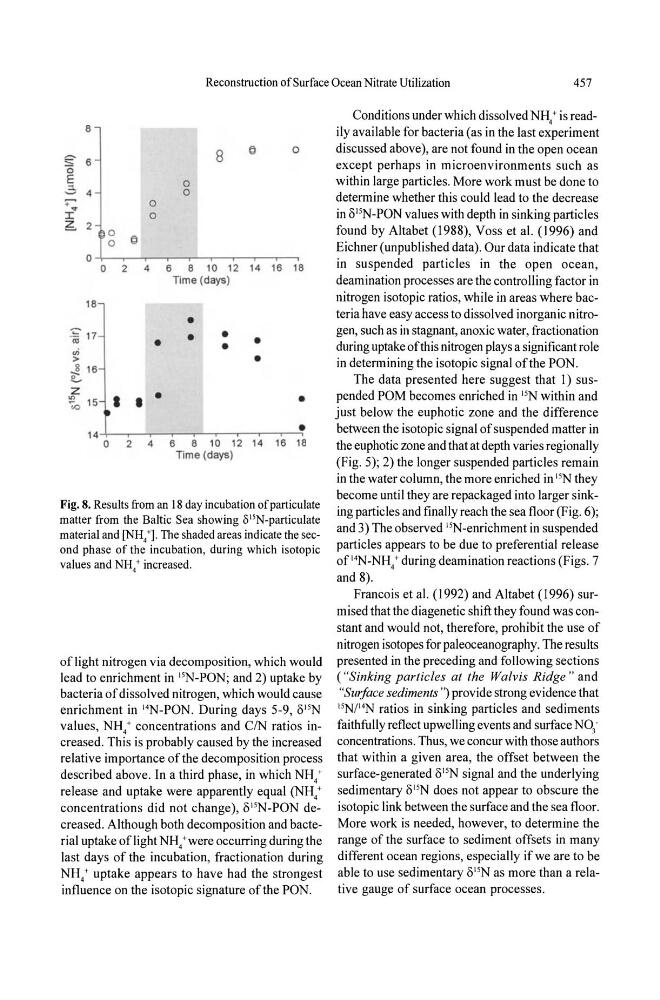
Fig. 8. Results from an 18 day incubation of particulate
matter from the Baltic Sea showing ol 5N-particulate
material and [NH: ]. The shaded areas indicate the second phase of the incubation, during which isotopic
values and NH: increased.
of light nitrogen via decomposition, which would
lead to enrichment in 15N_PON; and 2) uptake by
bacteria of dissolved nitrogen, which would cause
enrichment in 14N_PON. During days 5-9, 8 15 N
values, NH: concentrations and C/N ratios increased. This is probably caused by the increased
relative importance of the decomposition process
described above. In a third phase, in which NH:
release and uptake were apparently equal (NH:
concentrations did not change), 8 15 N-PON decreased. Although both decomposition and bacterial uptake oflight NH: were occurring during the
last days of the incubation, fractionation during
NH4 + uptake appears to have had the strongest
influence on the isotopic signature of the PON.
Conditions under which dissolved NH4 + is readily available for bacteria (as in the last experiment
discussed above), are not found in the open ocean
except perhaps in microenvironments such as
within large particles. More work must be done to
determine whether this could lead to the decrease
in 8 IS N-PON values with depth in sinking particles
found by Altabet (1988), Voss et al. (1996) and
Eichner (unpublished data). Our data indicate that
in suspended particles in the open ocean,
deamination processes are the controlling factor in
nitrogen isotopic ratios, while in areas where bacteria have easy access to dissolved inorganic nitrogen, such as in stagnant, anoxic water, fractionation
during uptake of this nitrogen plays a significant role
in determining the isotopic signal ofthe PON.
The data presented here suggest that I) suspended POM becomes enriched in ISN within and
just below the euphotic zone and the difference
between the isotopic signal of suspended matter in
the euphotic zone and that at depth varies regionally
(Fig. 5); 2) the longer suspended particles remain
in the water column, the more enriched in 15N they
become until they are repackaged into larger sinking particles and finally reach the sea floor (Fig. 6);
and 3) The observed I S N-enrichment in suspended
particles appears to be due to preferential release
of I4 N-NH: during deamination reactions (Figs. 7
and 8).
Francois et al. (1992) and Altabet (1996) surmised that the diagenetic shift they found was constant and would not, therefore, prohibit the use of
nitrogen isotopes for paleoceanography. The results
presented in the preceding and following sections
( "Sinking particles at the Walvis Ridge " and
"Surface sediments ") provide strong evidence that
ISN/14N ratios in sinking particles and sediments
faithfully reflect upwelling events and surface Nq'
concentrations. Thus, we concur with those authors
that within a given area, the offset between the
surface-generated 8 lS N signal and the underlying
sedimentary 8 lS N does not appear to obscure the
isotopic link between the surface and the sea floor.
More work is needed, however, to determine the
range of the surface to sediment offsets in many
different ocean regions, especially if we are to be
able to use sedimentary 8 15 N as more than a relative gauge of surface ocean processes.
457
8
8 e
0
S 6
0
E
0
2; 4
0
+' ...
0
I
0
6 2 0
e
0
0
0
2
4
6
8 10 12 14 16 18
TIme (days)
18
•
~17
• •
•
• •
•
[16
Z
•
'"
I
•
•
'Zo 15
•
14
0
2 4
6
8 10 12 14 16 18
Time (days)
Fig. 8. Results from an 18 day incubation of particulate
matter from the Baltic Sea showing ol 5N-particulate
material and [NH: ]. The shaded areas indicate the second phase of the incubation, during which isotopic
values and NH: increased.
of light nitrogen via decomposition, which would
lead to enrichment in 15N_PON; and 2) uptake by
bacteria of dissolved nitrogen, which would cause
enrichment in 14N_PON. During days 5-9, 8 15 N
values, NH: concentrations and C/N ratios increased. This is probably caused by the increased
relative importance of the decomposition process
described above. In a third phase, in which NH:
release and uptake were apparently equal (NH:
concentrations did not change), 8 15 N-PON decreased. Although both decomposition and bacterial uptake oflight NH: were occurring during the
last days of the incubation, fractionation during
NH4 + uptake appears to have had the strongest
influence on the isotopic signature of the PON.
Conditions under which dissolved NH4 + is readily available for bacteria (as in the last experiment
discussed above), are not found in the open ocean
except perhaps in microenvironments such as
within large particles. More work must be done to
determine whether this could lead to the decrease
in 8 IS N-PON values with depth in sinking particles
found by Altabet (1988), Voss et al. (1996) and
Eichner (unpublished data). Our data indicate that
in suspended particles in the open ocean,
deamination processes are the controlling factor in
nitrogen isotopic ratios, while in areas where bacteria have easy access to dissolved inorganic nitrogen, such as in stagnant, anoxic water, fractionation
during uptake of this nitrogen plays a significant role
in determining the isotopic signal ofthe PON.
The data presented here suggest that I) suspended POM becomes enriched in ISN within and
just below the euphotic zone and the difference
between the isotopic signal of suspended matter in
the euphotic zone and that at depth varies regionally
(Fig. 5); 2) the longer suspended particles remain
in the water column, the more enriched in 15N they
become until they are repackaged into larger sinking particles and finally reach the sea floor (Fig. 6);
and 3) The observed I S N-enrichment in suspended
particles appears to be due to preferential release
of I4 N-NH: during deamination reactions (Figs. 7
and 8).
Francois et al. (1992) and Altabet (1996) surmised that the diagenetic shift they found was constant and would not, therefore, prohibit the use of
nitrogen isotopes for paleoceanography. The results
presented in the preceding and following sections
( "Sinking particles at the Walvis Ridge " and
"Surface sediments ") provide strong evidence that
ISN/14N ratios in sinking particles and sediments
faithfully reflect upwelling events and surface Nq'
concentrations. Thus, we concur with those authors
that within a given area, the offset between the
surface-generated 8 lS N signal and the underlying
sedimentary 8 lS N does not appear to obscure the
isotopic link between the surface and the sea floor.
More work is needed, however, to determine the
range of the surface to sediment offsets in many
different ocean regions, especially if we are to be
able to use sedimentary 8 15 N as more than a relative gauge of surface ocean processes.