

The South Atlantic Carbon Isotope Record of Planktic Foraminifera
431
bonate precipitates to examine the carbon isotopic
fractionation as a function of carbonate mineralogy, temperature and precipitation rate (Emrich et
al. 1970, Turner 1982, Romanek et al. 1992).
Emrich et al. (1970) suggested thatthe fractionation
between precipitating calcite and surrounding bicarbonate increases by 0.035%0 per degree temperature increase. In contrast, a recent study of
Romanek et al. (1992) indicates that the 8 l3 C enrichment factor of calcite is 1 %0 (within the experimental error of± 0.2%0) between 10 and 40°C and
that the temperature dependence observed by
Emrich et al. (1970) might reflect an increase in
the proportion of aragonite in their samples. Following Romanek et al. (1992) the best estimate for
equilibrum calcification in waters warmer than
lOoC might be:
Hence, a foraminiferal shell calcified in equilibrium
should be 1 %0 heavier than the dissolved CO 2 of
the surrounding seawater. To evaluate the ability
of foraminifera to record the seawater carbon isotopic composition, researchers normally compare
the carbon isotopic composition of foraminiferal
shells to the predicted carbon isotopic composition
of inorganic calcite in equilibrium. Combined plankton tow holes and CTD casts provide the opportunity to compare the 8 l3 C of naturally grown
foraminifera directly to that ofthe dissolved inorganic carbon in equilibrium. Here, we show data
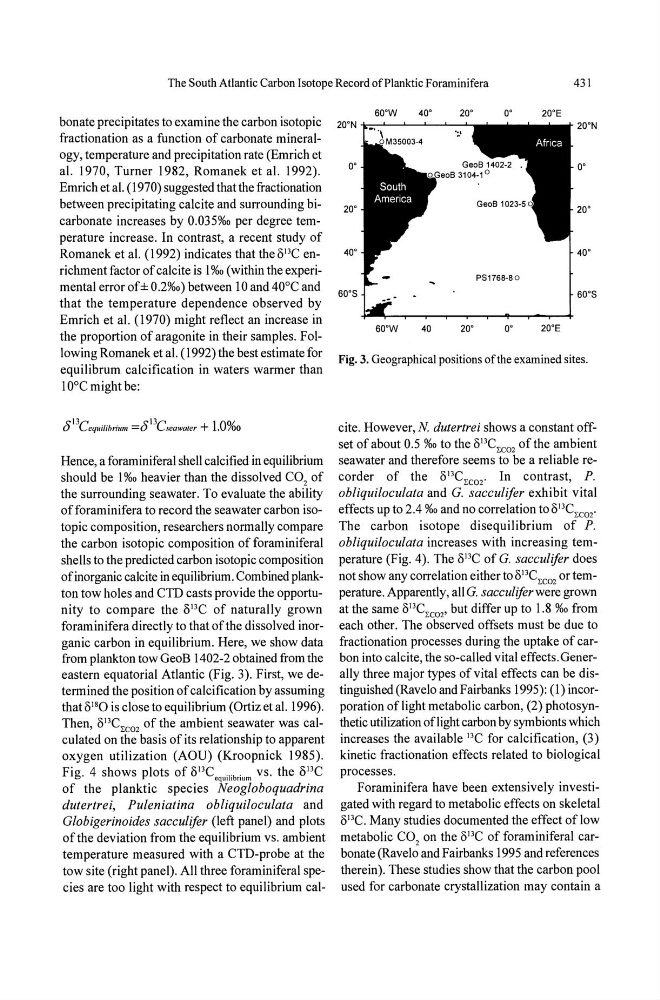
from plankton tow GeoB 1402-2 obtained from the
eastern equatorial Atlantic (Fig. 3). First, we determined the position of calcification by assuming
that 8 18 0 is close to equilibrium (Ortiz et al. 1996).
Then, 813CIC02 of the ambient seawater was calculated on the basis of its relationship to apparent
oxygen utilization (AOU) (Kroopnick 1985).
Fig. 4 shows plots of 8 l3 C equ ;lib,ium vs. the 8 13 C
of the planktic species Neogloboquadrina
dutertrei, Puleniatina obliquiloculata and
Globigerinoides sacculifer (left panel) and plots
of the deviation from the equilibrium vs. ambient
temperature measured with a CTD-probe at the
tow site (right panel). All three foraminiferal species are too light with respect to equilibrium cal60"W
40"
20"
0"
20"E
20"N
20"N
0"
0"
20"
20"
40"
40"
PS1768-80
60"S
60"S
60"W
40
20"
0"
20"E
Fig. 3. Geographical positions of the examined sites.
cite. However, N dutertrei shows a constant offset of about 0.5 %0 to the 813CIC02 of the ambient
seawater and therefore seems to be a reliable recorder of the 8l3CIC02. In contrast, P.
obliquiloculata and G. sacculifer exhibit vital
effects up to 2.4 %0 and no correlation to 813Cl:C02.
The carbon isotope disequilibrium of P:
obliquiloculata increases with increasing temperature (Fig. 4). The 8 l3 C of G. sacculifer does
not show any correlation either to 8l3CIC02 or temperature. Apparently, all G. sacculiferwere grown
at the same 8IJCIC02' but differ up to 1.8 %0 from
each other. The observed offsets must be due to
fractionation processes during the uptake of carbon into calcite, the so-called vital effects. Generally three major types of vital effects can be distinguished (Ravelo and Fairbanks 1995): (1) incorporation of light metabolic carbon, (2) photosynthetic utilization oflight carbon by symbionts which
increases the available 13C for calcification, (3)
kinetic fractionation effects related to biological
processes.
Foraminifera have been extensively investigated with regard to metabolic effects on skeletal
8 l3 C. Many studies documented the effect of low
metabolic CO 2 on the 8 13 C of foraminiferal carbonate (Ravelo and Fairbanks 1995 and references
therein). These studies show that the carbon pool
used for carbonate crystallization may contain a
431
bonate precipitates to examine the carbon isotopic
fractionation as a function of carbonate mineralogy, temperature and precipitation rate (Emrich et
al. 1970, Turner 1982, Romanek et al. 1992).
Emrich et al. (1970) suggested thatthe fractionation
between precipitating calcite and surrounding bicarbonate increases by 0.035%0 per degree temperature increase. In contrast, a recent study of
Romanek et al. (1992) indicates that the 8 l3 C enrichment factor of calcite is 1 %0 (within the experimental error of± 0.2%0) between 10 and 40°C and
that the temperature dependence observed by
Emrich et al. (1970) might reflect an increase in
the proportion of aragonite in their samples. Following Romanek et al. (1992) the best estimate for
equilibrum calcification in waters warmer than
lOoC might be:
Hence, a foraminiferal shell calcified in equilibrium
should be 1 %0 heavier than the dissolved CO 2 of
the surrounding seawater. To evaluate the ability
of foraminifera to record the seawater carbon isotopic composition, researchers normally compare
the carbon isotopic composition of foraminiferal
shells to the predicted carbon isotopic composition
of inorganic calcite in equilibrium. Combined plankton tow holes and CTD casts provide the opportunity to compare the 8 l3 C of naturally grown
foraminifera directly to that ofthe dissolved inorganic carbon in equilibrium. Here, we show data
from plankton tow GeoB 1402-2 obtained from the
eastern equatorial Atlantic (Fig. 3). First, we determined the position of calcification by assuming
that 8 18 0 is close to equilibrium (Ortiz et al. 1996).
Then, 813CIC02 of the ambient seawater was calculated on the basis of its relationship to apparent
oxygen utilization (AOU) (Kroopnick 1985).
Fig. 4 shows plots of 8 l3 C equ ;lib,ium vs. the 8 13 C
of the planktic species Neogloboquadrina
dutertrei, Puleniatina obliquiloculata and
Globigerinoides sacculifer (left panel) and plots
of the deviation from the equilibrium vs. ambient
temperature measured with a CTD-probe at the
tow site (right panel). All three foraminiferal species are too light with respect to equilibrium cal60"W
40"
20"
0"
20"E
20"N
20"N
0"
0"
20"
20"
40"
40"
PS1768-80
60"S
60"S
60"W
40
20"
0"
20"E
Fig. 3. Geographical positions of the examined sites.
cite. However, N dutertrei shows a constant offset of about 0.5 %0 to the 813CIC02 of the ambient
seawater and therefore seems to be a reliable recorder of the 8l3CIC02. In contrast, P.
obliquiloculata and G. sacculifer exhibit vital
effects up to 2.4 %0 and no correlation to 813Cl:C02.
The carbon isotope disequilibrium of P:
obliquiloculata increases with increasing temperature (Fig. 4). The 8 l3 C of G. sacculifer does
not show any correlation either to 8l3CIC02 or temperature. Apparently, all G. sacculiferwere grown
at the same 8IJCIC02' but differ up to 1.8 %0 from
each other. The observed offsets must be due to
fractionation processes during the uptake of carbon into calcite, the so-called vital effects. Generally three major types of vital effects can be distinguished (Ravelo and Fairbanks 1995): (1) incorporation of light metabolic carbon, (2) photosynthetic utilization oflight carbon by symbionts which
increases the available 13C for calcification, (3)
kinetic fractionation effects related to biological
processes.
Foraminifera have been extensively investigated with regard to metabolic effects on skeletal
8 l3 C. Many studies documented the effect of low
metabolic CO 2 on the 8 13 C of foraminiferal carbonate (Ravelo and Fairbanks 1995 and references
therein). These studies show that the carbon pool
used for carbonate crystallization may contain a