

430
Mulitza et al.
Atlantic into the South Atlantic. This water mass decreased since pre-industrial time. This process
is truncated by isotopically light and nutrient-rich is known as the " 13 C Suess-effect".
bottom and intermediate water masses of AntarcAnother source of variations for marine
ticorigin(Fig.la,b).
8 13 C);C02 is freshwater runoff. Since most of the
A second reason for 8 13 C);C02 variations in the CO 2 dissolved in groundwater derives from organic
ocean comes from the fact that carbon circulates matter degradation, river water has very low8 13 C.
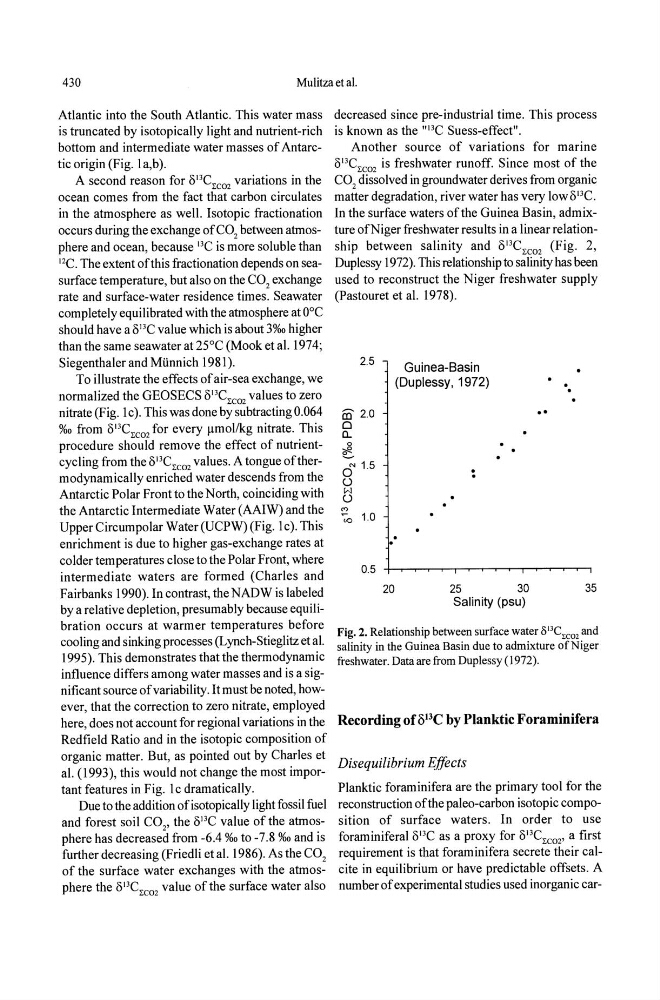
in the atmosphere as well. Isotopic fractionation In the surface waters of the Guinea Basin, admixoccurs during the exchange ofCO z between atmos- ture of Niger freshwater results in a linear relationphere and ocean, because 13C is more soluble than ship between salinity and 81JCLC02 (Fig. 2,
12C. The extent of this fractionation depends on sea- Duplessy 1972). This relationship to salinity has been
surface temperature, but also on the CO 2 exchange used to reconstruct the Niger freshwater supply
rate and surface-water residence times. Seawater (Pastouret et al. 1978).
completely equilibrated with the atmosphere at O°C
should have a 8 J3 C value which is about 3%0 higher
than the same seawater at 25°C (Mook et al. 1974;
Siegenthaler and Mlinnich 1981).
To illustrate the effects of air-sea exchange, we
normalized the GEOSECS 8 13 C);C02 values to zero
nitrate (Fig. 1 c). This was done by subtracting 0.064
%0 from 81JCLC02 for every Ilmollkg nitrate. This
procedure should remove the effect of nutrientcycling from the 8 13 C);C02 values. A tongue ofthermodynamically enriched water descends from the
Antarctic Polar Front to the North, coinciding with
the Antarctic Intermediate Water (AAIW) and the
Upper Circumpolar Water (UCPW) (Fig. 1 c). This
enrichment is due to higher gas-exchange rates at
colder temperatures close to the Polar Front, where
intermediate waters are formed (Charles and
Fairbanks 1990). In contrast, the NADW is labeled
by a relative depletion, presumably because equilibration occurs at warmer temperatures before
cooling and sinking processes (Lynch-Stieglitz et al.
1995). This demonstrates that the thermodynamic
influence differs among water masses and is a sign ificant source of variabi lity. It must be noted, however, that the correction to zero nitrate, employed
2.5
Guinea-Basin
(Duplessy, 1972)
. .
1D 2.0
..
0
0...
0
C
6' 1.5
U
V-l
U
~
1.0
00
.
.
0.5
20
25
30
35
Salinity (psu)
Fig. 2. Relationship between surface water 813C~C02 and
salinity in the Guinea Basin due to admixture of Niger
freshwater. Data are from Duplessy (1972).
here, does not account for regional variations in the Recording of 8 13 C by Planktic Foraminifera
Redfield Ratio and in the isotopic composition of
organic matter. But, as pointed out by Charles et
al. (1993), this would not change the most important features in Fig. lc dramatically.
Due to the addition of isotopically light fossil fuel
and forest soil CO 2 , the 8 13 C value of the atmosphere has decreased from -6.4 %0 to -7.8 %0 and is
further decreasing (Friedli et al. 1986). As the CO 2
of the surface water exchanges with the atmosphere the 8J3CLC02 value of the surface water also
Disequilibrium Effects
Planktic foraminifera are the primary tool for the
reconstruction ofthe paleo-carbon isotopic composition of surface waters. In order to use
foraminiferal 8 J3 C as a proxy for 81JCLcoz' a first
requirement is that foraminifera secrete their calcite in equilibrium or have predictable offsets. A
number of experimental studies used inorganic car-
Mulitza et al.
Atlantic into the South Atlantic. This water mass decreased since pre-industrial time. This process
is truncated by isotopically light and nutrient-rich is known as the " 13 C Suess-effect".
bottom and intermediate water masses of AntarcAnother source of variations for marine
ticorigin(Fig.la,b).
8 13 C);C02 is freshwater runoff. Since most of the
A second reason for 8 13 C);C02 variations in the CO 2 dissolved in groundwater derives from organic
ocean comes from the fact that carbon circulates matter degradation, river water has very low8 13 C.
in the atmosphere as well. Isotopic fractionation In the surface waters of the Guinea Basin, admixoccurs during the exchange ofCO z between atmos- ture of Niger freshwater results in a linear relationphere and ocean, because 13C is more soluble than ship between salinity and 81JCLC02 (Fig. 2,
12C. The extent of this fractionation depends on sea- Duplessy 1972). This relationship to salinity has been
surface temperature, but also on the CO 2 exchange used to reconstruct the Niger freshwater supply
rate and surface-water residence times. Seawater (Pastouret et al. 1978).
completely equilibrated with the atmosphere at O°C
should have a 8 J3 C value which is about 3%0 higher
than the same seawater at 25°C (Mook et al. 1974;
Siegenthaler and Mlinnich 1981).
To illustrate the effects of air-sea exchange, we
normalized the GEOSECS 8 13 C);C02 values to zero
nitrate (Fig. 1 c). This was done by subtracting 0.064
%0 from 81JCLC02 for every Ilmollkg nitrate. This
procedure should remove the effect of nutrientcycling from the 8 13 C);C02 values. A tongue ofthermodynamically enriched water descends from the
Antarctic Polar Front to the North, coinciding with
the Antarctic Intermediate Water (AAIW) and the
Upper Circumpolar Water (UCPW) (Fig. 1 c). This
enrichment is due to higher gas-exchange rates at
colder temperatures close to the Polar Front, where
intermediate waters are formed (Charles and
Fairbanks 1990). In contrast, the NADW is labeled
by a relative depletion, presumably because equilibration occurs at warmer temperatures before
cooling and sinking processes (Lynch-Stieglitz et al.
1995). This demonstrates that the thermodynamic
influence differs among water masses and is a sign ificant source of variabi lity. It must be noted, however, that the correction to zero nitrate, employed
2.5
Guinea-Basin
(Duplessy, 1972)
. .
1D 2.0
..
0
0...
0
C
6' 1.5
U
V-l
U
~
1.0
00
.
.
0.5
20
25
30
35
Salinity (psu)
Fig. 2. Relationship between surface water 813C~C02 and
salinity in the Guinea Basin due to admixture of Niger
freshwater. Data are from Duplessy (1972).
here, does not account for regional variations in the Recording of 8 13 C by Planktic Foraminifera
Redfield Ratio and in the isotopic composition of
organic matter. But, as pointed out by Charles et
al. (1993), this would not change the most important features in Fig. lc dramatically.
Due to the addition of isotopically light fossil fuel
and forest soil CO 2 , the 8 13 C value of the atmosphere has decreased from -6.4 %0 to -7.8 %0 and is
further decreasing (Friedli et al. 1986). As the CO 2
of the surface water exchanges with the atmosphere the 8J3CLC02 value of the surface water also
Disequilibrium Effects
Planktic foraminifera are the primary tool for the
reconstruction ofthe paleo-carbon isotopic composition of surface waters. In order to use
foraminiferal 8 J3 C as a proxy for 81JCLcoz' a first
requirement is that foraminifera secrete their calcite in equilibrium or have predictable offsets. A
number of experimental studies used inorganic car-