

Sediment Redistribution, 23°Th" - Normalization and Implications for the Reconstruction of Particle Flux 419
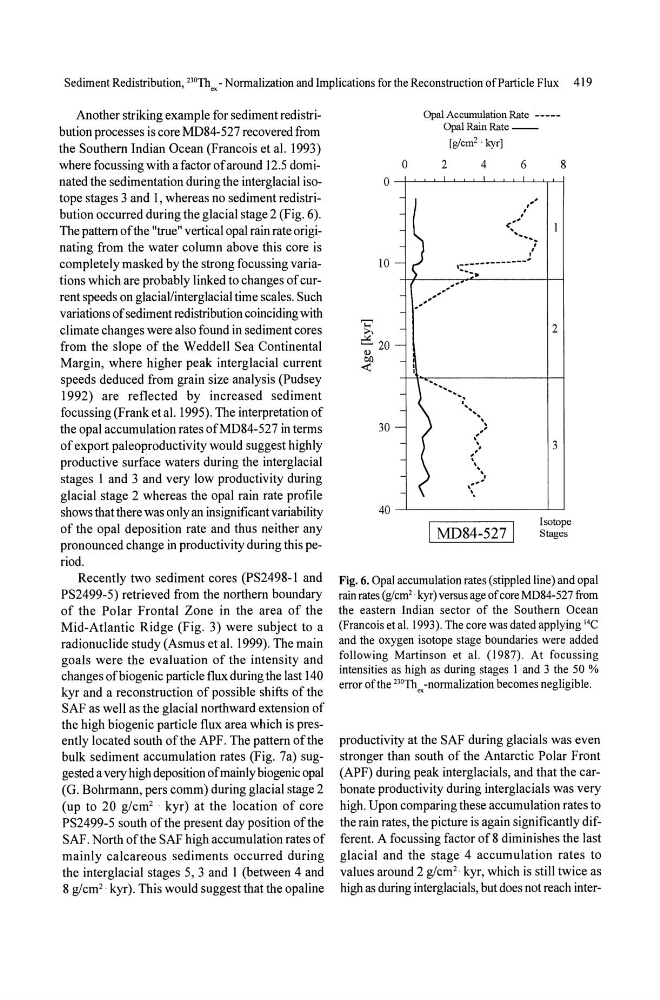
Another striking example for sediment redistribution processes is core MD84-S27 recovered from
the Southern Indian Ocean (Francois et al. 1993)
where focussing with a factor of around 12.5 dominated the sedimentation during the interglacial isotope stages 3 and I, whereas no sediment redistribution occurred during the glacial stage 2 (Fig. 6).
The pattern ofthe "true" vertical opal rain rate originating from the water column above this core is
completely masked by the strong focussing variations which are probably linked to changes of current speeds on glacial/interglacial time scales. Such
variations of sediment redistribution coinciding with
climate changes were also found in sediment cores
from the slope of the Weddell Sea Continental
Margin, where higher peak interglacial current
speeds deduced from grain size analysis (Pudsey
1992) are reflected by increased sediment
focussing (Frank et al. 1995). The interpretation of
the opal accumulation rates ofMD84-S27 in terms
of export paleoproductivity would suggest highly
productive surface waters during the interglacial
stages I and 3 and very low productivity during
glacial stage 2 whereas the opal rain rate profile
shows that there was only an insignificant variability
of the opal deposition rate and thus neither any
pronounced change in productivity during this period.
Recently two sediment cores (PS2498-1 and
PS2499-S) retrieved from the northern boundary
of the Polar Frontal Zone in the area of the
Mid-Atlantic Ridge (Fig. 3) were subject to a
radionuclide study (Asmus et al. 1999). The main
goals were the evaluation of the intensity and
changes of biogenic particle flux during the last 140
kyr and a reconstruction of possible shifts of the
SAF as well as the glacial northward extension of
the high biogenic particle flux area which is presently located south ofthe APF. The pattern ofthe
bulk sediment accumulation rates (Fig. 7a) suggested a very high deposition of mainly biogenic opal
(G. Bohrmann, pers comm) during glacial stage 2
(up to 20 g/cm2 kyr) at the location of core
PS2499-S south of the present day position ofthe
SAF. North of the SAF high accumulation rates of
mainly calcareous sediments occurred during
the interglacial stages 5, 3 and I (between 4 and
8 g/cm2 kyr). This would suggest that the opaline
o
30
Opal AcclUllulation Rate ----Opal Rain Rate-[g/cm2 . kyr]
2
4
6
2
3
8
40-L-----------------k~
! MD84-527!
Isotope
Stages
Fig. 6. Opal accumulation rates (stippled line) and opal
rain rates (glcm 2 . kyr) versus age of core MD84-527 from
the eastern Indian sector of the Southern Ocean
(Francois et al. 1993). The core was dated applying L4C
and the oxygen isotope stage boundaries were added
following Martinson et al. (1987). At focussing
intensities as high as during stages 1 and 3 the 50 %
error of the 2JOTh,,-normalization becomes negligible.
productivity at the SAF during glacials was even
stronger than south of the Antarctic Polar Front
(APF) during peak interglacials, and that the carbonate productivity during interglacials was very
high. Upon comparing these accumulation rates to
the rain rates, the picture is again significantly different. A focussing factor of 8 diminishes the last
glacial and the stage 4 accumulation rates to
values around 2 g/cm2 kyr, which is still twice as
high as during interglacials, but does not reach inter-
Another striking example for sediment redistribution processes is core MD84-S27 recovered from
the Southern Indian Ocean (Francois et al. 1993)
where focussing with a factor of around 12.5 dominated the sedimentation during the interglacial isotope stages 3 and I, whereas no sediment redistribution occurred during the glacial stage 2 (Fig. 6).
The pattern ofthe "true" vertical opal rain rate originating from the water column above this core is
completely masked by the strong focussing variations which are probably linked to changes of current speeds on glacial/interglacial time scales. Such
variations of sediment redistribution coinciding with
climate changes were also found in sediment cores
from the slope of the Weddell Sea Continental
Margin, where higher peak interglacial current
speeds deduced from grain size analysis (Pudsey
1992) are reflected by increased sediment
focussing (Frank et al. 1995). The interpretation of
the opal accumulation rates ofMD84-S27 in terms
of export paleoproductivity would suggest highly
productive surface waters during the interglacial
stages I and 3 and very low productivity during
glacial stage 2 whereas the opal rain rate profile
shows that there was only an insignificant variability
of the opal deposition rate and thus neither any
pronounced change in productivity during this period.
Recently two sediment cores (PS2498-1 and
PS2499-S) retrieved from the northern boundary
of the Polar Frontal Zone in the area of the
Mid-Atlantic Ridge (Fig. 3) were subject to a
radionuclide study (Asmus et al. 1999). The main
goals were the evaluation of the intensity and
changes of biogenic particle flux during the last 140
kyr and a reconstruction of possible shifts of the
SAF as well as the glacial northward extension of
the high biogenic particle flux area which is presently located south ofthe APF. The pattern ofthe
bulk sediment accumulation rates (Fig. 7a) suggested a very high deposition of mainly biogenic opal
(G. Bohrmann, pers comm) during glacial stage 2
(up to 20 g/cm2 kyr) at the location of core
PS2499-S south of the present day position ofthe
SAF. North of the SAF high accumulation rates of
mainly calcareous sediments occurred during
the interglacial stages 5, 3 and I (between 4 and
8 g/cm2 kyr). This would suggest that the opaline
o
30
Opal AcclUllulation Rate ----Opal Rain Rate-[g/cm2 . kyr]
2
4
6
2
3
8
40-L-----------------k~
! MD84-527!
Isotope
Stages
Fig. 6. Opal accumulation rates (stippled line) and opal
rain rates (glcm 2 . kyr) versus age of core MD84-527 from
the eastern Indian sector of the Southern Ocean
(Francois et al. 1993). The core was dated applying L4C
and the oxygen isotope stage boundaries were added
following Martinson et al. (1987). At focussing
intensities as high as during stages 1 and 3 the 50 %
error of the 2JOTh,,-normalization becomes negligible.
productivity at the SAF during glacials was even
stronger than south of the Antarctic Polar Front
(APF) during peak interglacials, and that the carbonate productivity during interglacials was very
high. Upon comparing these accumulation rates to
the rain rates, the picture is again significantly different. A focussing factor of 8 diminishes the last
glacial and the stage 4 accumulation rates to
values around 2 g/cm2 kyr, which is still twice as
high as during interglacials, but does not reach inter-