

Biogenic Barium as a Proxy for Paleoproductivity
347
A
~ 1 /l m
E - ~
B
c
1-----...... 1 /l m
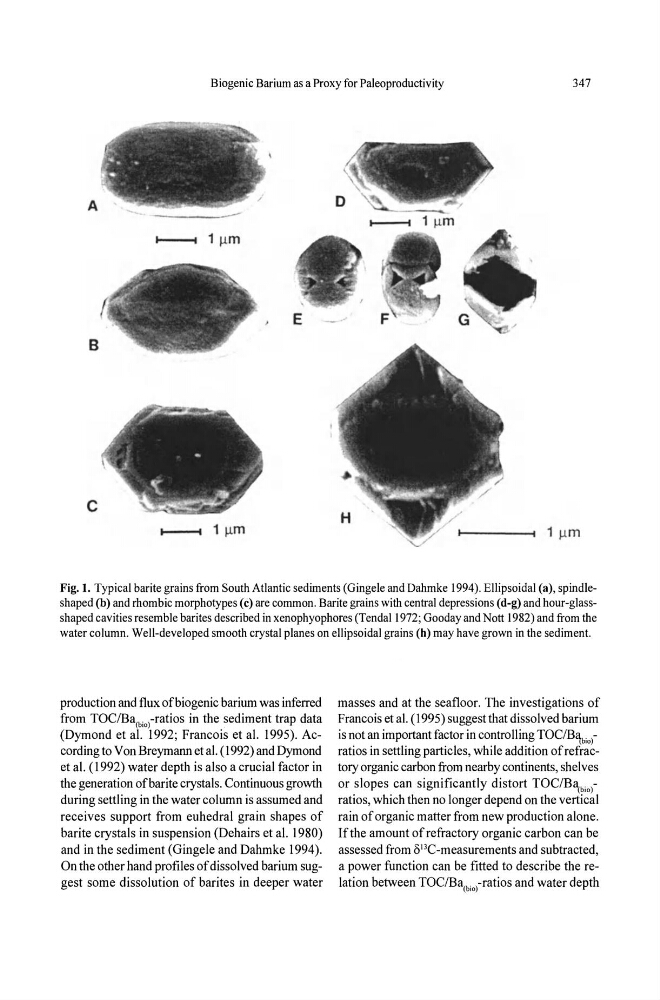
Fig. 1. Typical barite grains from South Atlantic sediments (Gingele and Dahmke 1994). Ellipsoidal (a), spindleshaped (b) and rhombic morphotypes (c) are common. Barite grains with central depressions (d-g) and hour-glassshaped cavities resemble barites described in xenophyophores (TendaI1972; Gooday and Nott 1982) and from the
water column. Well-developed smooth crystal planes on ellipsoidal grains (h) may have grown in the sediment.
production and flux of biogenic barium was inferred
from TOClBa(b;O)-ratios in the sediment trap data
(Dymond et al. 1992; Francois et al. 1995). According to Von Breymann et al. (1992) and Dymond
et al. (1992) water depth is also a crucial factor in
the generation of barite crystals. Continuous growth
during settling in the water column is assumed and
receives support from euhedral grain shapes of
barite crystals in suspension (Dehairs et al. 1980)
and in the sediment (Gingele and Dahmke 1994).
On the other hand profiles of dissolved barium suggest some dissolution of barites in deeper water
masses and at the seafloor. The investigations of
Francois et al. (1995) suggestthat dissolved barium
is not an important factor in controlling TOC/B~b;O)ratios in settling particles, while addition of refractory organic carbon from nearby continents, shelves
or slopes can significantly distort TOC/B~b;O)ratios, which then no longer depend on the vertical
rain of organic matter from new production alone.
Ifthe amount of refractory organic carbon can be
assessed from ollC-measurements and subtracted,
a power function can be fitted to describe the relation between TOC/Ba(b;O)-ratios and water depth
347
A
~ 1 /l m
E - ~
B
c
1-----...... 1 /l m
Fig. 1. Typical barite grains from South Atlantic sediments (Gingele and Dahmke 1994). Ellipsoidal (a), spindleshaped (b) and rhombic morphotypes (c) are common. Barite grains with central depressions (d-g) and hour-glassshaped cavities resemble barites described in xenophyophores (TendaI1972; Gooday and Nott 1982) and from the
water column. Well-developed smooth crystal planes on ellipsoidal grains (h) may have grown in the sediment.
production and flux of biogenic barium was inferred
from TOClBa(b;O)-ratios in the sediment trap data
(Dymond et al. 1992; Francois et al. 1995). According to Von Breymann et al. (1992) and Dymond
et al. (1992) water depth is also a crucial factor in
the generation of barite crystals. Continuous growth
during settling in the water column is assumed and
receives support from euhedral grain shapes of
barite crystals in suspension (Dehairs et al. 1980)
and in the sediment (Gingele and Dahmke 1994).
On the other hand profiles of dissolved barium suggest some dissolution of barites in deeper water
masses and at the seafloor. The investigations of
Francois et al. (1995) suggestthat dissolved barium
is not an important factor in controlling TOC/B~b;O)ratios in settling particles, while addition of refractory organic carbon from nearby continents, shelves
or slopes can significantly distort TOC/B~b;O)ratios, which then no longer depend on the vertical
rain of organic matter from new production alone.
Ifthe amount of refractory organic carbon can be
assessed from ollC-measurements and subtracted,
a power function can be fitted to describe the relation between TOC/Ba(b;O)-ratios and water depth