

336
Riihlemann et al.
changes in deep-water production and variations
of dissolved inorganic carbon species, are more
important (Riihlemann et al. 1996).
Comparison between Organic Carbon- and
Carbonate-Based Paleoproductivity
Estimates
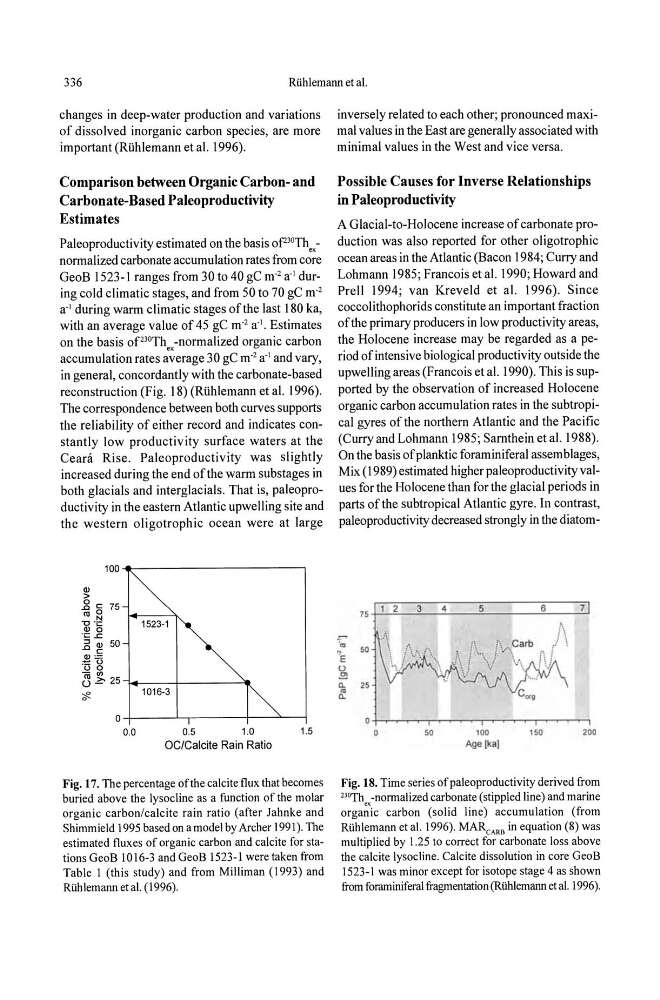
Paleoproductivity estimated on the basis of2 3 0Th ex -
normalized carbonate accumulation rates from core
GeoB 1523-1 ranges from 30 to 40 gC m· 2 a· 1 during cold climatic stages, and from 50 to 70 gC m· 2
a· 1 during warm climatic stages of the last 180 ka,
with an average value of 45 gC m· 2 a· ' . Estimates
on the basis 0[230Th ex -normalized organic carbon
accumulation rates average 30 gC ffi"2 a· 1 and vary,
in general, concordantly with the carbonate-based
reconstruction (Fig. 18) (Riihlemann et al. 1996).
The correspondence between both curves supports
the reliability of either record and indicates constantly low productivity surface waters at the
Ceara Rise. Paleoproductivity was s lightly
increased during the end of the warm substages in
both glacials and interglacials. That is, paleoproductivity in the eastern Atlantic upwelling site and
the western oligotrophic ocean were at large
100 ..... - - - - - - - - - - - - ,
Q)
>
25 75
'" N
-0 0C::
1523-1
Q) 0
.~ J:
~ Q)
.oc:
50
Q)=
:!::'o
U 0
8~ 25
?f' .
1016-3
0
0.0
0.5
1.0
1.5
OC/Calcite Rain Ratio
Fig. 17. The percentage of the calcite flux that becomes
buried above the lysocline as a function of the molar
organic carbon/calcite rain ratio (after Jahnke and
Shimmield 1995 based on a model by Archer 1991). The
estimated fluxes of organic carbon and calcite for stations GeoB 1016-3 and GeoB 1523-1 were taken from
Table 1 (this study) and from Milliman (1993) and
Riihlemann et aL (1996).
inversely related to each other; pronounced maximal values in the East are generally associated with
minimal values in the West and vice versa.
Possible Causes for Inverse Relationships
in Paleoproductivity
A Glacial-to-Holocene increase of carbonate production was also reported for other oligotrophic
ocean areas in the Atlantic (Bacon 1984; Curry and
Lohmann 1985; Francois et al. 1990; Howard and
Prell 1994; van Kreveld et al. 1996). Since
coccolithophorids constitute an important fraction
ofthe primary producers in low productivity areas,
the Holocene increase may be regarded as a period of intensive biological productivity outside the
upwelling areas (Francois et al. 1990). This is supported by the observation of increased Holocene
organic carbon accumulation rates in the subtropical gyres of the northern Atlantic and the Pacific
(Curry and Lohmann 1985; Sarnthein et at 1988).
On the basis of planktic foraminiferal assemblages,
Mix (1989) estimated higher paleoproductivity values for the Holocene than for the glacial periods in
parts of the SUbtropical Atlantic gyre. In contrast,
paleoproductivity decreased strongly in the diatom75
1 2
3
4
5
6
~
~E
50
()
.!:!l
II' "
25
II0
0
50
100
150
200
Age IkaJ
Fig. 18. Time series of paleoproductivity derived from
23°Thox-normalized carbonate (stippled line) and marine
organic carbon (solid line) accumulation (from
Riihlemann et al. 1996). MARcARB in equation (8) was
multiplied by 1.25 to correct for carbonate loss above
the calcite lysocline. Calcite dissolution in core GeoB
1523-1 was minor except for isotope stage 4 as shown
from foraminiferal fragmentation (Riihlemann et al. 1996).
Riihlemann et al.
changes in deep-water production and variations
of dissolved inorganic carbon species, are more
important (Riihlemann et al. 1996).
Comparison between Organic Carbon- and
Carbonate-Based Paleoproductivity
Estimates
Paleoproductivity estimated on the basis of2 3 0Th ex -
normalized carbonate accumulation rates from core
GeoB 1523-1 ranges from 30 to 40 gC m· 2 a· 1 during cold climatic stages, and from 50 to 70 gC m· 2
a· 1 during warm climatic stages of the last 180 ka,
with an average value of 45 gC m· 2 a· ' . Estimates
on the basis 0[230Th ex -normalized organic carbon
accumulation rates average 30 gC ffi"2 a· 1 and vary,
in general, concordantly with the carbonate-based
reconstruction (Fig. 18) (Riihlemann et al. 1996).
The correspondence between both curves supports
the reliability of either record and indicates constantly low productivity surface waters at the
Ceara Rise. Paleoproductivity was s lightly
increased during the end of the warm substages in
both glacials and interglacials. That is, paleoproductivity in the eastern Atlantic upwelling site and
the western oligotrophic ocean were at large
100 ..... - - - - - - - - - - - - ,
Q)
>
25 75
'" N
-0 0C::
1523-1
Q) 0
.~ J:
~ Q)
.oc:
50
Q)=
:!::'o
U 0
8~ 25
?f' .
1016-3
0
0.0
0.5
1.0
1.5
OC/Calcite Rain Ratio
Fig. 17. The percentage of the calcite flux that becomes
buried above the lysocline as a function of the molar
organic carbon/calcite rain ratio (after Jahnke and
Shimmield 1995 based on a model by Archer 1991). The
estimated fluxes of organic carbon and calcite for stations GeoB 1016-3 and GeoB 1523-1 were taken from
Table 1 (this study) and from Milliman (1993) and
Riihlemann et aL (1996).
inversely related to each other; pronounced maximal values in the East are generally associated with
minimal values in the West and vice versa.
Possible Causes for Inverse Relationships
in Paleoproductivity
A Glacial-to-Holocene increase of carbonate production was also reported for other oligotrophic
ocean areas in the Atlantic (Bacon 1984; Curry and
Lohmann 1985; Francois et al. 1990; Howard and
Prell 1994; van Kreveld et al. 1996). Since
coccolithophorids constitute an important fraction
ofthe primary producers in low productivity areas,
the Holocene increase may be regarded as a period of intensive biological productivity outside the
upwelling areas (Francois et al. 1990). This is supported by the observation of increased Holocene
organic carbon accumulation rates in the subtropical gyres of the northern Atlantic and the Pacific
(Curry and Lohmann 1985; Sarnthein et at 1988).
On the basis of planktic foraminiferal assemblages,
Mix (1989) estimated higher paleoproductivity values for the Holocene than for the glacial periods in
parts of the SUbtropical Atlantic gyre. In contrast,
paleoproductivity decreased strongly in the diatom75
1 2
3
4
5
6
~
~E
50
()
.!:!l
II' "
25
II0
0
50
100
150
200
Age IkaJ
Fig. 18. Time series of paleoproductivity derived from
23°Thox-normalized carbonate (stippled line) and marine
organic carbon (solid line) accumulation (from
Riihlemann et al. 1996). MARcARB in equation (8) was
multiplied by 1.25 to correct for carbonate loss above
the calcite lysocline. Calcite dissolution in core GeoB
1523-1 was minor except for isotope stage 4 as shown
from foraminiferal fragmentation (Riihlemann et al. 1996).