

334
Riihlemann et al.
GeoB
1016-3
1523-1
Ratio
Preservation
Loss
East
West
EastlWest
of initially produced Corg
[gC m- 2 a-I]
East [%]
West[%]
East [%]
West[%]
Warm Climatic Stages
pp
180
45
4
100
100
XP
63
6
10
35
14
65
86
FCorg
3.7
0.5
2
0.3
33
13.7
AR Corg
0.4
0.04
10
0.2
0.02
0.3
SI
3.5
2.2
1.6
SR
4 em ka- I 2 em ka- I
2
O2 penetr
13 mm
180mm
14
Cold Climatic Stages
pp
400
30
13
100
100
XP
260
4
62
65
14
35
86
FCorg
12
0.3
38
6
0.2
59
13.8
AR Corg
0.75
0.03
25
0.4
0.02
6
0.2
SI
>3.5
2.2
>1.6
SR
6 em ka- I 2emka- 1
O2 penetr
<13mm
180mm
<14
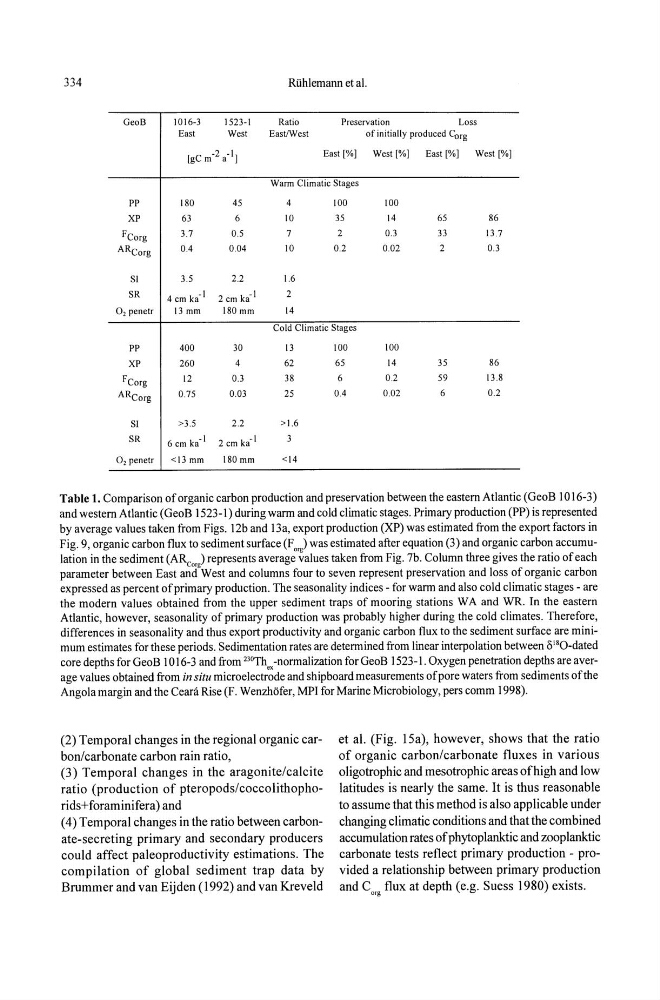
Table 1. Comparison of organic carbon production and preservation between the eastern Atlantic (GeoB 1016-3)
and western Atlantic (GeoB 1523-1) during warm and cold climatic stages. Primary production (PP) is represented
by average values taken from Figs. 12b and 13 a, export production (XP) was estimated from the export factors in
Fig. 9, organic carbon flux to sediment surface (F"g) was estimated after equation (3) and organic carbon accumulation in the sediment (ARC"g) represents average values taken from Fig. 7b. Column three gives the ratio of each
parameter between East and West and columns four to seven represent preservation and loss of organic carbon
expressed as percent of primary production. The seasonality indices - for warm and also cold climatic stages - are
the modem values obtained from the upper sediment traps of mooring stations W A and WR. In the eastern
Atlantic, however, seasonality of primary production was probably higher during the cold climates. Therefore,
differences in seasonality and thus export productivity and organic carbon flux to the sediment surface are minimum estimates for these periods. Sedimentation rates are determined from linear interpolation between (l I8 O-dated
core depths for GeoB 1016-3 and from 230Th ox -normalization for GeoB 1523-1. Oxygen penetration depths are average values obtained from in situ microelectrode and shipboard measurements of pore waters from sediments ofthe
Angola margin and the Ceara Rise (F. Wenzhofer, MPI for Marine Microbiology, pers comm 1998).
(2) Temporal changes in the regional organic carbon/carbonate carbon rain ratio,
(3) Temporal changes in the aragonite/calcite
ratio (production of pteropods/coccolithophorids+foraminifera) and
(4) Temporal changes in the ratio between carbonate-secreting primary and secondary producers
could affect paleoproductivity estimations. The
compilation of global sediment trap data by
Brummer and van Eijden (1992) and van Kreveld
et al. (Fig. 15a), however, shows that the ratio
of organic carbon/carbonate fluxes in various
oligotrophic and mesotrophic areas of high and low
latitudes is nearly the same. It is thus reasonable
to assume that this method is also applicable under
changing climatic conditions and that the combined
accumulation rates of phytoplanktic and zooplanktic
carbonate tests reflect primary production - provided a relationship between primary production
and C "g flux at depth (e.g. Suess 1980) exists.
Riihlemann et al.
GeoB
1016-3
1523-1
Ratio
Preservation
Loss
East
West
EastlWest
of initially produced Corg
[gC m- 2 a-I]
East [%]
West[%]
East [%]
West[%]
Warm Climatic Stages
pp
180
45
4
100
100
XP
63
6
10
35
14
65
86
FCorg
3.7
0.5
2
0.3
33
13.7
AR Corg
0.4
0.04
10
0.2
0.02
0.3
SI
3.5
2.2
1.6
SR
4 em ka- I 2 em ka- I
2
O2 penetr
13 mm
180mm
14
Cold Climatic Stages
pp
400
30
13
100
100
XP
260
4
62
65
14
35
86
FCorg
12
0.3
38
6
0.2
59
13.8
AR Corg
0.75
0.03
25
0.4
0.02
6
0.2
SI
>3.5
2.2
>1.6
SR
6 em ka- I 2emka- 1
O2 penetr
<13mm
180mm
<14
Table 1. Comparison of organic carbon production and preservation between the eastern Atlantic (GeoB 1016-3)
and western Atlantic (GeoB 1523-1) during warm and cold climatic stages. Primary production (PP) is represented
by average values taken from Figs. 12b and 13 a, export production (XP) was estimated from the export factors in
Fig. 9, organic carbon flux to sediment surface (F"g) was estimated after equation (3) and organic carbon accumulation in the sediment (ARC"g) represents average values taken from Fig. 7b. Column three gives the ratio of each
parameter between East and West and columns four to seven represent preservation and loss of organic carbon
expressed as percent of primary production. The seasonality indices - for warm and also cold climatic stages - are
the modem values obtained from the upper sediment traps of mooring stations W A and WR. In the eastern
Atlantic, however, seasonality of primary production was probably higher during the cold climates. Therefore,
differences in seasonality and thus export productivity and organic carbon flux to the sediment surface are minimum estimates for these periods. Sedimentation rates are determined from linear interpolation between (l I8 O-dated
core depths for GeoB 1016-3 and from 230Th ox -normalization for GeoB 1523-1. Oxygen penetration depths are average values obtained from in situ microelectrode and shipboard measurements of pore waters from sediments ofthe
Angola margin and the Ceara Rise (F. Wenzhofer, MPI for Marine Microbiology, pers comm 1998).
(2) Temporal changes in the regional organic carbon/carbonate carbon rain ratio,
(3) Temporal changes in the aragonite/calcite
ratio (production of pteropods/coccolithophorids+foraminifera) and
(4) Temporal changes in the ratio between carbonate-secreting primary and secondary producers
could affect paleoproductivity estimations. The
compilation of global sediment trap data by
Brummer and van Eijden (1992) and van Kreveld
et al. (Fig. 15a), however, shows that the ratio
of organic carbon/carbonate fluxes in various
oligotrophic and mesotrophic areas of high and low
latitudes is nearly the same. It is thus reasonable
to assume that this method is also applicable under
changing climatic conditions and that the combined
accumulation rates of phytoplanktic and zooplanktic
carbonate tests reflect primary production - provided a relationship between primary production
and C "g flux at depth (e.g. Suess 1980) exists.