

324
Riihlemann et al.
Carbonate ion concentration [lJmOI kg-')
% Foraminiferal Fragments
0
50
100
150
200
250
300
0
20
40
60
80
0
....
a
b
GEOSECS stations
%CaCO,
Station 39
o Box cores
...
Station 40
<> Sediment cores
(Curry & Lohmann. 1990)
E 2
C
• Fragments
.c
Ci.
C1>
"0
iii
0
~
3
Aragonite Iysodine
4
Caiote Iysodine
5
0
20
40
60
80
%CaCO,
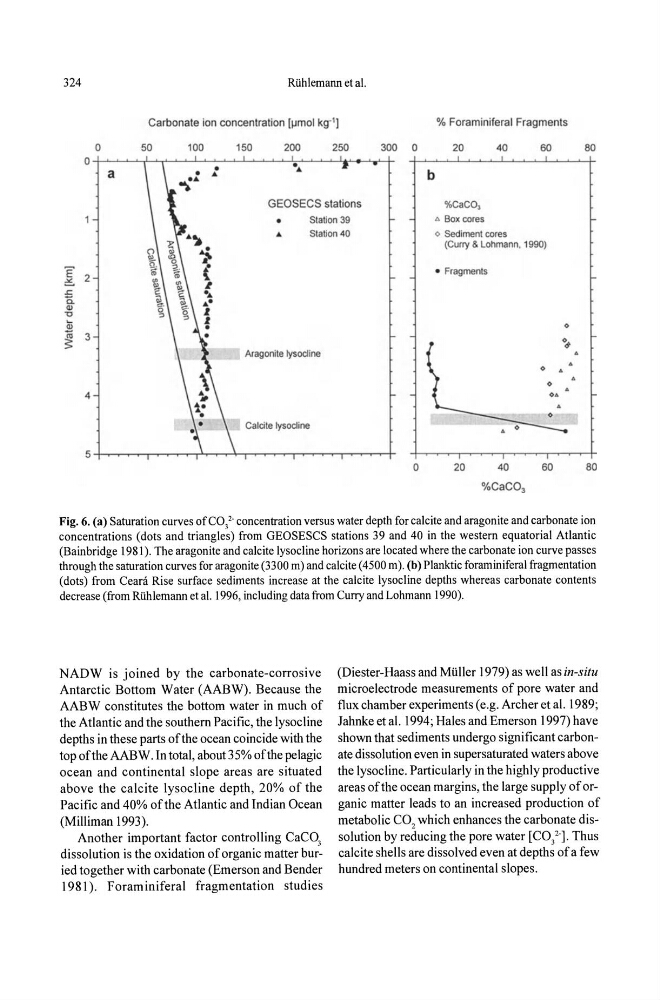
Fig. 6. (a) Saturation curves of CO,'" concentration versus water depth for calcite and aragonite and carbonate ion
concentrations (dots and triangles) from GEOSESCS stations 39 and 40 in the western equatorial Atlantic
(Bainbridge 1981). The aragonite and calcite lysocline horizons are located where the carbonate ion curve passes
through the saturation curves for aragonite (3300 m) and calcite (4500 m). (b) Planktic foraminiferal fragmentation
(dots) from Ceara Rise surface sediments increase at the calcite lysocline depths whereas carbonate contents
decrease (from Riihlemann et al. 1996, including data from Curry and Lohmann 1990).
NADW is joined by the carbonate-corrosive
Antarctic Bottom Water (AABW). Because the
AABW constitutes the bottom water in much of
the Atlantic and the southern Pacific, the lysocline
depths in these parts ofthe ocean coincide with the
top of the AABW. In total, about 35% of the pelagic
ocean and continental slope areas are situated
above the calcite lysocline depth, 20% of the
Pacific and 40% ofthe Atlantic and Indian Ocean
(Milliman 1993).
Another important factor controlling CaC0 3
dissolution is the oxidation of organic matter buried together with carbonate (Emerson and Bender
1981). Foraminiferal fragmentation studies
(Diester-Haass and MUller 1979) as well as in-situ
microelectrode measurements of pore water and
flux chamber experiments (e.g. Archer et al. 1989;
Jahnke et al. 1994; Hales and Emerson 1997) have
shown that sediments undergo significant carbonate dissolution even in supersaturated waters above
the lysocline. Particularly in the highly productive
areas ofthe ocean margins, the large supply of organic matter leads to an increased production of
metabolic CO 2 which enhances the carbonate dissolution by reducing the pore water [CO/l Thus
calcite shells are dissolved even at depths of a few
hundred meters on continental slopes.
Riihlemann et al.
Carbonate ion concentration [lJmOI kg-')
% Foraminiferal Fragments
0
50
100
150
200
250
300
0
20
40
60
80
0
....
a
b
GEOSECS stations
%CaCO,
Station 39
o Box cores
...
Station 40
<> Sediment cores
(Curry & Lohmann. 1990)
E 2
C
• Fragments
.c
Ci.
C1>
"0
iii
0
~
3
Aragonite Iysodine
4
Caiote Iysodine
5
0
20
40
60
80
%CaCO,
Fig. 6. (a) Saturation curves of CO,'" concentration versus water depth for calcite and aragonite and carbonate ion
concentrations (dots and triangles) from GEOSESCS stations 39 and 40 in the western equatorial Atlantic
(Bainbridge 1981). The aragonite and calcite lysocline horizons are located where the carbonate ion curve passes
through the saturation curves for aragonite (3300 m) and calcite (4500 m). (b) Planktic foraminiferal fragmentation
(dots) from Ceara Rise surface sediments increase at the calcite lysocline depths whereas carbonate contents
decrease (from Riihlemann et al. 1996, including data from Curry and Lohmann 1990).
NADW is joined by the carbonate-corrosive
Antarctic Bottom Water (AABW). Because the
AABW constitutes the bottom water in much of
the Atlantic and the southern Pacific, the lysocline
depths in these parts ofthe ocean coincide with the
top of the AABW. In total, about 35% of the pelagic
ocean and continental slope areas are situated
above the calcite lysocline depth, 20% of the
Pacific and 40% ofthe Atlantic and Indian Ocean
(Milliman 1993).
Another important factor controlling CaC0 3
dissolution is the oxidation of organic matter buried together with carbonate (Emerson and Bender
1981). Foraminiferal fragmentation studies
(Diester-Haass and MUller 1979) as well as in-situ
microelectrode measurements of pore water and
flux chamber experiments (e.g. Archer et al. 1989;
Jahnke et al. 1994; Hales and Emerson 1997) have
shown that sediments undergo significant carbonate dissolution even in supersaturated waters above
the lysocline. Particularly in the highly productive
areas ofthe ocean margins, the large supply of organic matter leads to an increased production of
metabolic CO 2 which enhances the carbonate dissolution by reducing the pore water [CO/l Thus
calcite shells are dissolved even at depths of a few
hundred meters on continental slopes.