

22
Weferetal.
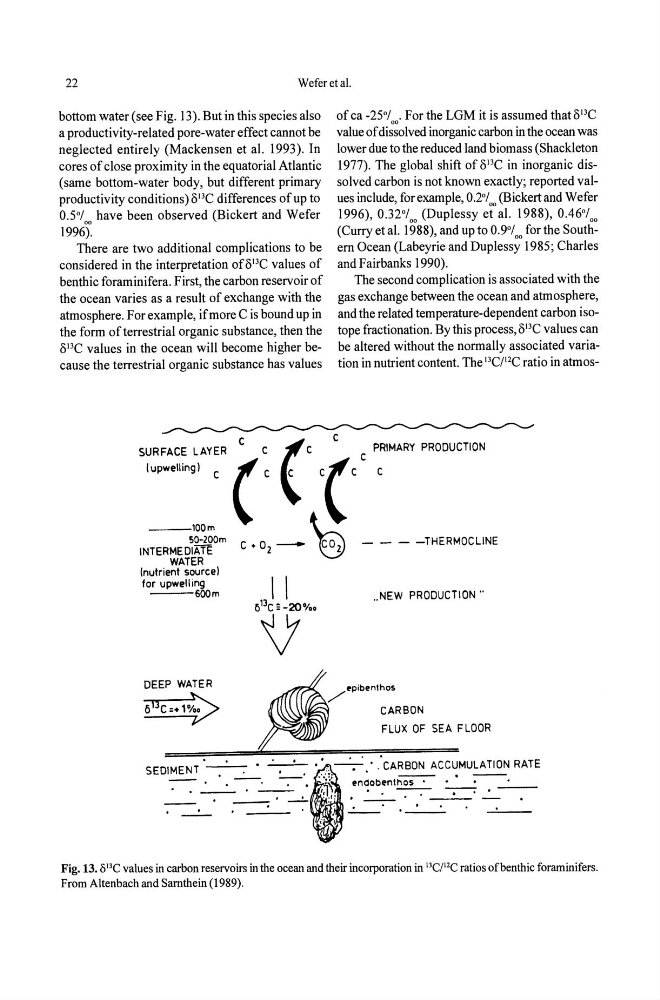
bottom water (see Fig. 13). But in this species also
a productivity-related pore-water effect cannot be
neglected entirely (Macken sen et al. 1993). In
cores of close proximity in the equatorial Atlantic
(same bottom-water body, but different primary
productivity conditions) (il3C differences of up to
0.5 0 / 00 have been observed (Bickert and Wefer
1996).
There are two additional complications to be
considered in the interpretation of(il3C values of
benthic foraminifera. First, the carbon reservoir of
the ocean varies as a result of exchange with the
atmosphere. For example, ifmore C is bound up in
the form of terrestrial organic substance, then the
(il3C values in the ocean will become higher because the terrestrial organic substance has values
of ca -25%0' For the LGM it is assumed that(il3C
value of dissolved inorganic carbon in the ocean was
lower due to the reduced land biomass (Shackleton
1977). The global shift of (il3C in inorganic dissolved carbon is not known exactly; reported values include, for example, 0.2 0 / 00 (Bickert and Wefer
1996), 0.32 0 / 00 (Duplessy et al. 1988), 0.46% 0
(Curry et al. 1988), and up to 0.9 0 / 00 for the Southern Ocean (Labeyrie and Duplessy 1985; Charles
and Fairbanks 1990).
The second complication is associated with the
gas exchange between the ocean and atmosphere,
and the related temperature-dependent carbon isotope fractionation. By this process, (il3C values can
be altered without the normally associated variation in nutrient content. The l3C/12C ratio in atmosSURFACE LAYER C etc c c PRIMARY PRODUCTION
'"pw.'lio,1 c (c \ '( c C
_ _ _ 100m
\§
50-200m
CO
- - - -THERMOCLINE
INTERMEDIATE
C • O2 -
2
WATER
(nutrient source)
for upwell ing
---600m
.. NEW PRODUCTION"
/"p;b"nlhOS
CARBON
FLUX OF SEA FLOOR
SEDI~ .~ • '. "I'~i:: ' . . . . .'CARBON ACC~MULATION RATE
' .
.
.
•
:~
endobenlhos'
•
,
.
_, _ _ • -,-~~~ ./~:I: f _ ' _ . _ - , - . -
• •
~--,' - - ' -
' - - ' - ' ' ; -'--' , - ' - - ' . - ' - -
l
I
Fig, 13, Ol3C values in carbon reservoirs in the ocean and their incorporation in l3C/I2C ratios of benthic foraminifers.
From Altenbach and Samthein (1989).
Weferetal.
bottom water (see Fig. 13). But in this species also
a productivity-related pore-water effect cannot be
neglected entirely (Macken sen et al. 1993). In
cores of close proximity in the equatorial Atlantic
(same bottom-water body, but different primary
productivity conditions) (il3C differences of up to
0.5 0 / 00 have been observed (Bickert and Wefer
1996).
There are two additional complications to be
considered in the interpretation of(il3C values of
benthic foraminifera. First, the carbon reservoir of
the ocean varies as a result of exchange with the
atmosphere. For example, ifmore C is bound up in
the form of terrestrial organic substance, then the
(il3C values in the ocean will become higher because the terrestrial organic substance has values
of ca -25%0' For the LGM it is assumed that(il3C
value of dissolved inorganic carbon in the ocean was
lower due to the reduced land biomass (Shackleton
1977). The global shift of (il3C in inorganic dissolved carbon is not known exactly; reported values include, for example, 0.2 0 / 00 (Bickert and Wefer
1996), 0.32 0 / 00 (Duplessy et al. 1988), 0.46% 0
(Curry et al. 1988), and up to 0.9 0 / 00 for the Southern Ocean (Labeyrie and Duplessy 1985; Charles
and Fairbanks 1990).
The second complication is associated with the
gas exchange between the ocean and atmosphere,
and the related temperature-dependent carbon isotope fractionation. By this process, (il3C values can
be altered without the normally associated variation in nutrient content. The l3C/12C ratio in atmosSURFACE LAYER C etc c c PRIMARY PRODUCTION
'"pw.'lio,1 c (c \ '( c C
_ _ _ 100m
\§
50-200m
CO
- - - -THERMOCLINE
INTERMEDIATE
C • O2 -
2
WATER
(nutrient source)
for upwell ing
---600m
.. NEW PRODUCTION"
/"p;b"nlhOS
CARBON
FLUX OF SEA FLOOR
SEDI~ .~ • '. "I'~i:: ' . . . . .'CARBON ACC~MULATION RATE
' .
.
.
•
:~
endobenlhos'
•
,
.
_, _ _ • -,-~~~ ./~:I: f _ ' _ . _ - , - . -
• •
~--,' - - ' -
' - - ' - ' ' ; -'--' , - ' - - ' . - ' - -
l
I
Fig, 13, Ol3C values in carbon reservoirs in the ocean and their incorporation in l3C/I2C ratios of benthic foraminifers.
From Altenbach and Samthein (1989).