

318
Riihlemann et al.
40·
'''' ~ .
• Geo~ 1p~~- 1
o·
South
10· -
America
35
20· 5
I
25
20·
• • l"'
....
. ... . .
... -
o·
20"E
..
.. ~\
,
1
GeoS 1016-3
.....
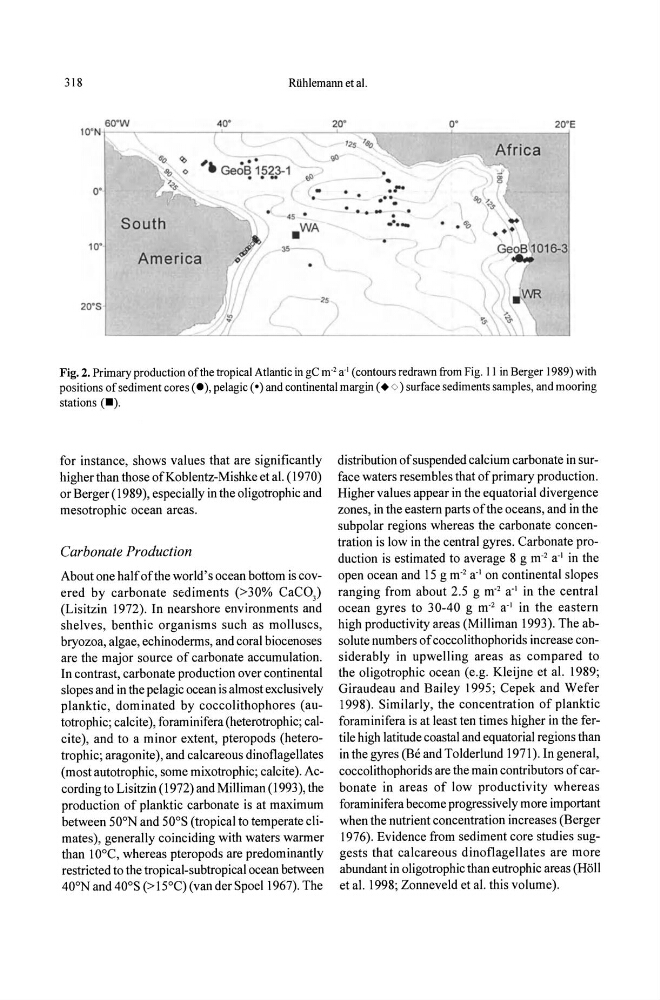
Fig. 2. Primary production of the tropical Atlantic in gC m- 2 a-I (contours redrawn from Fig. 11 in Berger 1989) with
positions of sediment cores (e), pelagic (.) and continental margin (. (> ) surface sediments samples, and mooring
stations (.).
for instance, shows values that are significantly
higher than those ofKoblentz-Mishke et al. (1970)
or Berger (1989), especially in the oligotrophic and
mesotrophic ocean areas.
Carbonate Production
About one half ofthe world' s ocean bottom is covered by carbonate sediments (>30% CaC0 3 )
(Lisitzin 1972). In nearshore environments and
shelves, benthic organisms such as molluscs,
bryozoa, algae, echinoderms, and coral biocenoses
are the major source of carbonate accumulation.
In contrast, carbonate production over continental
slopes and in the pelagic ocean is almost exclusively
planktic, dominated by coccolithophores (autotrophic; calcite), foraminifera (heterotrophic; calcite), and to a minor extent, pteropods (heterotrophic; aragonite), and calcareous dinoflagellates
(most autotrophic, some mixotrophic; calcite). According to Lisitzin (1972) and Milliman (1993), the
production of planktic carbonate is at maximum
between SooN and 50 0 S (tropical to temperate climates), generally coinciding with waters warmer
than 10°C, whereas pteropods are predominantly
restricted to the tropical-subtropical ocean between
400N and 40 0 S ( > 15°C) (van der Spoel 1967). The
distribution of suspended calcium carbonate in surface waters resembles that of primary production.
Higher values appear in the equatorial divergence
zones, in the eastern parts ofthe oceans, and in the
subpolar regions whereas the carbonate concentration is low in the central gyres. Carbonate production is estimated to average 8 g m- 2 a-I in the
open ocean and IS g m- 2 a-Ion continental slopes
ranging from about 2.5 g m- 2 a-I in the central
ocean gyres to 30-40 g m -
2 a-I in the eastern
high productivity areas (Milliman 1993). The absolute numbers of coccolithophorids increase considerably in upwelling areas as compared to
the oligotrophic ocean (e.g. Kleijne et al. 1989;
Giraudeau and Bailey 1995 ; Cepek and Wefer
1998)_ Similarly, the concentration of planktic
foraminifera is at least ten times higher in the fertile high latitude coastal and equatorial regions than
in the gyres (Be and Tolderlund 1971). In general,
coccolithophorids are the main contributors of carbonate in areas of low productivity whereas
foraminifera become progressively more important
when the nutrient concentration increases (Berger
1976)_ Evidence from sediment core studies suggests that calcareous dinoflagellates are more
abundant in oligotrophic than eutrophic areas (Hall
et al. 1998; Zonneveld et al. this volume).
Riihlemann et al.
40·
'''' ~ .
• Geo~ 1p~~- 1
o·
South
10· -
America
35
20· 5
I
25
20·
• • l"'
....
. ... . .
... -
o·
20"E
..
.. ~\
,
1
GeoS 1016-3
.....
Fig. 2. Primary production of the tropical Atlantic in gC m- 2 a-I (contours redrawn from Fig. 11 in Berger 1989) with
positions of sediment cores (e), pelagic (.) and continental margin (. (> ) surface sediments samples, and mooring
stations (.).
for instance, shows values that are significantly
higher than those ofKoblentz-Mishke et al. (1970)
or Berger (1989), especially in the oligotrophic and
mesotrophic ocean areas.
Carbonate Production
About one half ofthe world' s ocean bottom is covered by carbonate sediments (>30% CaC0 3 )
(Lisitzin 1972). In nearshore environments and
shelves, benthic organisms such as molluscs,
bryozoa, algae, echinoderms, and coral biocenoses
are the major source of carbonate accumulation.
In contrast, carbonate production over continental
slopes and in the pelagic ocean is almost exclusively
planktic, dominated by coccolithophores (autotrophic; calcite), foraminifera (heterotrophic; calcite), and to a minor extent, pteropods (heterotrophic; aragonite), and calcareous dinoflagellates
(most autotrophic, some mixotrophic; calcite). According to Lisitzin (1972) and Milliman (1993), the
production of planktic carbonate is at maximum
between SooN and 50 0 S (tropical to temperate climates), generally coinciding with waters warmer
than 10°C, whereas pteropods are predominantly
restricted to the tropical-subtropical ocean between
400N and 40 0 S ( > 15°C) (van der Spoel 1967). The
distribution of suspended calcium carbonate in surface waters resembles that of primary production.
Higher values appear in the equatorial divergence
zones, in the eastern parts ofthe oceans, and in the
subpolar regions whereas the carbonate concentration is low in the central gyres. Carbonate production is estimated to average 8 g m- 2 a-I in the
open ocean and IS g m- 2 a-Ion continental slopes
ranging from about 2.5 g m- 2 a-I in the central
ocean gyres to 30-40 g m -
2 a-I in the eastern
high productivity areas (Milliman 1993). The absolute numbers of coccolithophorids increase considerably in upwelling areas as compared to
the oligotrophic ocean (e.g. Kleijne et al. 1989;
Giraudeau and Bailey 1995 ; Cepek and Wefer
1998)_ Similarly, the concentration of planktic
foraminifera is at least ten times higher in the fertile high latitude coastal and equatorial regions than
in the gyres (Be and Tolderlund 1971). In general,
coccolithophorids are the main contributors of carbonate in areas of low productivity whereas
foraminifera become progressively more important
when the nutrient concentration increases (Berger
1976)_ Evidence from sediment core studies suggests that calcareous dinoflagellates are more
abundant in oligotrophic than eutrophic areas (Hall
et al. 1998; Zonneveld et al. this volume).