

20
Weferetal.
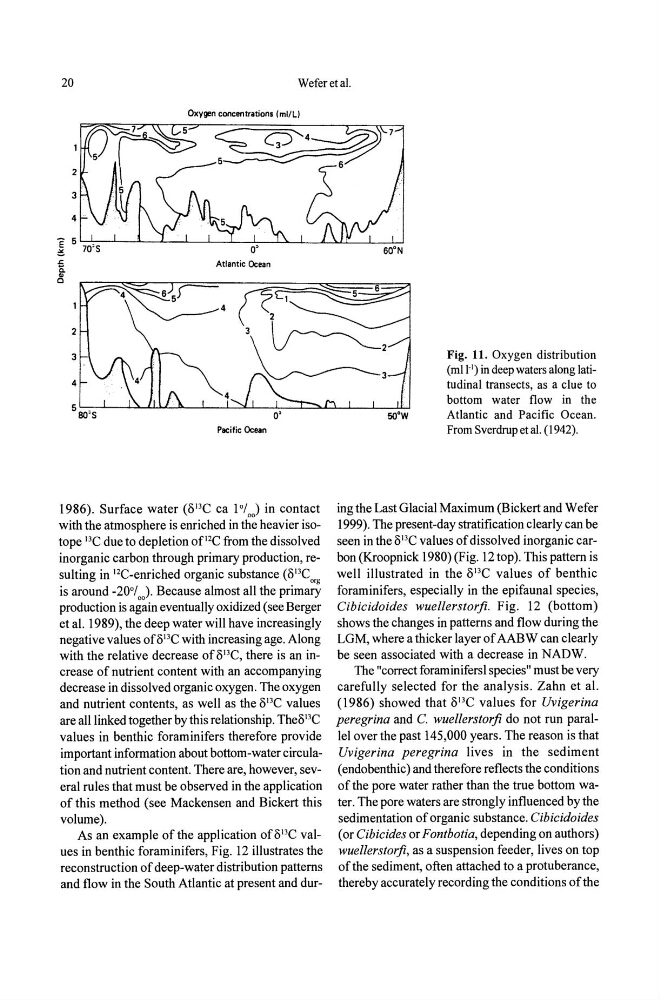
Oxygen concentrations (mill)
Pacific Ocean
1986). Surface water (813C ca 1 0 / 0 ) in contact
with the atmosphere is enriched in the heavier isotope 13C due to depletion of12C from the dissolved
inorganic carbon through primary production, resulting in 12C-enriched organic substance (8 l3 C O '"
is around -200/oJ Because almost all the primary
production is again eventually oxidized (see Berger
et al. 1989), the deep water will have increasingly
negative values of8 I3 C with increasing age. Along
with the relative decrease of 8 I3 C, there is an increase of nutrient content with an accompanying
decrease in dissolved organic oxygen. The oxygen
and nutrient contents, as well as the 8 I3 C values
are all linked together by this relationship. The8 l3 C
values in benthic foraminifers therefore provide
important information about bottom-water circulation and nutrient content. There are, however, several rules that must be observed in the application
of this method (see Mackensen and Bickert this
volume).
As an example of the application of 8 l3 C values in benthic foraminifers, Fig. 12 illustrates the
reconstruction of deep-water distribution patterns
and flow in the South Atlantic at present and durFig. 11. Oxygen distribution
(mll·l) in deep waters along latitudinal transects, as a clue to
bottom water flow in the
Atlantic and Pacific Ocean.
From Sverdrup et al. (1942).
ing the Last Glacial Maximum (Bickert and Wefer
1999). The present-day stratification clearly can be
seen in the 8 I3 C values of dissolved inorganic carbon (Kroopnick 1980) (Fig. 12 top). This pattern is
well illustrated in the 8 I3 C values of benthic
foraminifers, especially in the epifaunal species,
Cibicidoides wuellerstorfi. Fig. 12 (bottom)
shows the changes in patterns and flow during the
LGM, where a thicker layer of AABW can clearly
be seen associated with a decrease in NADW.
The "correct foraminifersl species" must be very
carefully selected for the analysis. Zahn et al.
(1986) showed that 8 13 C values for Uvigerina
peregrina and C. wuellerstorfi do not run parallel over the past 145,000 years. The reason is that
Uvigerina peregrina lives in the sediment
(endobenthic) and therefore reflects the conditions
of the pore water rather than the true bottom water. The pore waters are strongly influenced by the
sedimentation of organic substance. Cibicidoides
(or Cibicides or Fontbotia, depending on authors)
wuellerstorfi, as a suspension feeder, lives on top
of the sediment, often attached to a protuberance,
thereby accurately recording the conditions of the
Weferetal.
Oxygen concentrations (mill)
Pacific Ocean
1986). Surface water (813C ca 1 0 / 0 ) in contact
with the atmosphere is enriched in the heavier isotope 13C due to depletion of12C from the dissolved
inorganic carbon through primary production, resulting in 12C-enriched organic substance (8 l3 C O '"
is around -200/oJ Because almost all the primary
production is again eventually oxidized (see Berger
et al. 1989), the deep water will have increasingly
negative values of8 I3 C with increasing age. Along
with the relative decrease of 8 I3 C, there is an increase of nutrient content with an accompanying
decrease in dissolved organic oxygen. The oxygen
and nutrient contents, as well as the 8 I3 C values
are all linked together by this relationship. The8 l3 C
values in benthic foraminifers therefore provide
important information about bottom-water circulation and nutrient content. There are, however, several rules that must be observed in the application
of this method (see Mackensen and Bickert this
volume).
As an example of the application of 8 l3 C values in benthic foraminifers, Fig. 12 illustrates the
reconstruction of deep-water distribution patterns
and flow in the South Atlantic at present and durFig. 11. Oxygen distribution
(mll·l) in deep waters along latitudinal transects, as a clue to
bottom water flow in the
Atlantic and Pacific Ocean.
From Sverdrup et al. (1942).
ing the Last Glacial Maximum (Bickert and Wefer
1999). The present-day stratification clearly can be
seen in the 8 I3 C values of dissolved inorganic carbon (Kroopnick 1980) (Fig. 12 top). This pattern is
well illustrated in the 8 I3 C values of benthic
foraminifers, especially in the epifaunal species,
Cibicidoides wuellerstorfi. Fig. 12 (bottom)
shows the changes in patterns and flow during the
LGM, where a thicker layer of AABW can clearly
be seen associated with a decrease in NADW.
The "correct foraminifersl species" must be very
carefully selected for the analysis. Zahn et al.
(1986) showed that 8 13 C values for Uvigerina
peregrina and C. wuellerstorfi do not run parallel over the past 145,000 years. The reason is that
Uvigerina peregrina lives in the sediment
(endobenthic) and therefore reflects the conditions
of the pore water rather than the true bottom water. The pore waters are strongly influenced by the
sedimentation of organic substance. Cibicidoides
(or Cibicides or Fontbotia, depending on authors)
wuellerstorfi, as a suspension feeder, lives on top
of the sediment, often attached to a protuberance,
thereby accurately recording the conditions of the