

298
Diekmann et aI.
Isotope Stages
3
4
5.1
5.3
5.5
PS2495
'\
PS2498
,
"v""
PS2499
40
60
80
100
120
Age (ka)
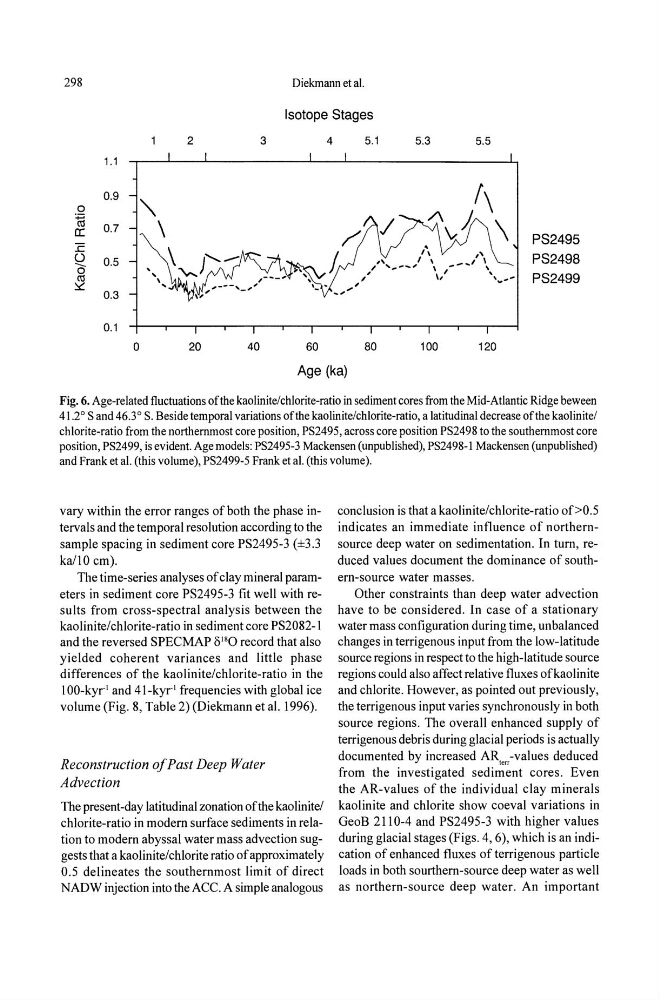
Fig. 6. Age-related fluctuations of the kaolinite/chlorite-ratio in sediment cores from the Mid-Atlantic Ridge beween
41.2° Sand 46.3 0 S. Beside temporal variations of the kaolinite/chlorite-ratio, a latitudinal decrease of the kaolinite/
chlorite-ratio from the northernmost core position, PS2495, across core position PS2498 to the southernmost core
position, PS2499, is evident. Age models: PS2495-3 Mackensen (unpublished), PS2498-J Mackensen (unpublished)
and Frank et al. (this volume), PS2499-5 Frank et al. (this volume).
vary within the error ranges of both the phase intervals and the temporal resolution according to the
sample spacing in sediment core PS2495-3 (±3.3
ka/IO cm).
The time-series analyses of clay mineral parameters in sediment core PS2495-3 fit well with results from cross-spectral analysis between the
kaolinite/chlorite-ratio in sediment core PS2082-1
and the reversed SPECMAP 8 18 0 record that also
yielded coherent variances and little phase
differences of the kaolinite/chlorite-ratio in the
100-kyrl and 41-kyr·1 frequencies with global ice
volume (Fig. 8, Table 2) (Diekmann et al. 1996).
Reconstruction o/Past Deep Water
Advection
The present-day latitudinal zonation of the kaolinite/
chlorite-ratio in modem surface sediments in relation to modem abyssal water mass advection suggests that a kaolinite/chlorite ratio of approximately
0.5 delineates the southernmost limit of direct
NADW injection into the ACC. A simple analogous
conclusion is that a kaolinite/chlorite-ratio of>O.5
indicates an immediate influence of northernsource deep water on sedimentation. In tum, reduced values document the dominance of southern-source water masses.
Other constraints than deep water advection
have to be considered. In case of a stationary
water mass configuration during time, unbalanced
changes in terrigenous input from the low-latitude
source regions in respect to the high-latitude source
regions could also affect relative fluxes of kaolinite
and chlorite. However, as pointed out previously,
the terrigenous input varies synchronously in both
source regions. The overall enhanced supply of
terrigenous debris during glacial periods is actually
documented by increased ARlen-values deduced
from the investigated sediment cores. Even
the AR-values of the individual clay minerals
kaolinite and chlorite show coeval variations in
GeoB 2110-4 and PS2495-3 with higher values
during glacial stages (Figs. 4, 6), which is an indication of enhanced fluxes of terrigenous particle
loads in both sourthern-source deep water as well
as northern-source deep water. An important
Diekmann et aI.
Isotope Stages
3
4
5.1
5.3
5.5
PS2495
'\
PS2498
,
"v""
PS2499
40
60
80
100
120
Age (ka)
Fig. 6. Age-related fluctuations of the kaolinite/chlorite-ratio in sediment cores from the Mid-Atlantic Ridge beween
41.2° Sand 46.3 0 S. Beside temporal variations of the kaolinite/chlorite-ratio, a latitudinal decrease of the kaolinite/
chlorite-ratio from the northernmost core position, PS2495, across core position PS2498 to the southernmost core
position, PS2499, is evident. Age models: PS2495-3 Mackensen (unpublished), PS2498-J Mackensen (unpublished)
and Frank et al. (this volume), PS2499-5 Frank et al. (this volume).
vary within the error ranges of both the phase intervals and the temporal resolution according to the
sample spacing in sediment core PS2495-3 (±3.3
ka/IO cm).
The time-series analyses of clay mineral parameters in sediment core PS2495-3 fit well with results from cross-spectral analysis between the
kaolinite/chlorite-ratio in sediment core PS2082-1
and the reversed SPECMAP 8 18 0 record that also
yielded coherent variances and little phase
differences of the kaolinite/chlorite-ratio in the
100-kyrl and 41-kyr·1 frequencies with global ice
volume (Fig. 8, Table 2) (Diekmann et al. 1996).
Reconstruction o/Past Deep Water
Advection
The present-day latitudinal zonation of the kaolinite/
chlorite-ratio in modem surface sediments in relation to modem abyssal water mass advection suggests that a kaolinite/chlorite ratio of approximately
0.5 delineates the southernmost limit of direct
NADW injection into the ACC. A simple analogous
conclusion is that a kaolinite/chlorite-ratio of>O.5
indicates an immediate influence of northernsource deep water on sedimentation. In tum, reduced values document the dominance of southern-source water masses.
Other constraints than deep water advection
have to be considered. In case of a stationary
water mass configuration during time, unbalanced
changes in terrigenous input from the low-latitude
source regions in respect to the high-latitude source
regions could also affect relative fluxes of kaolinite
and chlorite. However, as pointed out previously,
the terrigenous input varies synchronously in both
source regions. The overall enhanced supply of
terrigenous debris during glacial periods is actually
documented by increased ARlen-values deduced
from the investigated sediment cores. Even
the AR-values of the individual clay minerals
kaolinite and chlorite show coeval variations in
GeoB 2110-4 and PS2495-3 with higher values
during glacial stages (Figs. 4, 6), which is an indication of enhanced fluxes of terrigenous particle
loads in both sourthern-source deep water as well
as northern-source deep water. An important