

276
Dittert et al.
Increasing dissolution
J
J
0.75 0.5 0.25
0
E- O
-E
<>
<>
O ~
500
<>
"
a.
<>
<>
500 ~
Q)
"
1,000
1,000 ?}
... Q)
"0
-;;; 1,500
1 ,500~
~ 2,000
2,000 22,500
2,500
3,000
3,000
3,500
3,500
4,000
4,000
4,500
4,500
5,000
5,000
5,500
5,500
0
2
3
4
5
0
0.05
0.1
BDX
CEX
Rain ratio
Continental margin D
0(}
Transect 1 - Equatorial Atlantic
Opcn ocean
D 0 Transect 2 - Walvis Ridge
Deep sea
•
<>
Transect 3
Continental margin
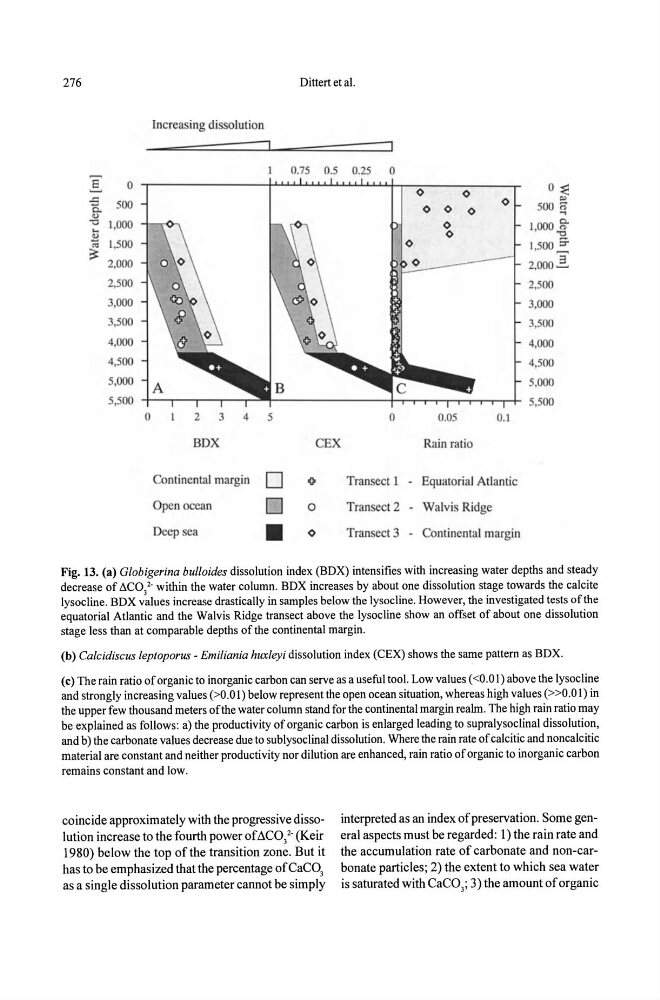
Fig. 13. (a) Globigerina bulloides dissolution index (BDX) intensifies with increasing water depths and steady
decrease of !o.CO/" within the water column. BDX increases by about one dissolution stage towards the calcite
lysocline. BDX values increase drastically in samples below the lysocline. However, the investigated tests of the
equatorial Atlantic and the Walvis Ridge transect above the lysocline show an offset of about one dissolution
stage less than at comparable depths of the continental margin.
(b) Calcidiscus leptoporus - Emiliania huxleyi dissolution index (CEX) shows the same pattern as BDX.
(e) The rain ratio of organic to inorganic carbon can serve as a useful tool. Low values «0.01) above the lysocline
and strongly increasing values (>0.01) below representthe open ocean situation, whereas high values (»0.01) in
the upper few thousand meters of the water column stand for the continental margin realm. The high rain ratio may
be explained as follows: a) the productivity of organic carbon is enlarged leading to supralysoclinal dissolution,
and b) the carbonate values decrease due to sublysoclinal dissolution. Where the rain rate of calcitic and noncalcitic
material are constant and neither productivity nor dilution are enhanced, rain ratio of organic to inorganic carbon
remains constant and low.
coincide approximately with the progressive dissolution increase to the fourth power ofto.CO/, (Keir
1980) below the top of the transition zone. But it
has to be emphasized that the percentage of CaC0 3
as a single dissolution parameter cannot be simply
interpreted as an index of preservation. Some general aspects must be regarded: 1) the rain rate and
the accumulation rate of carbonate and non-carbonate particles; 2) the extent to which sea water
is saturated with CaC0 3 ; 3) the amount of organic
Dittert et al.
Increasing dissolution
J
J
0.75 0.5 0.25
0
E- O
-E
<>
<>
O ~
500
<>
"
a.
<>
<>
500 ~
Q)
"
1,000
1,000 ?}
... Q)
"0
-;;; 1,500
1 ,500~
~ 2,000
2,000 22,500
2,500
3,000
3,000
3,500
3,500
4,000
4,000
4,500
4,500
5,000
5,000
5,500
5,500
0
2
3
4
5
0
0.05
0.1
BDX
CEX
Rain ratio
Continental margin D
0(}
Transect 1 - Equatorial Atlantic
Opcn ocean
D 0 Transect 2 - Walvis Ridge
Deep sea
•
<>
Transect 3
Continental margin
Fig. 13. (a) Globigerina bulloides dissolution index (BDX) intensifies with increasing water depths and steady
decrease of !o.CO/" within the water column. BDX increases by about one dissolution stage towards the calcite
lysocline. BDX values increase drastically in samples below the lysocline. However, the investigated tests of the
equatorial Atlantic and the Walvis Ridge transect above the lysocline show an offset of about one dissolution
stage less than at comparable depths of the continental margin.
(b) Calcidiscus leptoporus - Emiliania huxleyi dissolution index (CEX) shows the same pattern as BDX.
(e) The rain ratio of organic to inorganic carbon can serve as a useful tool. Low values «0.01) above the lysocline
and strongly increasing values (>0.01) below representthe open ocean situation, whereas high values (»0.01) in
the upper few thousand meters of the water column stand for the continental margin realm. The high rain ratio may
be explained as follows: a) the productivity of organic carbon is enlarged leading to supralysoclinal dissolution,
and b) the carbonate values decrease due to sublysoclinal dissolution. Where the rain rate of calcitic and noncalcitic
material are constant and neither productivity nor dilution are enhanced, rain ratio of organic to inorganic carbon
remains constant and low.
coincide approximately with the progressive dissolution increase to the fourth power ofto.CO/, (Keir
1980) below the top of the transition zone. But it
has to be emphasized that the percentage of CaC0 3
as a single dissolution parameter cannot be simply
interpreted as an index of preservation. Some general aspects must be regarded: 1) the rain rate and
the accumulation rate of carbonate and non-carbonate particles; 2) the extent to which sea water
is saturated with CaC0 3 ; 3) the amount of organic