

Clues to Ocean History: a Brief Overview of Proxies
15
0,006.,--=-_ _ _ _ _ _ _ _ _ _ _ _ _ _ _ _ _ _ _ _ _ ~
•
G. saccuHfer (this study)
o N. pachyder rna sin .• South AU. (f\llrnt:erg. 1995)
•
N. pachyder ma sin .• North Atl. (f\Ljrnt:erg. 1995)
O,OOS-l------------------____ --J~
i·
N. dutertrei (Rosenthal! Boyle, 1993)
(} G. ruber (Rosenthal & Boyle. 1993)
x G. sacculi'er (Rosenthal & Boyle, 1993)
.. G. sacculifsr (Oelan«,/ at a1.. 1985)
'" G. menardii (Delaney at al,. 1985)
() G. sacculifer (Delaney et at.. 1985). ~
'1'
G. menardii (Delaney at aI., 1985), ~
0.002-1----------------7"'~ __ - - - - - " - _ _ 1
0.001 +----.,..,.,. ... I.-~_::=:...-------------_l
y = 4, 7113&-4. 10"(3.573ge-2x)
R"2 • 0,845
·2
10
12
14
16
18
20
22
24
26
28
30
T ('C)
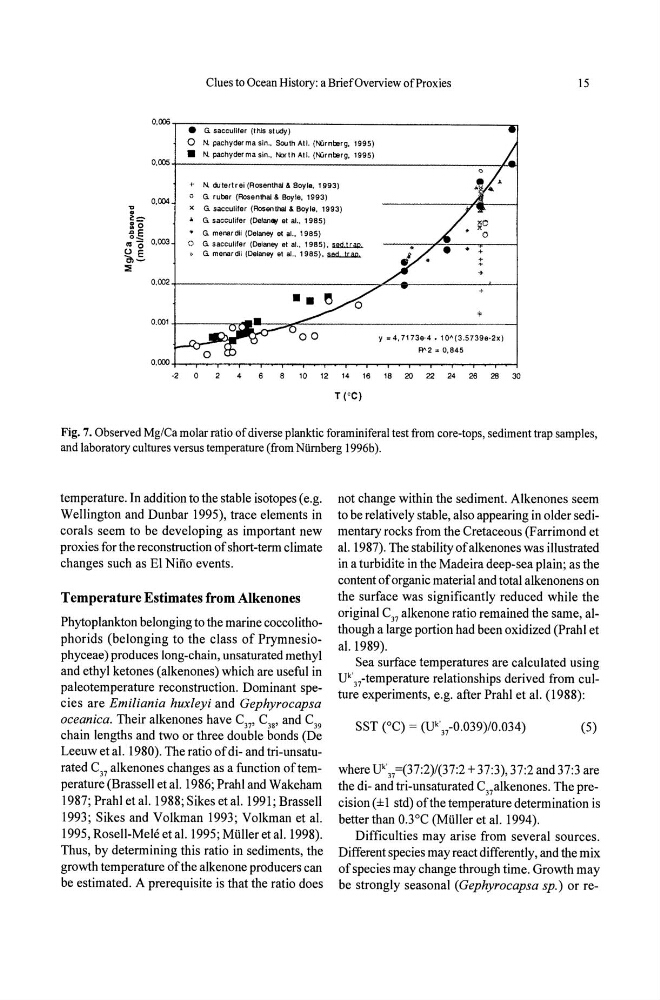
Fig. 7. Observed Mg/Ca molar ratio of diverse planktic foraminiferal test from core-tops, sediment trap samples,
and laboratory cultures versus temperature (from Niimberg 1996b).
temperature. In addition to the stable isotopes (e.g.
Wellington and Dunbar 1995), trace elements in
corals seem to be developing as important new
proxies for the reconstruction of short-term climate
changes such as El Nifio events.
Temperature Estimates from Alkenones
Phytoplankton belonging to the marine coccolithophorids (belonging to the class of Prymnesiophyceae) produces long-chain, unsaturated methyl
and ethyl ketones (alkenones) which are useful in
paleotemperature reconstruction. Dominant species are Emiliania huxleyi and Gephyrocapsa
oceanica. Their alkenones have C ,7 , C,., and C 39
chain lengths and two or three double bonds (De
Leeuw et al. 1980). The ratio of di- and tri-unsaturated C '7 alkenones changes as a function oftemperature (Brassell et al. 1986; Prahl and Wakeham
1987; Prahl et al. 1988; Sikes et al. 1991; Brassell
1993; Sikes and Volkman 1993; Volkman et al.
1995, RoseJl-Mele et al. 1995; Milller et al. 1998).
Thus, by determining this ratio in sediments, the
growth temperature ofthe alkenone producers can
be estimated. A prerequisite is that the ratio does
not change within the sediment. Alkenones seem
to be relatively stable, also appearing in older sedimentary rocks from the Cretaceous (Farrimond et
al. 1987). The stability of alkenones was illustrated
in a turbidite in the Madeira deep-sea plain; as the
content of organic material and total alkenonens on
the surface was significantly reduced while the
original C 37 alkenone ratio remained the same, although a large portion had been oxidized (Prahl et
al. 1989).
Sea surface temperatures are calculated using
Uk'37-temperature relationships derived from culture experiments, e.g. after Prahl et al. (1988):
SST (0C) = (Uk'37-0.039)/0.034)
(5)
where lJk'37=(37:2)/(37:2 + 37:3),37:2 and 37:3 are
the di- and tri-unsaturated C 37 alkenones. The precision (±I std) of the temperature determination is
better than O.3°C (Milller et al. 1994).
Difficulties may arise from several sources.
Different species may react differently, and the mix
of species may change through time. Growth may
be strongly seasonal (Gephyrocapsa sp.) or re-
15
0,006.,--=-_ _ _ _ _ _ _ _ _ _ _ _ _ _ _ _ _ _ _ _ _ ~
•
G. saccuHfer (this study)
o N. pachyder rna sin .• South AU. (f\llrnt:erg. 1995)
•
N. pachyder ma sin .• North Atl. (f\Ljrnt:erg. 1995)
O,OOS-l------------------____ --J~
i·
N. dutertrei (Rosenthal! Boyle, 1993)
(} G. ruber (Rosenthal & Boyle. 1993)
x G. sacculi'er (Rosenthal & Boyle, 1993)
.. G. sacculifsr (Oelan«,/ at a1.. 1985)
'" G. menardii (Delaney at al,. 1985)
() G. sacculifer (Delaney et at.. 1985). ~
'1'
G. menardii (Delaney at aI., 1985), ~
0.002-1----------------7"'~ __ - - - - - " - _ _ 1
0.001 +----.,..,.,. ... I.-~_::=:...-------------_l
y = 4, 7113&-4. 10"(3.573ge-2x)
R"2 • 0,845
·2
10
12
14
16
18
20
22
24
26
28
30
T ('C)
Fig. 7. Observed Mg/Ca molar ratio of diverse planktic foraminiferal test from core-tops, sediment trap samples,
and laboratory cultures versus temperature (from Niimberg 1996b).
temperature. In addition to the stable isotopes (e.g.
Wellington and Dunbar 1995), trace elements in
corals seem to be developing as important new
proxies for the reconstruction of short-term climate
changes such as El Nifio events.
Temperature Estimates from Alkenones
Phytoplankton belonging to the marine coccolithophorids (belonging to the class of Prymnesiophyceae) produces long-chain, unsaturated methyl
and ethyl ketones (alkenones) which are useful in
paleotemperature reconstruction. Dominant species are Emiliania huxleyi and Gephyrocapsa
oceanica. Their alkenones have C ,7 , C,., and C 39
chain lengths and two or three double bonds (De
Leeuw et al. 1980). The ratio of di- and tri-unsaturated C '7 alkenones changes as a function oftemperature (Brassell et al. 1986; Prahl and Wakeham
1987; Prahl et al. 1988; Sikes et al. 1991; Brassell
1993; Sikes and Volkman 1993; Volkman et al.
1995, RoseJl-Mele et al. 1995; Milller et al. 1998).
Thus, by determining this ratio in sediments, the
growth temperature ofthe alkenone producers can
be estimated. A prerequisite is that the ratio does
not change within the sediment. Alkenones seem
to be relatively stable, also appearing in older sedimentary rocks from the Cretaceous (Farrimond et
al. 1987). The stability of alkenones was illustrated
in a turbidite in the Madeira deep-sea plain; as the
content of organic material and total alkenonens on
the surface was significantly reduced while the
original C 37 alkenone ratio remained the same, although a large portion had been oxidized (Prahl et
al. 1989).
Sea surface temperatures are calculated using
Uk'37-temperature relationships derived from culture experiments, e.g. after Prahl et al. (1988):
SST (0C) = (Uk'37-0.039)/0.034)
(5)
where lJk'37=(37:2)/(37:2 + 37:3),37:2 and 37:3 are
the di- and tri-unsaturated C 37 alkenones. The precision (±I std) of the temperature determination is
better than O.3°C (Milller et al. 1994).
Difficulties may arise from several sources.
Different species may react differently, and the mix
of species may change through time. Growth may
be strongly seasonal (Gephyrocapsa sp.) or re-