

14
Weferetal.
30
111110
E
e
28
28
::I
24
i!
8. 22
! 20
~
18
J
.......... ----......... --.---~ •... -.•.•... -.... -.-.... -....... ----............. _-_.j. ......... .
T.(120m)
18
sample
5
10
15
20
22
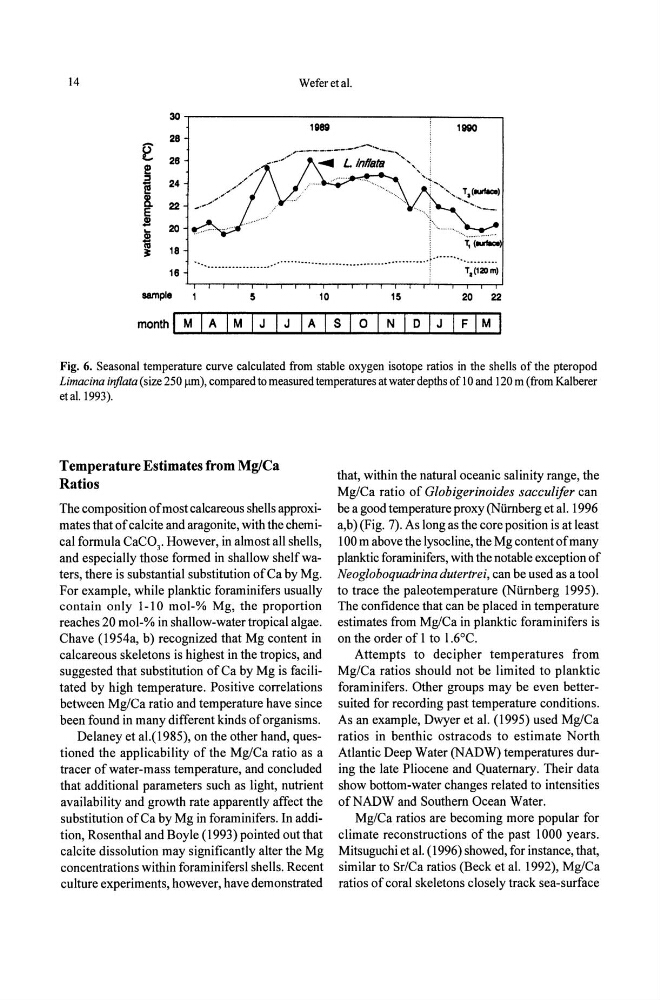
Fig. 6. Seasonal temperature curve calculated from stable oxygen isotope ratios in the shells of the pteropod
Limacina inflata (size 250 j.IlIl), compared to measured temperatures at water depths of 1 0 and 120 m (from Kalberer
eta!. 1993).
Temperature Estimates from MglCa
Ratios
The composition of most calcareous shells approximates that of calcite and aragonite, with the chemical formula CaC0 3 • However, in almost all shells,
and especially those formed in shallow shelfwaters, there is substantial substitution ofCa by Mg.
For example, while planktic foraminifers usually
contain only 1-10 mol-% Mg, the proportion
reaches 20 mol-% in shallow-water tropical algae.
Chave (1954a, b) recognized that Mg content in
calcareous skeletons is highest in the tropics, and
suggested that substitution of Ca by Mg is facilitated by high temperature. Positive correlations
between Mg/Ca ratio and temperature have since
been found in many different kinds of organisms.
Delaney et al.(1985), on the other hand, questioned the applicability of the Mg/Ca ratio as a
tracer of water-mass temperature, and concluded
that additional parameters such as light, nutrient
availability and growth rate apparently affect the
substitution ofCa by Mg in foraminifers. In addition, Rosenthal and Boyle (1993) pointed out that
calcite dissolution may significantly alter the Mg
concentrations within foraminifersl shells. Recent
culture experiments, however, have demonstrated
that, within the natural oceanic salinity range, the
Mg/Ca ratio of Globigerinoides sacculifer can
be a good temperature proxy (Niirnberg et al. 1996
a,b) (Fig. 7). As long as the core position is at least
100 m above the lysocline, the Mg content of many
planktic foraminifers, with the notable exception of
Neogloboquadrina dutertrei, can be used as a tool
to trace the paleotemperature (Niirnberg 1995).
The confidence that can be placed in temperature
estimates from Mg/Ca in planktic foraminifers is
on the order of 1 to 1.6°C.
Attempts to decipher temperatures from
Mg/Ca ratios should not be limited to planktic
foraminifers. Other groups may be even bettersuited for recording past temperature conditions.
As an example, Dwyer et al. (1995) used Mg/Ca
ratios in benthic ostracods to estimate North
Atlantic Deep Water (NADW) temperatures during the late Pliocene and Quaternary. Their data
show bottom-water changes related to intensities
ofNADWand Southern Ocean Water.
Mg/Ca ratios are becoming more popular for
climate reconstructions of the past 1000 years.
Mitsuguchi et al. (1996) showed, for instance, that,
similar to Sr/Ca ratios (Beck et al. 1992), Mg/Ca
ratios of coral skeletons closely track sea-surface
Weferetal.
30
111110
E
e
28
28
::I
24
i!
8. 22
! 20
~
18
J
.......... ----......... --.---~ •... -.•.•... -.... -.-.... -....... ----............. _-_.j. ......... .
T.(120m)
18
sample
5
10
15
20
22
Fig. 6. Seasonal temperature curve calculated from stable oxygen isotope ratios in the shells of the pteropod
Limacina inflata (size 250 j.IlIl), compared to measured temperatures at water depths of 1 0 and 120 m (from Kalberer
eta!. 1993).
Temperature Estimates from MglCa
Ratios
The composition of most calcareous shells approximates that of calcite and aragonite, with the chemical formula CaC0 3 • However, in almost all shells,
and especially those formed in shallow shelfwaters, there is substantial substitution ofCa by Mg.
For example, while planktic foraminifers usually
contain only 1-10 mol-% Mg, the proportion
reaches 20 mol-% in shallow-water tropical algae.
Chave (1954a, b) recognized that Mg content in
calcareous skeletons is highest in the tropics, and
suggested that substitution of Ca by Mg is facilitated by high temperature. Positive correlations
between Mg/Ca ratio and temperature have since
been found in many different kinds of organisms.
Delaney et al.(1985), on the other hand, questioned the applicability of the Mg/Ca ratio as a
tracer of water-mass temperature, and concluded
that additional parameters such as light, nutrient
availability and growth rate apparently affect the
substitution ofCa by Mg in foraminifers. In addition, Rosenthal and Boyle (1993) pointed out that
calcite dissolution may significantly alter the Mg
concentrations within foraminifersl shells. Recent
culture experiments, however, have demonstrated
that, within the natural oceanic salinity range, the
Mg/Ca ratio of Globigerinoides sacculifer can
be a good temperature proxy (Niirnberg et al. 1996
a,b) (Fig. 7). As long as the core position is at least
100 m above the lysocline, the Mg content of many
planktic foraminifers, with the notable exception of
Neogloboquadrina dutertrei, can be used as a tool
to trace the paleotemperature (Niirnberg 1995).
The confidence that can be placed in temperature
estimates from Mg/Ca in planktic foraminifers is
on the order of 1 to 1.6°C.
Attempts to decipher temperatures from
Mg/Ca ratios should not be limited to planktic
foraminifers. Other groups may be even bettersuited for recording past temperature conditions.
As an example, Dwyer et al. (1995) used Mg/Ca
ratios in benthic ostracods to estimate North
Atlantic Deep Water (NADW) temperatures during the late Pliocene and Quaternary. Their data
show bottom-water changes related to intensities
ofNADWand Southern Ocean Water.
Mg/Ca ratios are becoming more popular for
climate reconstructions of the past 1000 years.
Mitsuguchi et al. (1996) showed, for instance, that,
similar to Sr/Ca ratios (Beck et al. 1992), Mg/Ca
ratios of coral skeletons closely track sea-surface